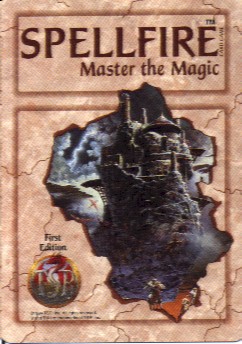
Cut It Open And See If It Swallowed Any Gems Part 28 – Spellfire

This is a tale of bad choices, wasted money and photos of idiots dressed as elves.

But enough about TSR, what about me?

Well I never dressed as an elf, but I did pick the wrong CCG game to play and then wasted a bunch of money on it. I would go onto to do this four more times before learning my lesson, but those are posts for another day.

Caught on the back foot by Magic: The Gathering‘s launch and subsequent success in 1993, TSR created their own CCG. With it being based on D&D one might think that they would have been onto a winner. As successful as Magic was, TSR had the grandaddy of fantasy gaming IP in their back pocket. That had to count for something? Right?

No, it did not.

The problem was they panicked.

The finished product was a mess, not unplayable, not the worst CCG in the world (we shall get to that in due time), but it was so, so sloppy and half-arsed. Rather than commissioning new original art, they just sliced up existing AD&D art into card sized shapes. Not just art, but also hex maps.

It was so devoid of detail that some of the original cards were just a name and a picture. Later on they would use photos of LARPers. I don’t know what the LARPers or the customers did to deserve that. The quality of the card stock used for the cards was pretty cheap too. The only thing it really had going for it was that you got a lot of cards in a booster.

Launched in 1994, it unfortunately coincided with my university holidays and a summer job. So I had plenty of money to spend on CDs I no longer listen to, RPGs I never played and this TSR CCG that arrived at our local games shop/club/Apple dealer. I was not alone in being tricked by the TSR & AD&D name, all our club started playing. Some bought the ridiculously over-sized rules clarification book they produced. TWICE. Some even bought their later CCG, the less rushed Blood Wars. 

I think I was into it for about a year, moving onto other CCGs in 95/96, before finally being turned off the whole CCG deal by one of the worst games I have ever attempted to get my brain around.

So, Spellfire, one more step on the road to TSR’s eventual downfall and takeover by Wizards of the Coast. It was pretty bad, and I’d have been better off without it, but at least it wasn’t Dragon Dice.

Be Sociable, Share!

Category: Cut It Open And See If It Swallowed Any Gems

Tagged: , ,

Cut It Open And See If It Swallowed Any Gems Part 19 – AD&D 2nd Edition – Part 2

Good grief it’s been April since I did one of these, so hopefully you’ve all forgotten that I said I was going to do one post apiece for the 2nd Edition AD&D Gameworlds I’d played. Because I’m not.

Spelljammer

My all time favourite gameworld, all my life. Whizzing around on flying boats in space, the setting could be used to tie the various AD&D gameworlds together or as its own sci-fi tinged fantasy setting. I think it worked better as the latter as it offered a change from the norm in that creatures that would be deadly enemies in other settings could end up as uneasy allies in space. And the excuse of new alien worlds allowed it to amplify the AD&D goofiness tenfold. Hippo-men, space orcs called “Scro”, Space Penguins, Aliens that hatch from eggs that look like gold pieces, Elven Guyver Units and of course, Giant Space Hamsters!

Ravenloft

A fantasy horror setting that span off from the first edition “module” of the same name, the idea of this setting was characters from other gameworlds would find themselves drawn to the world via mystic mists, and then struggle to find their way home as the world itself tried to corrupt them.

Unlike Spelljammer, whose supplements and adventures stood alone, this was one of those settings where the majority of the adventures were IMPORTANT~! to the gameworld, and by the time the first run of adventures were finished, the world was changed and so they could sell the gameworld to you again! As disgustingly mercenary as that was, that campaign did have some great adventures in it, and the final two were suitably epic. And most importantly they were written to make your characters feel like they were important.

Forgotten Realms

Unlike the opening trilogy of adventures that launched the revised Forgotten Realms for 2nd Edition, which often felt you were sitting around while you listened to your mate read out some crappy fantasy. These were full of IMPORTANT~! things happening involving IMPORTANT~! characters, and you occasionally rolled dice, but you often found youself on sidelines while fucking Elminster or some other crappy Ed Greenwood character did something IMPORTANT~!

Anyway, not a big fan of this bogstandard fantasy setting, even in its Baldur’s Gater & Neverwinter Nights computer game forms. However it did have a couple of spin-offs that I enjoyed more…

Al Qadim & Maztica

These were ostensibly set in the Forgotten Realms world, but were Arabian Nights and Mayan/Aztec/Incan themed settings respectively. My love of pirates and sea-faring adventure made Al Qadim fun and Maztica was designed by two of my favourite games designers John Nephew and Jonathan Tweet.

Dark Sun

Well this was an odd one. It’s sort of post-apocalyptic fantasy, with characters far more powerful than normal AD&D ones. And buckets full of psionics. The game line had a very distinct look provided mainly from the awesome Brom. So, psychics in bondage gear fighting on a dying desert planet.

The main problem I found is the psionic rules and the sheer abundance of psychics really bogged the thing down. AD&D 2nd edition was never the smoothest flowing rule system, but adding another rule system on top that was deliberately designed to run against the grain of similar powers already in the game, added to the pain.

Mystara

This was an attempt to bring the old D&D gameworld to AD&D as an introductory way into the game. It also tried to use CDs to bring extra atmosphere to the game… This was around beginning of TSR’s death spiral that led to Wizards of the Coast purchasing them, and gimmicky releases abounded. It’s probably more famous now as the setting for the Warriors of The Eternal Sun game on the Megadrive and the D&D arcade games from Capcom.

Red Steel

This was another setting that took place on the Mystara gameworld, but had an usual game mechanic addition that made it a world of its own. Essentially it’s the Gold Rush as a fantasy setting. It took place on the Savage Coast, a land permeated with a magical mineral that as well as making the eponymous Red Steel infused every living thing with superpowers.

Yes, superpowers. It was Dark Sun’s problem all over again. If I remember correctly you’d have to roll up a superpower for everything inhabiting the land, be it cat, horse or tortle (a type of turtle man). It’s a great idea in theory, a whole load of paperwork in practice.

Others

In addition to these TSR created settings, there were various settings from other publishers. I definitely played in a campaign that took place in the City State of the Invincible Overlord setting and there was another that I think started from the Thieves World setting (based on Robert Asprin’s shared universe books).

Be Sociable, Share!

Category: Cut It Open And See If It Swallowed Any Gems, Role-playing Games

Tagged: , , ,

CIOASIISAG Part 18 – AD&D 2nd Edition – Part 1

So after a session of MERP, this new gaming group introduced me to the most popular RPG on the planet – Advanced Dungeons & Dragons.

AD&D was such a sprawling game, that I’m going split this up as during the time I was playing AD&D, I played and ran such a wide variety of campaign systems that they deserve some comment of their own. Today, just some comments on the game itself.

AD&D 2nd Edition came out in 1989, I didn’t start playing until 1993, but that 1989 date is pertinent. Effectively the second edition is a document of TSR’s needless contrition to the 80′s witchhunt from Christian groups and spurious psychological claims that dogged them throughout that decade. The 2nd edition purged all references to devils and demons, and significantly toned down the artwork to try and placate criticism.

Backing down like this never works out well for the person backing down. The right move would have been to ride the storm of controversy and fight the criticism. There was an opportunity to become an anti-establishment subculture here and use the furor to sell more games. Instead, like the US comics industry in the 50′s, they kowtowed to their critics and cemented themselves as pawns to the establishment. Three years later a merger in the small press gaming world, would create a true anti-establishment gaming company. But we’ll get to them later.

The rules themselves were fine at the time. In retrospect, they are full of logical contradictions, albeit ones that long time D&D players were intensely fond of. Mainly they fondly remember the combat rules that revolved around the classic acronym THACO (To Hit Armor Class Zero).

The rule books were fairly horribly laid out, but fairly typical of American publishing – I remember seeing US console magazines in 90-91 and being bewildered by the poor typesetting they’d have, particularly compared with UK and Japanese magazines, they felt more alien to us as British readers than the magazines that read back to front in a language we couldn’t read, such is the power of layout.

However they way they replaced their “Monster Manual” from the first edition was a masterstroke of layout and design. The Monstrous Compedium was a ring binder containing sheets of monsters, normally one monster to a page. You could find the information with ease, and didn’t need to take a whole book with you to wherever you were playing the game. Of course later on they’d go back the old style monster manual in the sort of double dipping that must have played some part in TSR’s financial downfall.

Artwise it was the usual clash of styles that characterised TSR material at this time. It often felt like uncommissioned fantasy art that they’d purchased, rather than work created specifically for books. I’ll be coming back to TSR’s terrible handling of art in a later installment.

I’m probably being over-critical due to disillusionment created by TSR’s handling of the product line, and 3rd Edition that Wizards of The Coast released (yup, I’ll be getting to this too, very later). At release, and through the early years, this edition was very successful. And you can still have fun times with the rules, and definitely fun times with some of the material published for it, which I’ll start to get at next.

Be Sociable, Share!

Category: Cut It Open And See If It Swallowed Any Gems, Role-playing Games

Tagged: , , ,

CIOASIISAG Part Fourteen – Top Secret/SI

Top Secret/SI was the second edition of TSR’s not particularly popular spy RPG. The SI stood for Special Intelligence, a fact I am only just learning today. My sleepless nights are now over. I believe our teenage gaming group played this a grand total of three times, all of which I remember as being fun. It was just that we tended to be fickle in our tastes and we still tended towards the old Games Workshop wargames. We played one game using the standard rules, which was very much in the James Bond / Man From UNCLE mold. You played agents of ORION battling the evil espionage group WEB, it was all very sixties spy movie-like, girls, gadgets and glamourous locations.

Then, the other two games were using the adventure settings books they had brought out for it. “Agent 13” was the first, a setting recreating 1920s and 1930s pulp adventures. I’m not sure if this was based on the novels by Flint Dille (GI Joe/Transformers) and David Marconi (GI Joe/Enemy of the State/Die Hard 4.0~!~!) that TSR printed, or vice versa.

The second was F.R.E.E. Lancers by Jeff Grubb, that was plain nutty. Grubb, who’d been behind TSR’s Marvel RPG, spot-welded super powers and cyberpunk onto the espionage genre, resulting in a gloriously goofy mess. I can’t recall the details, but I do remember it being great fun.

Be Sociable, Share!

Category: Cut It Open And See If It Swallowed Any Gems, Role-playing Games

Tagged: ,

CIOASIISAG Part X – Conan RPG

And now I’m getting games I played in that first gaming group, but didn’t own. So these posts will be noticably shorter.

We played this once and all I recall was it involved the most massive dungeon map I can recall seeing, being as it was drawn on sheets of chip paper (we gamed on Sundays in the restaurant of the Fish and Chip shop my friend’s parents owned – “The Crispy Cod”). Ah the nostalgia of that chip shop smell, R-Type arcade machine, playing imported PC-engine games and chip shop buns filled with nice and spicey nik naks and/or refreshers fizzy sweets!

Be Sociable, Share!

Category: Cut It Open And See If It Swallowed Any Gems, Role-playing Games

Tagged: ,

CIOASIISAG Part 9 – Marvel Super Heroes

These are probably the RPGs I’ve run the most, and written the most material for a campaign for. Which is astounding considering how poor the actual rules are.

Obviously the pull of these games to me was the Marvel license. I’d liked Marvel comics as kid, starting with a Spidey/Ghost Rider UK reprint as a treat as a kid after having to go to London for various tests (the other treat being a Battle Of The Planets transfer kit). Then various second comics picked up in school fairs/jumble sales and the occasional present from my grandmother. Finally there was the UK printing of Secret Wars, Secret Wars II and Spider-Man and ZOIDS.

I kind of forgot about them when I went to secondary school, until WH Smith’s started getting US Marvel comics in. Which coincided with when I got into RPGs. So TSR’s licensed Marvel RPG was a natural draw.

Now the rules were based around this colour coded chart. You rolled percentile dice, the cross referenced the roll on the chart against the value of the statistic you were using. They used this system on various other non-D&D games that TSR released at the time. One of the Gamma World editions used it as did their Conan RPG and Star Frontiers. Possibly the Indiana Jones RPG too. I don’t think Top Secret/SI did, but I could be wrong. I’ll look it up when I get to that one.

Some people liked this system, but I found it a pain. I dislike games with unnecessary work, and cross referencing two numbers on a chart definitely count as too much work. But I still kept hacking away, trying to get a decent campaign going, because I had such Marvel love. And this really was a game for Marvel lovers.

It was essentially OHOTMU the RPG, particularly the Advanced version and it’s supplements. Most of it’s supplements were vast depositories of statistics for Marvel characters both prominent and obscure. And on top of that there were the Gamers Guide To The Marvel Universe books that at the time were arguably better than the information provided by Marvel at the time. At one point I had all but 5 products published in this line (I’ve since disposed of a lot of that material via eBay) and here’s the products I’d recommend if you were interested in playing:

Marvel Advanced Set – The core rule book. The rules aren’t particularly clear and you’ll end up winging a lot of it. Plus there’s not that much scope for character variety.
Ultimate Powers Book – An expanded character creation book. You’ll end up rewriting the character type table, as frankly it’s barking mad, but the range of powers and the rules to use them are expansive.
Realms Of Magic – This was for the Basic set, but the magic rules in the Advanced are, if anything, even worse than the Basic’s. This supplement completely replaces the magic rules and makes them workable.
The MT Modules – This was a 3 part time travel themed campaign by Ray Winninger. A great adventure with a superb meta-gaming climax.
The MX Modules – This was a 4 part campaign based on The Nightmares Of Futures Past story from the X-Men. It’s clever trick is to set the adventure in your hometown. Of course this trick works better when you are in America. I had to pretend Spalding was in Massachusetts when I ran it.
Deluxe City Campaign – This is the only supplement that actually gets around to telling you how to run your own campaign. I think TSR must have thought you were only going to play their published supplements.

Most of these can be downloaded in PDF form for free at MarvelRPG.net

It should be said a lot of my criticisms of the game are in hindsight, back when I started playing I was a lot less critical of game mechanics and more interested in settings. But I do think those flaws held me back in every getting a campaign really off the ground in my first gaming group. I’ll talk about my long-term Marvel campaign when I get around to talking about the SAGA rules Marvel RPG, but here’s some teenage brain spill about the characters we created at secondary school.

AXE-MAN – This was the first character I created using the Basic set. His power was that his hand turned into an Axe. I was 13, this seemed cool to me then. I believe he was a mutant and that his background was that he had been asked to join the X-Men but was thrown out for being too cool.
TWISTED SOULS – This was the superhero team that my players in my first group came up with they were:

MR MYSTERY – a robotic Rorschach clone, with Hank Pym powers
ACE OF SPADES – a mystic swordsman
TWISTER – a mutant with wind based powers
and there was a Captain Marvel-type whose name I forget. The twist was that he was a cat who turned into a human superhero.

THE WRESTLER – a teleporting wrestler
MEK-A-NEK – a blatent copy of the He-Man character
ALIEN SKATER – The HR Giger creation. BUT ON A SKATEBOARD!

Be Sociable, Share!

Category: Cut It Open And See If It Swallowed Any Gems, Role-playing Games

Tagged: , , , ,

CIOASIISAG Part 5: Dungeons & Dragons

The next lot of entries cover a lot of the games I played during secondary school. And there are a lot of them. Some of them I owned for but a few weeks before swapping them for a different game, or selling them. Dungeons and Dragons was probably the beginning of that trend, with most the rulebooks for the system I had I bought off my friend JDG. In fact I didn’t realise that the “Expert” Rules were from an earlier edition and so there were actually number of character levels I didn’t have rules for.

Now Dungeons and Dragons is the prototypical RPG, and I’m probably an anomaly for starting with something else, particularly so for that something else being Paranoia. The game is what spawned the RPG subculture and craze, and it’s an interesting insight of the hobby’s roots. Which is hairy Tolkein loving hippies who played wargames and simulation boardgames.

The “non-advanced” version was apparantly made as a stop-gap for the more popular “Advanced Dungeons And Dragons” but became a game in it’s own right. While it has some stuff that is just plain odd, namely Elf, Dwarf and Halfling as very limited character classes, it holds it’s own as a game quite well. Particularly in the “Companion” and “Master” Rules sets that have the sort of campaign rules still sorely missing from most high level (A)DnD games.

I’m struggling to remember exactly what happened in the campaign I ran with this game. I remember it started in the DnD game world “Mystara” then went to countries that I had invented myself, and ended with the characters becoming gods. The Mystara world was strange in that it seemed to have been made up by TSR as they went along. There’s a tightly packed group of countries, with lots of detail and background all in the corner of one continent. Then as they expanded the world, the details got less and less, and countries bigger and bigger.

Obviously the presence of this game here goes to show that my parents had realised that pretending to be a dwarf wasn’t going to turn me into a satanist and that stuff like “Mazes and Monsters” was scare mongering guff. I’ll discuss the Eighties RPG witchhunt when I get to Dragon Magazine or AD&D second edition, as I want to go into it in a bit more detail and what I think TSR did that crippled the hobby.

Be Sociable, Share!

Category: Cut It Open And See If It Swallowed Any Gems, Role-playing Games

Tagged: , , ,

Podcast

Archives

Twitter