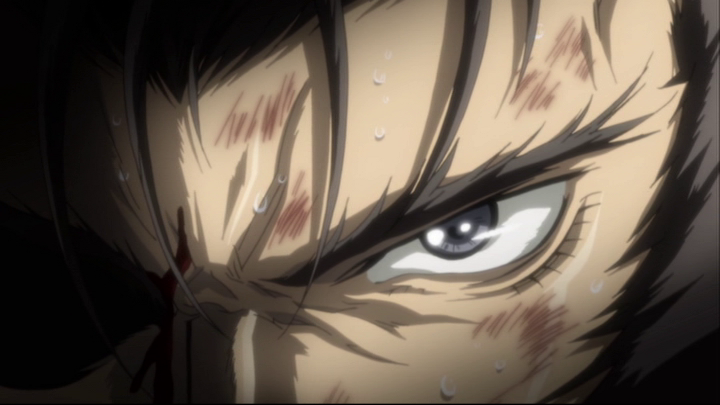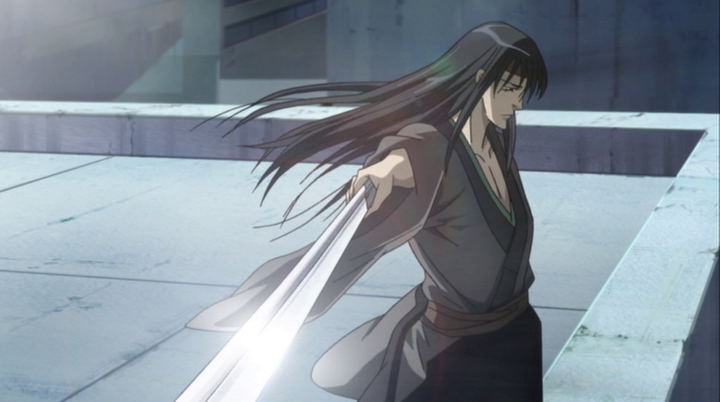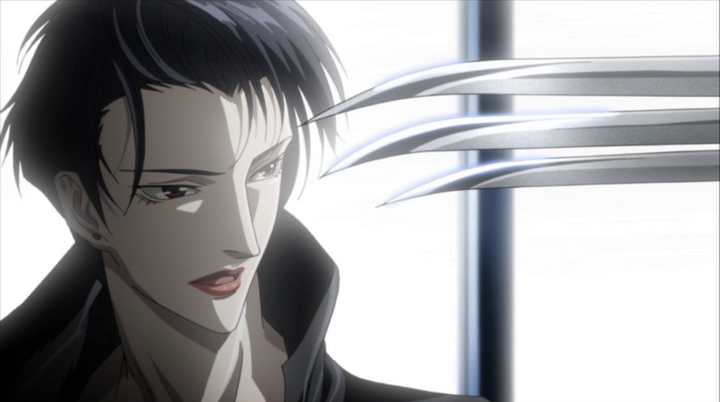
Kaiba Episode 1

April 24th, 2008 by Brack

My first thought after watching this was “Why am I even bothering watching any of the other new anime?”.

There’s two reasons for this. Firstly, and most obviously, it’s better animated than anything else right now. There are two wonderful set pieces in this first episode. The opening where Kaiba/Warp is chased by “Skronks” through the alien looking architecture, and a more slapstick section where Cloak is running trying to board a spaceship. One thing that Yuasa doesn’t get complimented enough on is his ability to direct physical comedy in animation. The scene with Cloak and Vanilla is a fantastic combination of the sort of desperation, pain and sadism that great slapstick comedy is born from. Also there’s moments of subtle beauty, such as when a child flies her toy bird through the hole in Kaiba/Warp’s chest.

Secondly, and to an extent it can be seen as an explanation of the first reason, it’s not an adaptation.

Now, part of me likes adaptations, it can be fun to see your favourite thing from one medium in another medium and I’m like an eager little puppy with anticipation for the Iron Man film. Some things do transfer to film wonderfully with little effort, some require panel beating until they are unrecognisable.

But there’s things that bother me about adaptations. One is that they are done often for the wrong reasons, film wants the respectability of literature so it adapts novels to film. Comics wants the respectability of film, so you get comic companies setting up movie studios. Manga wants to sell more copies, so it makes anime to advertise it.

However the main one is that even if you willfully ignore the source material, you are still a slave to it. The very act of denying the source is influenced by that source’s existence. And I think that, in general, gives you less worthwhile results than if you build something from scratch just for the medium it’s made in.

As good as the animation and design is on something like Soul Eater, it still has things that would work far better on the printed page than in animation dragging it down (I’m actually hoping that Square-Enix and Bones pull what they did on FMA and create new stories halfway through).

Whereas, what Kaiba has, and Kemonozune before it, is a sense that every creative decision made was to the benefit of making a cartoon. For instance, I’ve seen people complain that there’s too little talking, which is slightly bewildering to me. You’re watching a cartoon, surely you’d prefer storytelling to be told via animated drawings rather than static talking heads. But when so much anime comes from manga, and increasingly novels, people are more accustomed to anime ruled by writers, rather than animators. Plus talking heads are often cheaper to animate…

It’d be nice to see more original shows from animators with a particular voice, but I’m not sure how many have the cache to be allowed to do so or how many outlets there are for this sort of work. So let’s be thankful we get things like Kaiba, Mononoke, Denno Coil and Tengen Toppa Gurren Lagann.

That all being said, this didn’t grip me quite the way Kemonozume did. I’m not overly keen on science fiction and this story, with it’s own strange world and rules of physics, wasn’t as immediately relatable as Kemonozume’s setting and characters were. So I’ve only watched it twice so far, rather than the three times in a row I did with Kemonozume’s first episode.

Posted in Anime, Hate Fun? | Tags: , , | No Comments »

Oh! Edo Rocket

March 11th, 2008 by Brack

Boy meets girl. Boy builds giant firework to get girl to the moon.

This ridiculously multi-layered 2007 series from Madhouse based on the 2001 (?) play by playwright (and Gurren Lagann screenwriter) Kazuki Nakashima has been overlooked somewhat in English speaking anime coverage.

I’d hazard a guess it’s down to the somewhat era-specific references it partly leans on to make it’s points. It takes place in Edo in 1842, when the city was under the strict frugality reforms introduced by Mizuno Tadakuni. Mizuno appears as a character, as does Toyama Kinshiro, a character from the historical detective drama Toyama no Kinsan (not sure of his historical existance) and Torii Yozo, another real government figure who also features in the anime Ayakashi Ayashi.

Also the main character and an “anime exclusive” supporting cast member are named after the rival guilds of firework makers that took part in the Sumidagawa Fireworks Festival.

But that density of historical reference shouldn’t put you off. The series is well aware of just how dense and Japan-specific a lot of their references are. They joke at one point that certain gags won’t go over with international audiences. And more importantly, it’s not all about history.

For as well as being dense with cultural references of the era it’s set, the show is accutely aware of both it’s existence as an anime and as an adaptation of a play. It periodically makes reference to it’s own production, breaks the fourth wall to address the audience and has characters interact with the animation in a way to break the fragile illusion of reality it creates.

And it throws gag after gag of varying levels of obscurity, making pop culture references, poking fun at itself, and the anime industry in general (Production IG and Mamoru Oshii in particular get a rather cruel barb thrust their way). Lots of visual, script and audio cues come from who is playing a particular character, there’s FMA, Cowboy Bebop and Gurren Lagann gags that all come up in this way.

But don’t think it’s just an Excel Saga-esque array of obscure references and satire.

There’s a strong story at the core, that takes some surprisingly dark turns early on, and has a great conclusion that has it’s cake AND eats it. However even the story isn’t the point of the show.

The story, the historical references and the pop culture gags and satire are all in service of an overall theme, which is looking at the role of populist entertainment. It draws a comparison between how entertainment, art and craft still flourished under the frugality of Edo at the time and how the frugality of limited budgets effect the way anime is made. And it looks at what cheap, populist entertainment means to the common man, and the motives behind the people who make it.

Assuming this is a relatively fair adaptation of Nakashima’s play (and beyond expansion of the plot, there’s no reason not to - Nakashima shows up to write an episode later on) then the themes of the story closely mirror the intention of Nakashima and Hidenori Inoue’s Gekidan Shinkansen troupe - the creation of a modern equivalent of kabuki, telling lively, relevant and populist stories.

There’s still much of the theatrical origins about the anime - the credits are written using theatrical terms, background paintings are treated occasionally as physical set dressings, one character is played by the actor who played him in the original play, and in one great episode, the characters put on a play recreating the events of previous episodes.

Now I know some people balk at this level of folding in on itself in a cartoon, prefering a straight narrative. I say these people are wrong. Almost straight out the box, animation has been experimenting with it’s own form, with the best of that experimentation being done in popular vehicles. Max Fleishcer’s Out of the Inkwell series from the 20’s had drawn characters, exist as drawn characters within the “real” world rather than characters in their own drawn world. Tex Avery had characters played with what you could do once you acknowledge the cartoon as frames on film. Bugs Bunny would address the audience directly, providing his own commentary on his actions. Breaking the fourth wall and acknowledging your existance as a fictional creation trapped in film is at the heart of animation innovation, and when a cartoon finds a new twist on that, to actually examine it’s own role in culture it should be embraced.

Oh and in the last 3 episodes it even finds room to take a pop at nationalism (Japanese nationalism in particular, but a lot of the points clearly apply to all nationalists).

Mononoke might have been more visually innovative, Denno Coil might have been more nuanced, Tenga Toppa Gurren Lagann might have more thrills per minute, but Oh! Edo Rocket is a little gem that deserves your attention.


2007 was a great year for TV anime, I’ve still got more series I need to talk about (To Terra, Shigurui, Kaiji, Moyashimon).

Posted in Anime | Tags: , , | 1 Comment »

Kaiba

January 9th, 2008 by Brack

Iwa ni Hana brings the knowledge on Yuasa Masaaki’s new TV show.

Everything looks in place for awesome to abound. Yay.
カイバ|WOWOW ONLINE

Posted in Anime | Tags: , , | No Comments »

Kaiji Episodes 1-3

October 22nd, 2007 by Brack

While the autumnal anime season hasn’t offered the massive dose of animation loveliness that the summer gave us, it has given me an anime about microbiology and this, an anime about game mechanics and probabilities. So it’s not all bad.

After 2005’s Akagi, Madhouse have assembled pretty much the same team to create an anime of Akagi creator Nobuyuki Fukumoto’s gambling manga Kaiji. Whereas Akagi’s title character was a cold fish, a man who could calmly bluff and cheat in the face of death, a genius at the game of mahjong, Kaiji’s title character is an emotional loser who finds himself thrust into a gambling tournament aimed the most desperate of competitors.

Kaiji, you see, foolishly co-signed a loan made to a former co-worker. This loan was made by the yakuza, and now they want their money back and can’t find the co-worker. Kaiji is given the option of paying it back over 10 years at a rate he can’t afford, or go on the ship Espoir and take part in the gambling tournament that takes place on there. If he wins, he clears the debt and gets to keep whatever else he wins. If he loses, he’ll be taken to parts unknown and made to work hard labour for a year. Or at least that’s what he’s told.

As a series about a man paying back a loan over 10 years would not be that exciting, Kaiji chooses Espoir, and finds himself taking part in a game of Restricted Rock, Paper, Scissors.

Restricted Rock, Paper, Scissors. This is now my dream anime.

Kaiji (manga) - Wikipedia, the free encyclopedia:

The game featured in the gambling tournament the first night Kaiji spends on Espoir, with an average survival rate of 50%. The rules were outlined after the issuing of war funds, which were done in 2,000,000¥ and 10,000,000¥ increments referred to as the “lower” and “upper” bound, respectively. The money was in effect a loan, equalling the debt of the contestant and compounded at 1.5% every ten minutes for the four hour voyage; contestants who hold onto their funds for the length of the trip would have to pay 140% of what they invested, thus putting an incentive to finish games early. Money that exceeded the amount needed to repay the loan to the Espoir hosts would be pocketed by the contestant. This gamble is similar to the original game but with a twist - the hand gestures are represented by cards, and contestants are given four cards each with the same gesture for a total of twelve. Contestants are also given three plastic stars as collateral to bet on each round of play - whenever one loses a round, the winner gets a star from the loser. To survive the night, contestants must maintain their three star pendants and lose all of their gesture cards, while earning enough money to repay the interest owed to the Espoir hosts. Cards cannot be destroyed or thrown away, to do so is subject to instant disqualification. Unofficially, however, the star pendants can be traded using the war funds for around one or two million yen each, and they are typically how contestants manage to meet the interest demands of the Espoir hosts.

What makes this series great is how Kaiji’s mind works to find the way through the rules of the game, to find the best chance of surviving. At first glance the rules seem very constraining, but as desperation rises, Kaiji starts to see loopholes in the rules, and the clues in the game that will allow him to determine the best odds. As someone who can spend hours getting lost in the mechanics, logic and probability of games, I loved this. It will be interesting to see if Fukumoto’s story keeps this theme up throughout the series.

The animation improves on the standard set by Akagi. While it’s probably not everyone’s cup of tea, particularly those who only want the big eyes/small mouth look of “typical” anime, Yuzo Sato brings Fukumoto’s unique look to screen with aplomb. I hope that this and Akagi will be big enough successes that people will follow the lead of their characters and gamble on adapting other seinen series with unique visual styles, rather than the seinen moe series adaptations that seem to be the norm nowadays.

Posted in Anime | Tags: , , , , | No Comments »

Kemonozume - Episode 1 - more

August 21st, 2006 by Brack

More on Kemonozume.

Toshihiko is training in a dynamically animated sequence where he dodges tennis balls fired at him by his compatriots. One of which gets over excited and so Toshihiko takes him outside to remind him of what the Kifuuken's goal is - “to contain the evil in your own heart”.

But now Kazuma wants to inherit the Kifuuken, and challenges Toshihiko to a fight to prove he is more worthy. However, The Monkey wants a peach. And subsequently disarms and debags Kazuma in his attempt to get a peach.

Toshihiko chases The Monkey onto the beach and almost has a parachutist land on him. He lays eyes on the woman (Yuka) and is instantly smitten. Here is the genius bit of animation from this episode. Once he lays on eyes on her the “camera” stays fixed on her face. It's clear from the movement that she's picking up her parachute and getting in a car, but you only see her face. It's like they are animating something you aren't actually seeing. Fantastic stuff that totally conveys the love at first sight emotions Toshihiko is feeling at that moment.

Toshihiko then can't sleep and sees her face everywhere, on The Monkey, on Kazuma, on the all the other hunters. He runs to the beach were he meets Yuka, and to the sound of a thunderstorm we get a segue of them making love. However, Toshihiko fails to notice that as she climaxes she starts to shapechange into a flesh eating monster of seemingly of the kind we met at the start of the episode…

Excellent 1st episode, looking to be the best show so far this year. I've now watched it 4 times after doing this write up. Get the fansub here.

MINOR RANT TIME:

While the show's gotten good feedback on the whole (and what I considered a surprising number of downloads), I had to laugh at this idiot proclaiming it as cheap porn. I'm guessing the porn thing is down to the sex scene. The eyes roll. It does seriously weird me out how some anime fans seem to instantly equate sex with porn, act all squeamish about it and then merrily watch some simpering otaku pandering show that was made by watering down some pornographic PC game. Whether it's a reaction against other elements of anime fandom parading their weird fetishes as a badge of honour, or something else, I don't know. But it weirds me out. Happy mediums folks, happy mediums.

Posted in Animation, Anime | Tags: , , | No Comments »

Kemonozume Episode 1

August 21st, 2006 by Brack

I think I've watched Kemonozume episode 1 three times in total.

The prelude to the credits describes and event that took place in the ancient history of the show's world. An event that directly leads to the situation the characters find themselves in. Simple small shadows form the characters here, reminding me of the interstitial segments linking scenes in Jim Henson's Storyteller.

After the credits we find ourselves in a club where 2 men are talking surrounded by aquariums. The fish in the aquariums look like digitally treated live footage. While this scene betrays the cheapness TV animation tends to possess, the dialogue and acting here are great. And the body language is well portrayed. One man (or monster) is revelling in his murder and eating of young women, the other is restrained, seemingly happy to live a hidden existance. The flesh eating monster chides his companion for not giving into these urges. However it turns out he has been set up.

The Kifuuken, a group of monster hunters attack the creature with swords and missiles. And the male lead Toshihiko shits himself when confronted by the creature…

There then follows a lengthy talking heads scene that acts as both detail of the world the show takes place in and the relationships between Toshihiko, his father and adopted brother Kazuma. Here we seem to have themes of tradition vs. ambition introduced as Kazuma wishes to use high-tech means to eliminate all the Kemonozume (the monsters we met at the start), whereas his father seems to have other intentions in the fight with them other than to kill them (once an arm was removed he allowed the creature in the opening scene to flee).

We then get a scene between Toshihiko and Rie walking on the beach. Old friends, a subtle scene where Rie tries holding his hand shows you all you need to know about their relationship. This is followed with a short montage showing various Kifuuken at work. Also a Monkey!

Sheesh, that's only about half way through the episode. I shall rave on more about it tomorrow I think.

Posted in Animation, Anime, Comics, Hate Fun? | Tags: , , | No Comments »