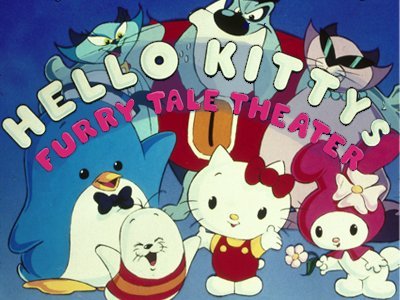
This Sanrio creation possibly answers my question about penguins wearing bowties from the first Penguin History post. Created in 1979, he appeared in Hello Kitty’s Furry Tale Theater in 1987. I don’t know of any other appearances.
1998 Himitsu no Akko-chan
The 1998 revival of Fujio Akatsuka’s iconic magical girl character featured a cool and cheeky surfing penguin called Ippei. No word on if he died on the way back to his home planet.
2005 Gunparade Orchestra
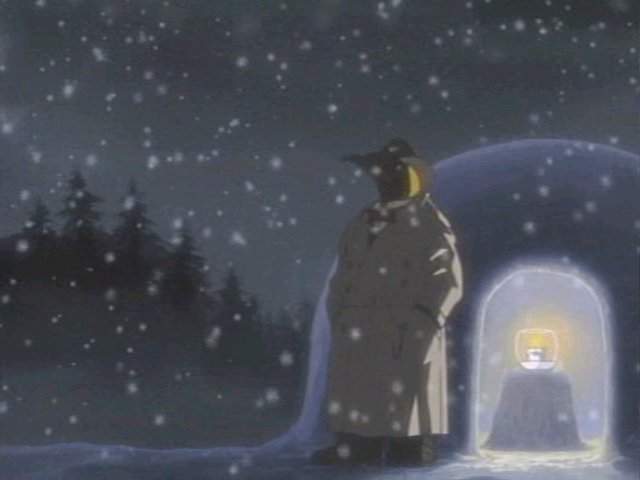
Sequel to videogame anime Gunparade March, this show features Norio Wakamoto as a character known as HARD-BOILED PENGUIN
2006 Gag Manga Biyori 2
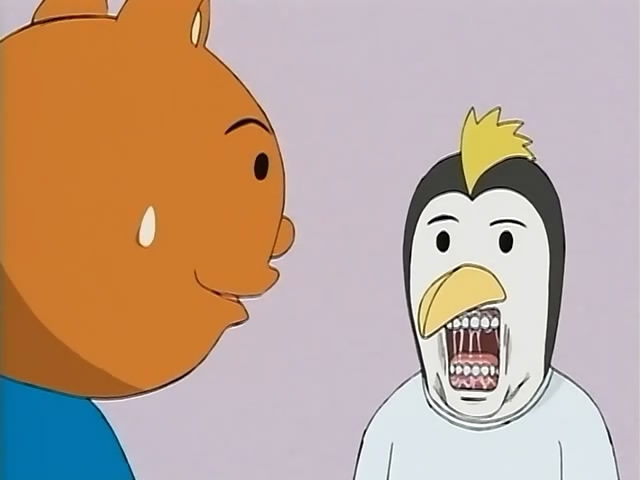
The great detective Usami-chan has a detective contest with the penguin transfer student Pensuke-kun to determine who stole the teacher’s giant set square and Nyami-chan’s socks.
2008 Inazuma Eleven
This anime based on the Level 5 football-themed roleplaying game of the same name features many, many crazy special moves. One of which is Emperor Penguin No.2. Which involves kicking a ball while accompanied by five penguins that emerge from the pitch and perform a short Itano Circus with the ball.
There are variations such as Emperor Penguin No.3, Emperor Penguin X and the forbidden move, Emperor Penguin No.1
Inazuma Eleven is kind of nuts.
2011 Minori Scramble
A girl with a hatred of penguins is given a superdeformed robot penguin-girl by her penguin researcher father in the hope of making her see how cute penguins are. Madcap hijinks ensue.
2011 Mawaru Penguindrum
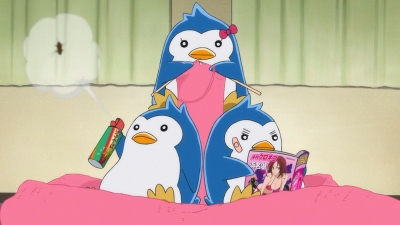
A girl is raised from the dead by a magic penguin hat. She and her brothers are given three penguins, and when possessed by the hat she orders the brothers to recover the “penguin drum” with the penguins’ help. And that is barely scratching the surface of this fantastic show.
2011 Toriko
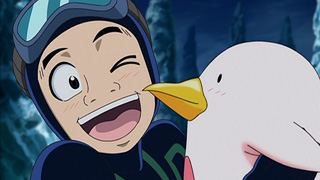
In the world of Toriko there are endangered penguins called Wall Penguins. While a full grown Wall Penguin is dangerous, their babies are naive, fearless and delicious. Yun is a baby Wall Penguin adopted by Komatsu. Its saliva proved a vital ingredient in part of Toriko’s Full Course Menu, the Century Soup.
2012 Polar Bear’s Cafe
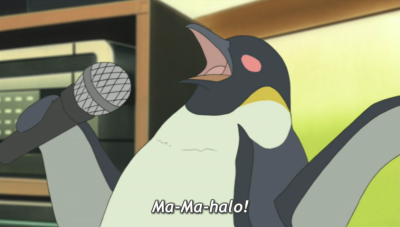
Based on Aloha Higa’s manga, Polar Bear’s Cafe features a cafe run by a Polar Bear. One of his main customers is a penguin, called Penguin. Apparently some sort of office worker, though he is vague when asked directly what he does for a job, he pines after a female penguin called Penko who works at a bakery.
That ends this installment of A Brief History of Anime Penguins, are there any more I should include next time?
After the Dodge Danpei post I thought I’d look a little closer into the career of Tetsuhiro Koshita. His early career seems a little problematic in putting a finger on. For starters, his wikipedia page doesn’t give dates or links for his earliest work. Luckily it does seem to all available on the Comic Park site.
His first work was 拝啓サラダボーイ (Dear Salad Boy?) in 1985. No idea what it was about, but it does have some curious set texts in the English lessons featured in the Comic Park preview pages.
This was followed by the similarly not talked about in English, パニック方程式 (Panic Equation?). Here you can start to see a Toriyama influence come through on the male lead’s character design. According to Comic Park both these strips ran in Special Edition Shonen Sunday as it was then.
Next we have the series that really sets the tone for Koshita’s career, ミニ四駆 RC伝説 燃えろ! アバンテ兄弟 (Which I’m guessing is something like Mini 4WD RC Burning Legend! Avante Brothers). It’s also the first series I could find real details on, but even then I don’t have publication dates for it. It was a strip in Shogakukan’s CoroCoro Comic Special designed to promote Tamiya’s Avante 2001 radio controlled (RC) car. As that came out in 1990, it would suggest the strip hit around that time too.
During the 80s, the RC hobby boomed and so did Tamiya’s fortunes. There were two prongs to this boom, the first was the launch of a non-RC range of battery powered mini four wheel drive (4WD) cars in 1982. By 1987, they had sold 10 million mini 4WD, leading to the launch of a mini 4WD themed manga in the pages of Monthly CoroCoro Comic, Dash! Yonkuro by the late Zaurus Tokuda. This was followed by a Dash! Yonkuro anime in 1989.
The other key to Tamiya’s boom was the release of their first four wheel drive RC car, the Hot Shot in 1985.
This meant you had a situation where kids would get started with the mini-4WD, then move onto the 4WD RC racers as they got older. If you don’t believe me, then check out the preview of ミニ四駆 RC伝説 燃えろ! アバンテ兄弟 on comicpark.net. It is a shameless instructional document on how to enjoy your Tamiya product.
The older brother has an RC Avante, so the kid brother goes to the shop and buys the Avante Jr, the mini 4WD brother of the Avante. There are even photos of the cars in the strip. And in case you don’t get the message, kid brother wears a top with 4WD on it, older brother a hat with Avante on it. BUY BUY BUY, RACE RACE RACE!
Let us also take the time to note the superb slogan of the Avante line of cars – BEING NUTS IS NEAT.
While we didn’t get the cartoons or comics, the RC & mini-4WD craze spread far and wide, our local model shop in Spalding, Lincolnshire did great business in selling mini-4WD cars to our year when I was at secondary school, with some moving onto RC as they got older. Even now I find the Tamiya logo sets off some nostalgic trigger in my brain.
Next from Tetsuhiro Koshita was Dodge Danpei, running from 1989 to 1995 in CoroCoro Comic, but we’ve covered this in its own post here.
Then, we get the big series where Koshita truely becomes Tamiya’s go to guy for selling their cars to kids, in the way Zaurus Tokuda had been in the 80s - Bakusō Kyōdai Let’s & Go!!
Much like his other Tamiya strip it involves two brothers who race Tamiya cars, cars that you could then go to the shops and buy, with little pictures of the anime characters in the corner. It ran in CoroCoro Comic from 1994 to 1999 and spawned three tv series that ran during 1996 to 1998. In retrospect it feels like these sort of series are the connective tissue between the robot model kit selling shows of the 80s and trading card game selling shows of the late 90s/00s.
They’ve got the elements of SD look that the robot shows started to move to with the popularity of console games, they’ve got the kit building element of Gundam and its followers, but they’ve also got the stronger protagonist identification that Pokemon and the shows that came in its wake have.
2000 for Koshita saw him return to strips that weren’t designed to sell toys, with Get the Goal!! 4v4 Arashi. It did still stick to the tried and tested formula of young boys and sports, this time focussing on 4v4 football, the Dutch coaching system that gained popularity in youth football. While it didn’t get the anime that Dodge Danpei and Lets & Go did, it did get a Gameboy Advance game.
And a pencil.
Such is the parcity of facts on this strip that the pencils are mentioned on the wikipedia page for the manga.
Then, it was back to working with Tamiya in 2004, with Kattobi Racer! Dangun Wolf. This was to tie in with the Dangun Racer line of models. Whereas the Mini 4WD race in seperate lanes, these are designed to run in the same lane and run each other off the course. Basically imagine if everyone in a bobsleight contest went at the same time and their bobsleighs had motors.
In effect you’re seeing the physical battling aspect of Pokemon work it’s way into the markets that it elbowed out of the hearts and minds of children.
Then, apparently there was something called STRONGEST WATCHDOG GAO, that I have no clue about. Anyone?
That was followed by another football manga, Goal Getter Yao, which only lasted one volume.
Then we get onto what seems to be the next part to Koshita’s career. Whereas before he’d been building characters and stories around Tamiya’s products, since 2008 there’s been a run of series based on other people’s characters. Firstly a Yatterman manga to tie into the very successful revival on television and the cinema. Then in 2010, he worked on a Toy Story series based on the Disney/Pixar property and an Inazuma Eleven series based on the Level 5 videogame.
That last one is a natural fit, as it’s very much in the mould of both Koshita’s sports manga and the sports/rpg hybrid videogames that were often made from them.
Please do correct anything I’ve got wrong or add any obvious missing aspects in the comments. There’s very little in English about Koshita, so there’s plenty of room for me making mistakes here or overlooking the obvious. Never the less, I do feel like I’ve made some more connections in my mind about how we got from Gundam to Cardfight Vanguard.
I’d been crunching some Japanese TV ratings numbers for a different post, and one thing that struck me was, beyond the usual ignored-by-internet-chatter shows that tend to top the ratings (Sazae-san, Chibi Maruko-chan, Doraemon and Shin-chan), there was another show that occasionally squeezed in at the bottom of the top ten, often above the pop culture sensation that is Naruto.
That show was Inazuma Eleven.
Which you had probably guessed from the name of the post.
Based on the hybrid RPG/football game from Level-5, it presents an OTT version of a school football league that resembles Shaolin Soccer more than it does Jossy’s Giants. As best I can tell from the eight episode’s I’ve watched so far, the plot closely follows that of the videogame. And there’s a recurring visual of players running towards goal that I’m guessing is a straight pull from the videogame as it really doesn’t belong in animation otherwise.
Despite that adherence to its videogame parent, there’s plenty to recommend if you’re a fan of OTT exaggeration and of Level-5′s character design (like Professor Layton, Inazuma Eleven benefits from a huge cast of characters who are far from cookie cutter in design). The exaggeration though is where the real fun lies.
For starters you’ve got a team of kids learning special football moves (the goalie summons a giant hand, the striker has a flaming kick) from an secret handbook in an underground training compound built under the school. That’s bigger than the actual school. And then there are the opposing teams.
The “evil” team drives arround in a bizarre looking giant bulldozer type vehicle that they use to destroy the schools of the teams they beat. It looks like something that belongs in a Warhammer 40,000 army. The other teams I’ve seen them play so far include a team of supernatural monster children, children raised by wild animals like Tarzan and cyborg children. Such are the wonders of the Japanese education system. Of course they’ve all got their own special football moves too – for example, the supernatural team cast “spells” on our heroes mid match.
You may note that I’ve mentioned 4 teams there, and indeed they’ve played 4 matches so far in the 8 episodes I’ve watched. No Eyeshield 21-style pacing here, Inazuma Eleven moves ahead at a fair clip, with nothing taking more than two episodes to resolve so far. As kids shows based on handheld RPGs go, this is up there with Pokemon. That might seem like I’m damning it with faint praise, but given the usual success rate with transferring properties from videogames to cartoon, Inazuma Eleven is a resounding win for director Katsuhito Akiyama (Gall Force) and OLM (Pokemon). In fact, if it wasn’t for the United States’ disinterest in the sport, I’d have expected the game and anime to have had an English language release.
One final note. The end credits feature the three female leads singing the ending theme in what I believe is a homage to the daddy of all sports anime with ridiculous training regimes Star of The Giants. Of course, Star of The Giants homages are as regular as clockwork, but I’d not seen that particular aspect, The Aurora 3 (or Three Daughters of Aurora, not sure on the exact translation/name), being referenced so directly before.