Best Anime of the 00′s – Trapeze (2009)

Yes, I am still writing best of the decade retrospectives. In fact I will soon be writing my first Best Anime of the 2010′s and then I plan on going back to the 1990s. I’ve decided there’s no point in restricting yourself to a “top ten”, sealing off a decade when you see something from that decade after the decade has past or having to wait until the decade’s over before declaring something’s greatness.

Trapeze is an adaptation of a number of short stories written by Hideo Okuda, all featuring the character of the psychiatrist Ichiro Irabu and his nurse Mayumi. This being a Kenji Nakamura show the visual story-telling takes things a little further than a straight adaptation.

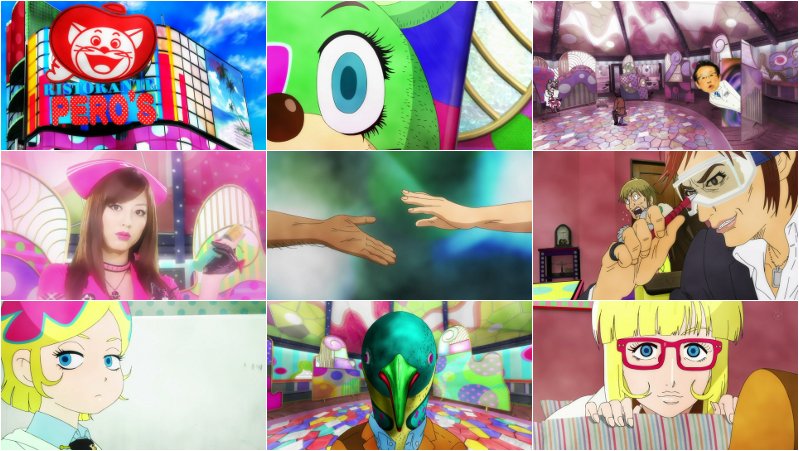
For starters, Irabu, a pale overweight man in the short stories, is represented by three different character designs in the anime. One is overweight and has a giant bear head, the second is tall thin bespectacled man with bear ears and the third is a young boy carrying a bear soft toy. Often he will switch between all three within a scene. I’ll let you decide if they are the id, ego and superego or just a neat visual trick.

Moreover, it’s a mixed media piece with elements of live action, rotoscoping and traditional animation all used together. It’s not as polished as Masaaki Yuasa’s experiments in the same, but once you acclimatise to it pays off. There’s elements in the visual storytelling that would be impossible in just live action (and there’s already many live action interpretations of the material so a straight adaptation would be foolish). For instance the representation of the “common man” as cardboard cutouts and how that ultimately pays off in episode 10 is very clever, and I’d quite like to rewatch sometime to see if the various visual metaphors spread across episodes in a similar fashion (in checking episode one to get the screen shots above it looks like they do).

The reason for those visual tricks spreading through the separate stories is because the stories all take place with the same time frame (roughly the week before Xmas). Each episode deals with a different patient of Irabu’s, but often characters and events make cameos or have direct effects from story to story. Like Nakamura’s own Medicine Seller character from Mononoke, Irabu is a detective of sorts. A more obvious comparison would be with Gregory House, only with mental health problems being the target of his investigation. Each episode involves him getting to the bottom of his latest patient’s problems and then providing a treatment.

Despite the psychedelic, cartoonish approach to the visuals and some of the slapstick, the show deals with mental health quite sensibly. The story is frequently interupted by the talking head Fukuicchi who explains the science behind the various symptoms of the patients, but more importantly not everyone is “cured”. Often the patient has to manage their symptoms rather come out the other side as “normal”, or even just admit that they have problems in the first place. Like the real world, nobody’s perfect.

Unfortunately it’s another noitaminA show that’s unlikely to get licensed, and while it’s not Nakamura’s best, the subject matter and execution still make it worth checking out. Though do check Mononoke first.

Be Sociable, Share!

Category: Anime

Tagged: ,

Best Anime of the 00s – The Diary of Tortov Roddle (2003)

Early web-animation from Oscar winning animator Kunio Katō. This review originally appeared in my livejournal in 2005, when the animation was still available on his website – you can now see it on Crunchyroll.

The Diary of Tortov Roddle is a short film divided into shorter, well not even stories, more like tableau, of a traveller. The land in which is he travels is surreal. The way in which he travels is surreal. The things he sees are surreal. Now surrealism is a difficult thing to pull off. You see it often mistaken for Eddie Izzard-style meandering wacky nonsense, invariably ending in “…err…FISH!”.

This is not the route this piece takes.

This is not a comedy, is more a creation of a feeling or mood. Slightly melancholy, yet warm and inviting. It’s not a scary surrealism, its more the feeling of seeing something out of the ordinary and then being able to sit back and feel the glow of being gifted with the opportunity to see that. Be it a cartoon projected onto the side of a bear, or rabbit people commuting to the moon. This is achieved not only by the events depicted but by the techniques used. No dialogue is used, only music and interstitial captions. But more importantly is the art. Apparently using pencil illustrations and 2d computer animation, it has wonderful sense of being to it.

Be Sociable, Share!

Category: Anime

Tagged: ,

Best Anime of the 00s – Mononoke (2007)

This is an shortened version of this 2007 post.

It’s a 12 episode series, spinning off from the Bakeneko arc of 2006’s Ayakashi. A viewing of the Bakeneko arc isn’t essential, while there’s a literal callback in one arc and a thematic callback in another, you can follow it without viewing the previous series.

The series deals with five different supernatural creatures encountered by the mysterious Medicine Seller. They are unnatural spirits that have merged with strong emotions, to form a dangerous creature, a mononoke. The Medicine Seller travels the world hunting down and killing these creatures with his sword. However he cannot use his sword until he learns the Form, Truth and Regret of the individual mononoke. This places it in the realm of the occult detective genre, rather than a simple ghost story or folklore tale.

Director Kenji Nakamura brings a unique look to the animation. Colours are vibrant, but gloriously flat. Scenery is highly detailed, but facial designs are simple and expressive. Everything has had a texture applied giving the show the look of rough paper/parchment. There’s an obvious callback to Edo period woodcuts in it’s look (indeed 3/4 of the series is set in that period), but also to art movements inspired by those woodcuts. My art history is extremely ropey, so I’m sure this is something someone else could write far more about. Also there’s little anachronisms in there that are fascinating, the whole thing glorifies in it’s artifice, partly because there’s the sense of what we are seeing as the viewer is also an illusion in the eyes of the characters.

This is a brilliant show, and deserves your attention. 2007 was a very strong year of Japanese animation, and for my money Mononoke is the cream of the crop. In terms of TV animation, it may be the best of the last 10 years. Certainly as a complete product, there’s little to fault it on an episode by episode basis.

Be Sociable, Share!

Category: Anime

Tagged: ,

Best Anime of the 00s – One Piece: Baron Omatsuri and the Secret Island (2005)

I wasn’t sure whether or not include this sixth One Piece film in this run down of the best anime of the 2000s, after all it’s a franchise piece, and there are two clearly better Mamoru Hosoda films in The Girl Who Leapt Through Time and Summer Wars. However, when I went back and looked at it again, I felt I couldn’t let it go unrecognised.

It’s a beautiful piece of work.

Hosoda takes a fairly standard One Piece film story about helping kids beat a villain (despite this happening twice in 500+ chapters of the manga, it happens ALL THE TIME in the anime-only stories) and turns it into some strange and at points very bleak (reportedly he threw a lot of the original script out). The Secret Island slowly turns from a hyper colourful playground like the world of Superflat Monogram and Oz in Summer Wars, to a nightmare in black, red and green overseen by the utterly alien creature Lily and the desperate, sad Baron Omatsuri.

And when you factor in that this was made off the back of Hosoda’s aborted, unhappy attempt at making Howl’s Moving Castle and the changes he made to the script allegedly make it an allegory for his time at Ghibli, it adds another level of interest and a longing that Hosoda had made Howl’s Moving Castle.

The visual style of this movie, at the time a severe diversion from the usual look of the One Piece franchise, has since pretty much been adopted for the TV series now, particularly in episodes by Naoki Tate.

If you’re a fan of Hosoda’s work since this film, don’t let the fact it’s a franchise film put you off watching it (nor for that matter his Digimon films), as it has plenty to offer the non-fan too.

Be Sociable, Share!

Category: Anime

Tagged: ,

Best Anime of the 00s – Mind Game (2004)

Well, I couldn’t find the Mind Game review I wrote for Anime England back in 2006 so here’s something new I cooked up.

A yakuza’s stolen World Cup tickets sets off a strange series of events of wannabe comic writer Nishi. First he runs into his childhood crush Myon, then he dies and meets God, before a car chase ends with Nishi, Myon and her sister Yan being swallowed by a whale.

Inside the whale they meet an old man, and the four of them begin to develop their true selves rather than the people life has ground them down into. However they come to realise that such developments are worthless if they can’t share them with the world at large. So they have to attempt the seemingly impossible task of escaping the very large whale in which they are trapped.

Stylistically, Masaaki Yuasa’s feature film often feels like an anthology united by a continuing narrative. This is both in the varying animation techniques used through the duration and in the moods of the individual scenes. I mentioned John K’s What is a Cartoon article in the FLCL post, and while I’m certain the character designs and some techniques would be anathema for him, Mind Game at various points does fulfil all 5 points, including the ultimate in butt stabs.

That’s the great thing about Yuasa, his experience on Shin-chan and Maruko-Chan has left him with a sensibility that knows that one thing cartoons do really well is physical comedy, because they can go beyond what the human body can easily do in real life. Actually that’s probably a little unfair on other Japanese animators, I’m sure they know it too, they’re often prevented from taking advantage by what they’re stuck working on.

Until I rewatched Mind Game today, I was going with FLCL as being my favourite Japanese animation of the last 10 years, but I’m finding that every time I watch Mind Game it gets better, whereas watching FLCL is just a confirmation of its excellence. If you’ve not had the chance to see the film (luckily I caught it on the big screen at the NFT in 2006), I recommend picking up either the Australian or Japanese release (it has English subtitles). Criminally it’s not had a release in the US or UK yet, despite getting strong reviews when it made their festival circuits.

It’s definitely worth the investment of your time and money.

Be Sociable, Share!

Category: Anime

Tagged: ,

Best Anime of the 00s – Paranoia Agent (2004)

For a show that sprung from unused ideas leftover from earlier Satoshi Kon and Seishi Minakami projects, Paranoia Agent is a surprisingly cohesive experience. Described as being about that feeling when you’re a child and will yourself sick to avoid going to school, a variety of characters find themselves assaulted by a mysterious roller-blading assailant known only as Shonen Bat. It’s a psychological thriller in the most literal sense.

As interesting as the overlapping narratives of the first seven episodes are, the real fun comes in episodes 8, 9 & 10 were we divert from the characters whose destinies have been interlinked so far and we see how the Shonen Bat story is turning into mass hysteria. The overall highlight is Satoru Utsunomiya’s episode 8 “Happy Family Planning”, which is probably the funniest thing ever made about suicide. Unfortunately in the UK, there is a cut of over a minute in this episode –

Cuts required (on potential harm grounds) to the sight of a child attempting to hang herself, and accompanying subtitles. Cuts in accordance with the Video Recordings Act 1984

– so make sure you get the R1 release rather than the UK release, as that episode really deserves to be seen in it’s complete form. Episode 9 is a number of short pieces from a variety of animators and episode 10 is a satire of the animation production process with storyboards from Tatsuo Sato (Nadesico, Stellvia).

Other familiar Kon collaborators like musician/composer Susumu Hirasawa and character designer/animator Masashi Ando are present here too and their contributions add to the appeal a great deal. Hirasawa’s opening theme is hauntingly demented, and Ando’s character designs are some of the best in the business. He’s never afraid of turning a character into a caricature and their faces are so rich with personality that animators can really cut loose compared to the usual copy/paste manga faces that permeate anime.

Some folks will complain that the ending doesn’t explain everything for them, but it’s a testament to Kon’s powers as a director that it never seems to be that much of a problem for them. All in all it’s pretty much what you’d want from a Kon television project, a chance to both examine ideas in a longer form than film allows, as well as using throwaway ideas that you couldn’t build a film around. Great stuff.

Be Sociable, Share!

Category: Anime

Tagged: ,

Best Anime of the 00s – Kemonozume (2006)

Masaaki Yuasa’s tale of romance between monster and monster hunter.

Of course, doing a supernatural Romeo & Juliet tale is hardly the most original of premises, though at the moment it is a lucrative premise. Kemonozume breaks from the pack on a number of points, for a start unlike Romeo & Juliet or their hundreds of supernatural imitators, the two leads in Kemonozume, Toshihiko and Yuka, are adults rather than lovestruck teens. More importantly, in a genre where the man tends to be the supernatural creature, here the female lead is the monster. And she’s not a vampire, or a ghost, but a cannibalistic ogre.

It takes this fairy tale premise and weaves a tale that starts out as being about forbidden love, then heads into more interesting areas like disability and ageing, before ending on a surreal, over the top final battle against the villain of the piece.

Of course the main draw for me is that the show is a showcase for some of the best talent working in Japanese animation at the moment (in much the same way Hakkenden was for Yuasa in the 90s). Both Michio Mihara and Osamu Kobayashi produce solo episodes, and the avant-title shorts provide an opportunity for animators to flex their own style free of the narrative of the series. Probably my favourite episodes are Kanji Wakabayashi/Eun Young Choi’s slapstick filled hilarious episode 6 and Soichi Masui/Masakazu Hashimoto/Kayoko Nabeta’s episode 9 with the old couple.

While not as polished and complete as Yuasa’s later Madhouse/WOWOW production Kaiba, I find this series easier to relate to and so it’s my favourite of the two.

Be Sociable, Share!

Category: Anime

Tagged: ,

Best Anime of the 00s: Shin Mazinger Shougeki! Z Hen (2009)

…on television! Mustn’t forget that.

The original poster for The Rocky Horror Picture Show featured the tagline “He’s the hero – that’s right, the hero!“. In much the same way that you could apply that tagline to Imagawa’s Giant Robo OAV series, it applies here to at least two of Shin Mazingers characters (if you switch the gender on the slogan for one of them). Imagawa has cited RHPS a major influence on him, and the work of Go Nagai is a much better fit for that influence than Yokoyama’s work was.

The show can be seen to have two Frank N. Furter surrogates, maybe more. There are a lot scientists messing with things they shouldn’t in the show, after all. Most obviously, you assume the spliced together man-woman, Baron Ashura will be the main place the Frank comparison can be made, and I think to a certain extent it is. Particularly in the latter portion of the series where we delve into Ashura’s background. But Ashura can also be seen as having elements of Rocky Horror about him/her too. For me, it’s Tsubasa Nishikori who is true the Frank stand-in, and her addition to the Mazinger myth marks the biggest influence of RHPS on the project.

Tsubasa is the most significant divergance from previous Mazinger adaptations. Drawn from the Golden City arc of Violence Jack, she at first appears to be the “lady boss” of a small gang of yakuza operating out of a bath house. Here is where I think we get the key element in the comparison to Frank. Instead of operating out of the Photonic Research Laboratory as they would in previous versions, Koji and Shiro, operate out of the Kurogane bath house, living alongside the cyborg gangsters and their initially sinister mistress. In much the same way that the Annual Transylvanian Convention embraces Brad & Janet, the other of the world of the yakuza embraces the Kabutos. There’s other little things in her relationships to other characters like her henchmen and Dr Hell’s generals, but it is the allure of the other that I think she’s primarily there for.

For a show aimed at the forty- & fifty-somethings that watched Mazinger as kids, Imagawa rightly makes the decision to shift focus from Koji, Sayaka and Boss to the adults in the story. Rather than just retelling the story and relying on nostalgia, he actually does something new with it and creates a plot that hinges on parent-child relationships in way that is far more complex than giant robot shows normally manage. Which is saying something as giant robot shows do love that parent-child thing a lot.

And Tsubasa is at the heart of that too. I don’t think I’ve overselling it by saying she’s probably the most fascinating and complex character in anime this year. In part it’s because you just don’t see characters like this very often, but the art, writing and Miyuki Ichijo’s performance all combine to make it work on another level above sheer novelty.

I should make it clear, that while you’ve got clever character work going on, there also this sense of escalation of action and threat that progresses through the show to the extreme levels it reaches in the final episode. And a tremendous glee in the insanity of the Mazinger universe, mainly through the excitable narrator, though there also are 4th wall breaking asides and references to other Go Nagai properties contributing to it.

In short, if you loved Imagawa’s Giant Robo, you’ll love his Mazinger too.

Be Sociable, Share!

Category: Anime

Tagged: ,

Best Anime of the 00s – Puni Puni Poemy (2001)

A lot of shows this decade have made with the self-referential humour about anime and anime fandom. The most popular is probably student film episode of The Melancholy of Haruhi Suzimiya, which seemed almost sharp in the first episode, but was undermined by the rest of the show. Ultimately, like so many of these shows, it was proved to be toothless. Scared of offending the audience it’s mocking, because they are also the audience for the show.

It’s basically the Japanese cartoon equivalent of something like a Dork Tower. It’s all “Ho! Ho! We are like that” humour – designed to comfort, rather than confront, through the identification.

So thank fuck for Shinichi Watanabe, the man they call Nabeshin, and his 2001 OAV series Puni Puni Poemy.

Outside of his later Nerima Daikon Brothers, a musical satire, it’s the purest illustration of his worldview available. Compared to the sort of shows I mentioned above, this is far more abrasive, akin to Evan Dorkin’s Eltingville Club in its brutal satire of excess. Or possibly Johnny Ryan’s Comic Book Holocaust is a better comparison, as Watanabe’s trick here, like in the non-TV broadcast Excel Saga episode, is take anime industry standards and turn them into grotesque exaggerations.

Episode one lures you somewhat into a false sense of security, even with trouserless aliens with pendulous giant testicles, a magical girl who is so stupid she refers to herself by her voice actress’ name and a family of sisters, each of whom fulfils some fetish in the most extreme way possible, it’s fairly subdued stuff compared to the second and final episode.

There the show goes full bore in grotesquely parodying pornographic anime and videogame material. We discover that Poemy’s crush and classmate is actually an alien, who believes that Japanese Culture is all rape, maids, tentacles and bondage. And that like him, THIS IS WHAT YOU WANT!

Except in New Zealand of course, where the show is banned.

Of course, it’s kind of bothersome that everything Puni Puni Poemi goes after, just got more pervasive in the 8 years that followed, but never as truly self aware. Now we can look at it as a warning from history, that no one listened to.

Be Sociable, Share!

Category: Anime

Tagged: ,

Best Anime of the 00s – Kuruneko (2009)

If the 00s was the era of visual and light novel adaptations, then the 10s looks like it could be the era of the webcomic adaptation. Buzzer Beater (2005 & 2007), Hyakko (2008), Hetalia: Axis Powers (2008 & 2009) Uchi no 3 Shimai (2008), Nyan Koi! (2009) all started life on the web and Kuruneko marks a significant advance in the production of such material.

Yamato Kuruneko’s cat manga blog is a huge success both online and in printed collections, and her use of the web means she breaks out of the restrictions of the traditional 4 panel gag manga, using as many panels as she feels necessary while maintaining that down the page rhythm. And she doesn’t shy away from some of the more unsavoury aspects of cat ownership (illnesses, vet visits, odd unwanted gifts).

So it’s great that the anime version is overseen by someone who knows how to adapt that sort of material well. Namely, Akitaro Daichi. Is there anyone who knows how to adapt gag manga better?

The animation is handled by Rie Ooshima, who works with Daichi on the long running Ojarumaru. Combined with actress Satomi Kobayashi performing all the roles AND the sound effects, it lends the animation the same handmade feel that Kuruneko’s comic panels have. It’s incredibly refreshing to have a simple little cartoon that doesn’t feel like you’re watching something assembled on a production line.

Disappointingly this didn’t get streamed anywhere this year, despite the similar Chi’s New Address and Kaasan – Mom’s Life getting the streaming treatment. It’s a shame, Kuruneko’s dose of feline ownership reality would go well with Chi’s cat’s eye view of the world.

Be Sociable, Share!

Category: Anime

Tagged: ,

Podcast

Archives

Twitter