Dissecting Frogs with Seitokai Yakuindomo

“Analyzing humor is like dissecting a frog. Few people are interested and the frog dies of it”. – EB White.

Like that is going to stop me.

The Seitokai Yakuindomo anime started recently as part of the summer season of anime. It’s based on Tozen Ujiie’s 4-panel gag manga that currently runs in Weekly Shonen Magazine. The gags are hung on the premise of an all-girls high school having to open its doors to male students due to a falling birth rate (Gakuen Utopia Manabi Straight! also uses falling birth rate for a springboard). The main characters are three girls on the school council and the boy they press gang onto the council to represent the new gender in the school. So far, so cliched. School councils and press ganging people onto committees seem to be some of the most popular “me-too” ideas in manga and light novels at present.

The manga of Seitokai Yakuindomo stands out from its peers and influences on two main points. First off, it’s very low on fan service. In fact in terms of art it’s less salacious than Azumanga Daioh. Compare these bikini pin ups, Tozen Ujiie uses far less suggestive angles than Kiyohiko Azuma, who seemed to love that “looking up at boobs” angle more and more as Azumanga Daioh progressed.
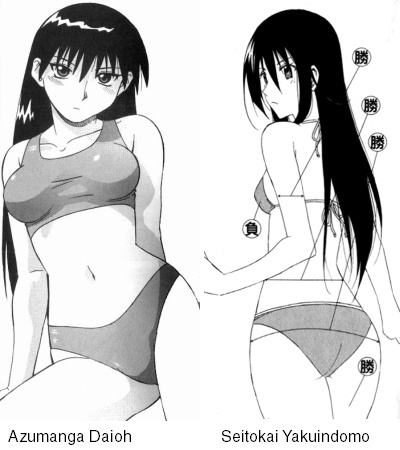
The second point is in direct contrast to the first, indeed without the first it would not be as effective. Namely, “dirty jokes”. Obviously this is hardly unique, we’ve already had B Type H System adapted this year, another series whose female lead is sex-obsessed. The differences are that Seitokai Yakuindomo isn’t visually explicit, there’s no romantic underpinnings and while the lead does/says stupid things, she isn’t a complete idiot. Just a partial one when the gag demands it.

Most of all though, the series is highly focussed on gags over characterisation. The four main characters are basically there to be shuffled about into various combinations to set up and deliver gags. In fact they are barely characters. You’ve got Takatoshi (male, defacto straight man), Shino (President of the Council, sex-obsessed), Aria (busty, tells dirty jokes) and Suzu (super-intelligent, comically short). They’re basically hooks to hang jokes on.

A typical gag set up will be as follows:

* Character A says something ostensibly serious.
* Character A then says something stupid/incongruous to the setup.
* Character B reacts to it.

Normally it will have the same character deliver the setup as the punchline, rather than break it down to a standard feed/comic distribution of roles. The straight man often only comes into play in the last panel, commenting on the idiocy that happened in panel 3.

This is why I don’t feel it’s setting out to shock by using “dirty jokes”, but rather just using sex as the incongruity. Sure, the toilet talk adds a frisson to the joke, particularly as the comic doesn’t try to be sexy, but the funny is in how it gets from something perfectly clean to something dirty. It’s cleverer than just drawing a cock on a blackboard (which is still admittedly funny). There’s other joke formula they use (and over use) like Suzu being too short to do something and something innocent looking like something rude from a certain angle, but the one above is probably the most common so far. It’s all very music hall, rather than out and out shock humour.

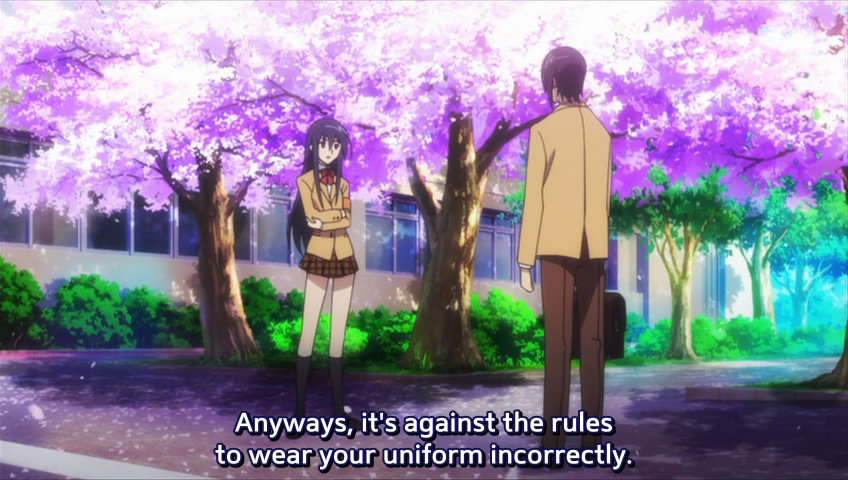
The anime on the other hand is different beast to the manga, and that’s what I really want to talk about here. If you weren’t aware of the manga, then from a distance the anime might just strike you as your typical slightly smutty otaku bait shows. One thing that really adds to that is the colour palette chosen. Seriously fuck this colour palette. Particularly when it saturates the incredibly dull opening sequence of episode one, playing like the opening to some dumb erotic video game being adapted into animated homeopathic porn. You know what palette I’m talking about.
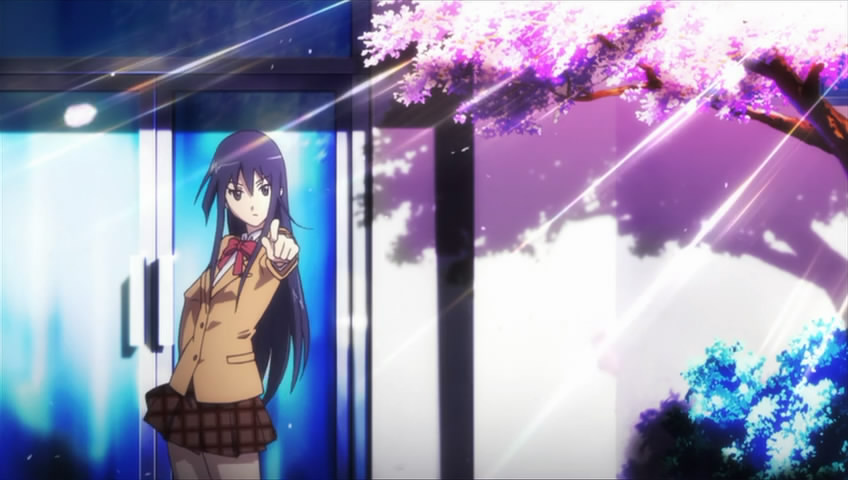

Yeah, that fucking palette. There’s some blue-green in there too, but the backgrounds in that opening are awash with oversaturated pastel blues and pinks. The blues should be complementary to the browns of the school uniform (at least in the RGB spectrum), but they are so oversaturated that they overpower the characters. The pink just makes it so much worse. This sort of thing is what annoys me the most about modern anime, moreso than poor hat animation!

After a couple of minutes of this opening that seems to go on forever, we get an opening animation full of brazen dick jokes and one of those tedious peppy J-pop songs (not to mention some ludicrously ambitious panning animation).

Then we get an even more ludicrous 3D shot to set up the first gag. Which isn’t that great so let’s skip to the second gag, based on the second 4 panel strip. Prepare to have any humour present killed by over analysis.

Panel 1 / Shot 1
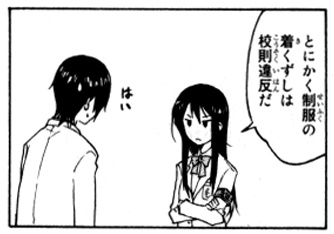
The anime flips the characters around, and pulls the focus from them by filling the screen with a busy, garish background that overpowers the layout. Apart from that it’s pretty much adhering to the strip.

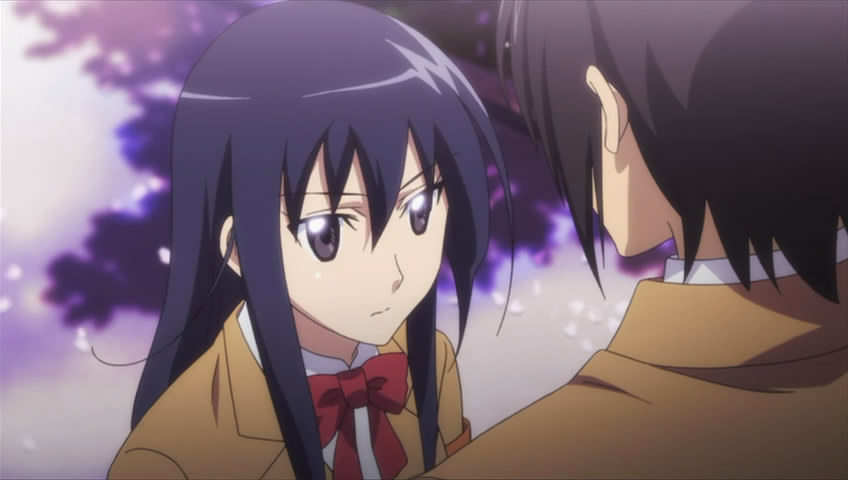
Panel 2 / Shot 2
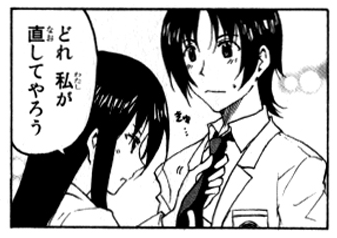
Here we get a complete change in camera position, as the middle two panels are pretty much the same shot it in the original. By changing the shot, the anime can recreate the beat made by the movement from one panel to another.

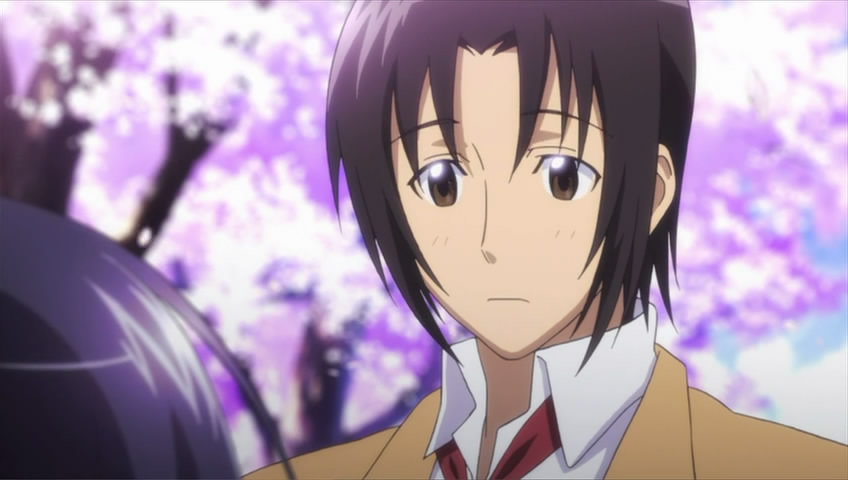
Panel 3 / Shot 3
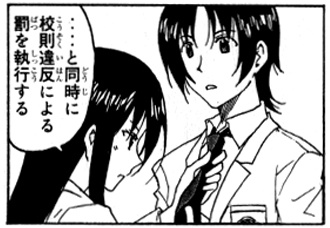
Here the shot is much closer to the original layout, however we now get a budget saving move come into play, where the anime hides the mouth of the character talking off screen. Hooray, one less thing to animate!

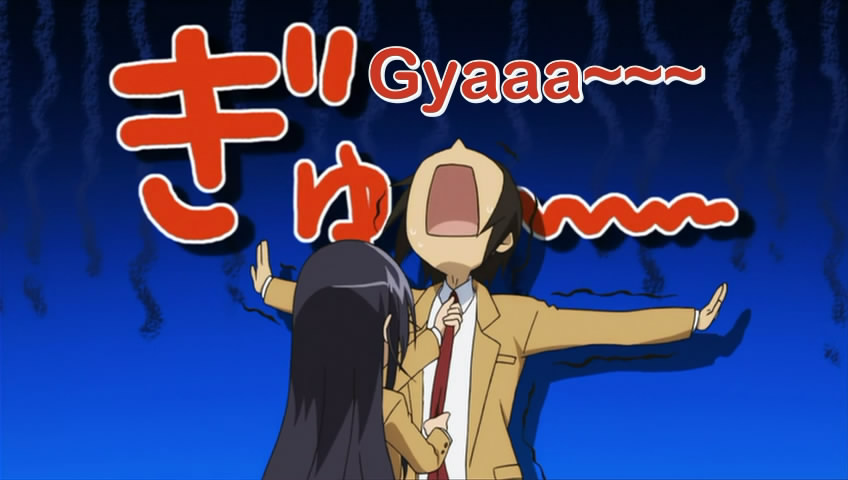
Panel 4 / Shot 4
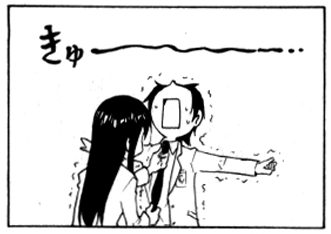
And finally, the punchline is delivered with a shot that’s pretty much straight out of the manga. However, the anime has second response shot that it adds…
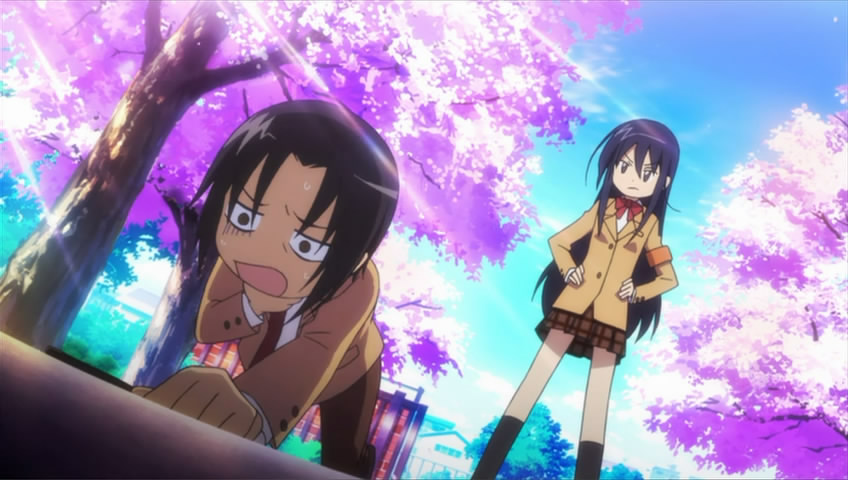
This is the sort of shot that doesn’t really happen in the comic, if only due to the restraint of the 4 panel half page format. It’s one place where the anime can take advantage of it’s medium.

Now while that’s not the funniest or the most typical gag on the show, it does demonstrate what the show does best – nail the rhythm of a 4 panel gag strip.

Here’s a few other notes on how it takes advantage of the medium:

  • Movement. Gags that rely on movement (e.g. the kick with the shoe flying off the foot) are framed to take advantage of actual movement.
  • Asides. Not super-keen on this technique, if only because it’s been done to death by Family Guy, but it will throw in extra shots to illustrate something said, rather than keep to the proscenium leaning step ups preferred by the manga.
  • Visual gags. Similarly it will sometimes add visual gags to the background that weren’t present originally. The best example is the strip where Aria’s suggesting boys might join the school to start a harem and in the anime we see someone in the background clearly hoping for just that. That strip’s anime version is also a good illustration of the asides the anime uses, as we get asides to both an 80′s style sex comedy and a Maria-sama ga Miteru style show to match what Aria’s suggesting.

However, as good as the anime is adapting individual strips from the manga, there’s a couple of flaws.

Firstly there’s the issue of repetition, both in terms of the structure and the punchlines. The structure of the jokes can be so similar, that over half an hour it can get wearisome. Add in the fact that so many punchlines seem really similar in the first episode and I wouldn’t blame you for tapping out. Personally I found enough to admire in the mechanics of it to push on, particularly as most of these sort of adaptations let the air out of the gags, and this gets the rhythm right. You, on the other hand, might find the amount of times Shino turns the conversation towards periods somewhat sapping.

The big flaw though reveals itself in episode 3. Or rather in the preview to episode 3. It just gets confirmed in episode 3.

One of the anime’s gags is that in the preview the characters mention what pages from the manga they are adapting next week. Episode 1 covers the first 32 pages, episode 2 covers pages 33 to 56, episode 3 on the other hand only covers page 57 to 60.

Four pages. In a half hour anime. Even Naruto manages more pages than that.

What this meant was we were going to get lots of anime “original” material. And by original I mean they turned the show into exactly what you might have thought it was going in. We get a load of fanservice, gags that outstay their welcome and finally, accidental bestiality.

There’s a fine line that the manga walks with its dirty jokes and in episode three the anime takes a running jump over that line. There’s clues that the screenwriter’s sense of humour might not be on the same page as the comic’s in the first two episodes, but by episode three it becomes crystal clear. The big problem with it is they don’t have the character Takatoshi around to act as straight man to Shino and so her digressions into stupidity go unanswered. Without someone to annoy them in the show, idiots are just annoying you the viewer. Plus she seems more idiotic when the anime screenwriters write her without the original manga’s scripts to base the gags on.

In short, it’s a really awful episode.

Episode four promises more manga adaptations so hopefully that will get back on form, though given how bad episode 3 was that’s the only chance I’m giving it.

If you do have an interest in the mechanics of gag anime I’d definitely recommend the first episode at the very least, as to me it felt much closer to the sort of shows we got during the dawn of late night anime than we get nowadays.

Oh, and the ending animation is really well made, to the point where you’ll wish you’d seen whatever show from an alternate reality it really belongs to.

Be Sociable, Share!

Category: Anime, Manga

Tagged: , ,

Durarara!!

I wrote about the first three episodes and the gist of the show over here.

The first 12 episodes are really great, totally living up to the promise of those opening episodes. Had it stopped there, I’d probably love it as much as I did the same team’s Bacanno!. The problem is they then went straight into another 12 episode story arc.

That second arc unfortunately pales next to the first. It’s more to do with the strengths of the first arc than any specific flaws the second has. Particularly how those strengths aren’t able to be duplicated in the second arc due to the nature of the adaptation.

The big problem is that the first arc does a really great job of introducing characters, and there’s a lot of characters it has to introduce. The second arc has a lot less characters to fill us in on, and some of the new characters don’t get their backgrounds fleshed out.

Where the first arc felt like a series of interlocking origin stories, the second arc has to deal with a fairly linear gang war story. We do get a couple of new origin stories and a couple of fun character introductions in there, but it doesn’t compare with the weirdness of the first arc. Related to this is the second arc’s use of different narrators to relay different points of view of the narrative and characters isn’t as strong as the first arc’s episodes.

The second problem is that the lead of the first arc, Celty, is pushed into a supporting character role in the second arc, with Mikado, Masaomi and particularly Anri taking the lead roles.

Frankly, they aren’t as interesting as the adult characters, plus the plans of Izaya which set them up as the main characters, are revealed as delusions of grandeur by the end. Which is kind of the point, and you can appreciate that when the point is forcibly made by Simon in the final episode, but while you’re getting there you’re expecting a little more than what you get.

That plan of Izaya’s is probably the one weakness that is the arc’s own. The plan relies on that screen-writing cliche of not having characters talk to one another in order to keep the running time up and the story going. If the three had just talked honestly to one another the whole story would have lasted on episode. They give enough reasons to keep the characters emotionally isolated from each other, and that isolation is somewhat the theme of the arc, but I felt there was about one too many episodes of drawing that out. It passed from tension to frustration.

Had they put a gap between arcs, I think I’d have been a bit more accepting of the changes, but in contrast with the opening arc it was a little dissatisfying.

That being said, there’s still plenty to like in the second arc, particularly the various fight scenes with Shizuo and the inventive lengthy chase sequence where Anri is pursued by the Yellow Scarves. And there’s a pay-off between Izaya and Anri (and then Izaya & Simon) at the end that puts Izaya’s self-proclaimed “love” of humanity in a clearer light. Makes me wonder if there’s some subtle word play around that in the original Japanese dialogue that the Crunchyroll subtitles miss?

Certainly there’s nothing in the second half that would put me off wanting more Durarara!!, there’s still mysteries to be explored and it’s full of engaging characters. I just hope that further story arcs don’t rely on three teenagers not talking too one another to power twelve episodes worth of plot.

Be Sociable, Share!

Category: Anime

Tagged: ,

The Tatami Galaxy – Episode 1

Boy has overly romantic view of college life. College life fails to live up to his fantasies and he becomes the enemy of romance, via the “help” of a trouble causing friend. Possible divine intervention occurs.

Let’s get the major issue with The Tatami Galaxy out the way first. It is very wordy. I think the wordiness itself is more of an issue than the rate at which the words are delivered (very fast).

I’m not sure if this wordiness is born from it being an adaptation of a novel, or if it’s a specific creative choice. I’d guess the former, simply because Masaaki Yuasa’s other works aren’t wordy in this way and novel adaptations in anime (and elsewhere) find themselves driven by internal monologue in the same way this episode was. Not having access to the original text though means that’s all guesswork on my part, so take it with a pinch of salt. Another difference between this and previous Yuasa projects is the involvement of playwright Makoto Ueda (Summer Time Machine Blues, Go Find a Psychic!), so that may also have influenced the verbosity of the production.

So, having established that monologues are often par for the course for these sorts of adaptation, how does The Tatami Galaxy deal with it? By going about three times as fast as anyone else would go.

That works well in terms of giving the episode a rhythm to work to, but it presents challenges in watching subtitled animation that don’t necessarily exist with conversational dialogue at the same speed. The rhythm of back and forth dialogue lends itself better to rhythms of reading and watching animation than more complex monologues do. If you want a comparison with an English language cartoon, try to imagine watching Tex Avery’s Symphony in Slang with subtitles. Even then, the narration seems positively sedate compared to The Tatami Galaxy‘s. I wonder if the between narration beats that Avery leaves are also present in Tatami Galaxy, but lost when you have to read as well.

I thought I had coped perfectly well, and never felt I was struggling, but going back and watching again without subtitles, I discovered images and details in the animation I’d completely overlooked. That’s fine however, as it’s a joy to watch again and again (though I didn’t go quite as mad with it as I did Kemonozume‘s opening episode which I’d watched three times before I even had subtitles to go with it).

So don’t let the machine gun monologues put you off, as ultimately it is a very minor quibble for what is likely to be one of the best TV shows of the 21st Century.

Visually it’s a treat. It’s full of fantastic shots, movement and character design. Despite it looking different, once again, from Yuasa and Nobutaka Ito’s previous collaborations, you can still tell it is their vision that is driving the overall look of the show. That has a lot to do with the fact that not many creators working in anime would have created a cast of such diverse body shapes and facial features, something they also did in both Kemonozume and Kaiba.

In this episode you’ve got the relatively normal looking lead and the object of his affection, Akashi (though she too is not above cartoon warping of her form), and on the opposite side of the design spectrum, the devilish looking Akashi and a god of matchmaking who’d give Popeye a chinferiority complex.

Ozu is clearly the character that people are going to have most fun animating, and his voice actor Hiroyuki Yoshino (Kazuma Momota in Kemonozume) seems to be relishing the scenery chewing the role gives him. It’s great to have cartoon characters who act like they are. And the final scene he’s involved in this episode leaves so many questions unanswered that you’ve got see more.

If you are in the US you can watch this via Funimation’s various portals, which is great news for Americans who like awesome animation. The rest of us outside of American or Japan will have to use the Evil Powers of the Internet to get to it. It’s worth it either way, as it is just a joy to see something both this idiosyncratic and this well made.

Be Sociable, Share!

Category: Anime

Tagged: ,

B Type H System – Episode 1

It’s a new anime season and that means the race is on to be offended by at least one new show. Go, anime bloggers go!

In the lead at present is B Type H System, based on Yoko Sanri’s manga that runs in Weekly Young Jump. Once again it’s a female author giving young men a glimpse into the lives of young women via the medium of sex comedy. I believe in this case, she’s claimed that lead character is based on her younger self, and that makes some sense of the moustachioed tiny version of the lead who floats on a cloud providing commentary on her inept attempts at losing her virginity. However in the manga that device doesn’t show up until the end of the first volume, and she also turns her eye to the libidos of teenage boys more than is indicated in this first episode.

The plot summary given at the start of the episode is that the lead wants to sleep with 100 boys at high school, but has such a messed up idea of sex and relationships that the chances of her actually managing to do this are non-existent. Having grown up during the success of the Secret Diary of Adrian Mole, the fact that anyone thinks she’ll actually manage this, that it will even be the focus of the show or that this sort of teenage sex comedy is so inherently creepy amuses me greatly.

In fact now that I think about, we still have that sort of sex comedy in the mainstream with The Inbetweeners, a show that just like B Type H System has sex-obsessed teenagers played by adults, and is far less satiric than Adrian Mole was. Honestly, so much writing about anime lately seems like a race to be offended that people aren’t properly analysing the shows they are watching. Chu Bra was creepy because it was excusing itself – B Type H System has no excuses, it’s just a comedy about horny teenage idiots.

That’s not to say the show doesn’t have its problems. In fact it’s full of them from head to toe. The real problem with B Type H System is that it’s so shoddily executed.

The original manga, while not the work of a great illustrator, has a lightness of touch completely absent from anime. Yuuko Yahiro (also the Animation Director) just kills all that dead. Even the well chosen colour schemes from the original book covers are turned into the usual palette of digital colours and soft focus crap in the anime.

Most importantly though, the manga is a four panel gag strip. Something you cannot tell at all from anime. The rhythm of the manga’s beats are just laid waste to in the anime. Which is not that surprising when you consider that they’ve actually removed some of the punchlines. Sanri often uses the beat of three panels of a continuing scene, then the four panel acts as a smash cut to the punchline. It’s hardly rocket science, lots of authors use similar beats, but when you remove that final panel, you aren’t left with much in terms of a gag. She’s also a lot more realistic in her portrayal of teenage horniness than the anime which may go some way to explaining why some of those punchlines are just missing in the anime. What I’m saying is this – there’s a lot more jokes about masturbation in the manga.

It’s not a masterpiece by any means, it’s just one of many 4-panel sex comedy strips that have been created, but it’s certainly better than the anime might lead you to believe.

It all boils down to the fact that this is one of those manga that would be much better served as an anime by being 5-10 minutes per episode and in the hands of a director who both understands the rhythm of comedy and would keep it closer to the visuals of the manga like Akitaro Daichi, Hiroaki Sakurai or even Bob Shirohata. Even if you still didn’t like the subject the matter, the gags would work better.

Instead it’s been pushed through the same aesthetic filter that so many anime seem to use nowadays and toned down for an audience that can’t handle jokes about wanking. That’s what you should really be annoyed at rather than the shocking revelation that teenagers think about sex a lot.

Be Sociable, Share!

Category: Anime

Tagged: ,

Heroman – Episode 1

Heroman is a fantastically crafted piece of hokum. As long as you aren’t some sort of po-faced nincompoop who mistakes a lot of writing for “depth”, you’ll likely have a lot of fun with the show. Not all entertainment has to be art, and highly skilled craft is a far more valuable commodity than bad art.

The craft in Heroman lies in two places. The first and most obvious is in the animation. Not only does it have a great set of character designs, full of variety and fun, but the first episode blows most other television animation out the water in terms of actual movement. It may not have the best direction or storyboarding, but what there is on screen is incredibly slick in execution and aesthetically pleasing. Denton, the scientist who accidentally dooms humanity through his well meaning attempts to contact extraterrestrials, is an especially fun design, that is echoed in all the character his movement has. Also look at how fat rich kid Nick and his gang of hangers on move around each other, there’s a character work going on with them in the actual animation, not just what they say. It is those touches that set this apart from other shows that will get taken more seriously, it’s a cartoon that’s a cartoon, not just the cheapest delivery medium for a story.

The second place the craft lies is in how it ties classic Stan Lee ideas and concepts to the ideas and concepts of classic robot manga, namely those originated by Mitsuteru Yokoyama. It’s rare enough nowadays that a manga or anime will channel Yokoyama directly, let alone one that’s got Stan Lee involved at the same time. Not only is the core concept pure Yokoyama – a young boy who controls a robot via a device on his wrist, but Heroman also has this stoic, almost sad face that has echoes of Giant Robo‘s face.

With the various Stan Lee-isms (orphan raised by elderly relative, having to do a part time job, name alliteration, bullied at school, hots for blondes) mixed in, it feels like Peter Parker cast in the role of a Yokoyama hero. While that means that most, if not all, the story elements will be incredibly familiar to most people due to Spider-Man and Tetsujin 28-go/Gigantor being such a part of the global pop culture consciousness, you probably haven’t seen them combined before. And certainly not with such skill.

If you like either classic Stan Lee or Mitsuteru Yokoyama it’s worth your time checking it out. If you like both, like I do, then you’ll probably love it.

Be Sociable, Share!

Category: Anime

Tagged: ,

Durarara!! – Episodes 1, 2 & 3

From the author of Bacanno! and the folks who turned that book series into a cartoon, comes this tale of strange goings on in the Ikebukuro district of Japan.

Like Bacanno! the first episode flings a whole load of characters, factions and plots at you at once. However it’s a little easier to get to grips with as it’s all taking place in the same time period and locale. Well, ignoring the fact that the lead character has no head. It’s an approach that worked well in Bacanno! and it works here too, though perhaps not quite as well. It’s a little more linear in its approach and the characters doing the introduction are more part of the story than in Bacanno!.

It reminded me of Jonathan Tweet’s RPG, Over The Edge, as you have a locale populated by outsiders, some of whom are somewhat odd, and all sorts of conspiracies, secrets and gangs operating beneath the surface. Like Baccano! there’s a very thin line between normality and the supernatural, and having your lead be an Irish unseelie faerie (Durarara!! is a corruption of Dullahan) calls into question the humanity of some of the other characters who show unnatural abilities and behaviours.

Episodes 2 & 3 begin to put some distance between Durarara!! and Bacanno! in the approach to adaptation. Each Durarara!! episode has a narrator, and focusses on an individual story, even if there are sub-plots ongoing throughout. Gone is the clockwork script and editing of Bacanno! and its time slips, instead we get a slower paced, more deliberate approach. It’s more interested in the characters and, so far, works very well, as different characters see different sides of each other depending on the episode and circumstance. Most notably, the information broker, Izaya Orihara, sinister and manipulative in episode 2, comes across more positively in episode 3.

As to the narrator, it’s not clear who the narrator is in Episode 2, but in Episode 3 it’s the character of Simon (the guy who works at the Russian sushi restaurant with the overly complicated nationality) suggesting that the each episode has a different character narrating, so Episode 2′s could be supposed to be Celty the Dullahan’s voice rather than just Narrator as actress Miyuki Sawashiro is listed as.

In terms of animation, the character design isn’t quite as solid as Bacanno!, but there’s lots and lots of great movement. A lot of it is in the body language and poses, but there’s also a lot of physical comedy, particularly from the supernaturally strong and perpetually angry Shizuo Heiwajima (shades of Bacanno‘s Graham Specter). There’s one beautiful gag in episode 3 that had me cackling, and it’s something you could only do in cartoons.

Other bits I liked included, the spot in episode 3 where Mikado and Anri are running away and she ends up dragging him along, Masaomi’s general theatricality in the way he moves and how that disappears when Izaya shows up, and the puckish way Izaya moves throughout. It feels like Masaomi is putting on a show in his movements, whereas Izaya’s feel like the movements of a natural born trouble-causer and shit-stirrer.

It’s the only new show that’s really gripped me in both story and animation, an all round great package. So check it out.

Be Sociable, Share!

Category: Anime

Tagged: ,

Kaitou Reinya – Episode 1

Behold. The Future of the Anime. Today.

Forget moe. Forget light novels. Forget visual novels. They are all red herrings. They are just pop eating itself, and most of those who protest their existance would simply replace them with works equally niche and worthless.

If you want the actual future of anime, look to this show. The future is cheap flash animation done badly.

When you look at Akitaro Daichi’s Flash work on Gag Manga Biyori, it is hard to distinguish from his hand-animated work on 1998′s Sexy Commando. The makers of Kaitou Reinya on the other hand have gone for a look that is much closer to Flash artists like FROGMAN or Weebl. And that’s probably an overly favourable comparison. Lets just say it is very obvious that the show has  been made in Flash or something similar. At its worst, it equates stretching and squashing a static drawing of a figure as animation.

It feels like they’re seeing just how much they can shave the production budget down to before viewers stop tuning in. Similar to when Adult Swim started squeezing animation budgets and we ended up with stuff like 10oz Mouse. Of course there’s a second factor involved here and that’s the fact the show is a vehicle for one of the womanchildren spat out by the Morning Musume machine. In this case, Tanaka Reina who is cast as the lead character thief Kaitou Reinya. So it’s possible most the budget is going to her, or her management, and that’s why this thing looks so cheap.

It’s a shame, as the character design is quite fun and there’s actually some good gags with the mouse that would work so much better they’d put more money/effort into it. Thankfully what little I’ve caught of Ufotable’s Yawarakeme and of the fourth season of GMB suggests there’s still some promise in this growing sector of anime. And as more people turn to it, I think we’ll see innovation in the same way we’ve seen it in western Flash animation over the last decade.

Be Sociable, Share!

Category: Anime

Tagged: ,

Okami Kakushi – first 10 minutes or so of Episode 1

Boy, do I ever hate Visual Novel adaptations.

They’re everything that’s wrong with videogame adaptations, but with added problems of:

  • Having emulate the visuals of a medium that has some of the most moribund visuals in the videogame market.
  • Adapting something inherently heavy with dialogue and exposition.

The episode with an avant title sequence that exhibits a whole bunch of elements I hate in modern Japanese cartoons:

  • Sad doe-eyed girls.
  • Excessive use of a colour filter. In this case red.
  • Glaringly obvious 3D modelling work.

Then we get an opening sequence full of girls that I can’t tell apart. The discount CLAMP, Peach Pit, did the design work for the game, so that’s another negative against it.

Then we discover that the opening was a flashforward, and we meet the lead and his family (dad and wheelchair bound little sister) driving to their new home in their dreadful-looking 3D model of a car. Then the lead meets the sad, doe-eyed girl of the opening, except here she’s aggressively upbeat.  I should also mention, the wheelchair is also a 3D model much of the time, and it’s possible the sister wears an excessively large hat when going out in it to hide the model of her that’s riding it, rather than shade from the sun.

There’s then a ton of exposition from various people. As it’s based on a visual novel after all and as you can’t read all this in a cartoon we get characters clunkily telling you the information in boring scenes. Then around 10 minutes in I decided this whole exercise was a waste of my time and gave up. Yes, it is worse than Chu Bra, Ladies versus Butlers and Baka to Test to Shoukanjuu. While they might have been either offensive, poorly directed or overly ambitious, none of them ever induced the feelings of utter boredom that the small portion I managed to watch of this show did. Nothing in the story, characters or visuals held my interest at all.

Visual novel adaptations are the dirt worst thing to happen to anime in the last 15 years.

Be Sociable, Share!

Category: Anime

Tagged: , ,

Getting the SHAFT again.

As I may have mentioned, I have a recurring problem with SHAFT productions and the work of their director Akiyuki Shinbo. That problem is that while I like the art direction & design in their shows, the actual material they are adapting leaves me cold. Mainly it’s the fact they tend to handle otaku pandering material that’ll shift DVD units and merchandise in Japan.

This week they launched the latest of Shinbo’s works, an adaptation of the manga Dance In The Vampire Bund. Also launched this week was Baka to Test to Shoukanjuu from frequent SHAFT collaborator SILVER LINK, with Shin Oonuma directing. Oonuma worked on many SHAFT shows like Ef, Natsu no Arashi & Pani Poni Dash. In fact looking at the staff list it’s only animation director Miwa Oshima who seems the odd one out, with much the remaining staff coming with Oonuma from Ef. So I’ll be looking at that show as well, as it’s an interesting comparison to Dance In The Vampire Bund. And finally, to get some perspective, I’ll take a look at the first episode of last years Bakemonogatari, the show that cemented Shinbo as an otaku favourite.

Bakemonogatari Episode 1

With a completely different story, or possibly just a different script I’d probably love this. But when you’ve got characters in a show about ghost stories discussing and using otaku jargon, it feels like they are grasping for those otaku wallets a little too hard.

Visually of course, it’s fantastic. While Shinbo’s particular fetishes are all over the show – namely typography, geometrical design and near subliminal editing – he allows Akio Watanabe to bring plenty of himself to the show too in the action and character design. The only real flaw in Shinbo’s approach for me is his love of dialogue, too many long conversations and monologues slow the show down, even with all the visual tricks he pulls to try and keep them interesting. While that could be said to be the fault of the script, the fact is he does it across a lot of his shows, so it’s clearly something he digs himself. To the point where you think rather than a way around bad scripts, Shinbo thinks Wally Wood’s 22 Panels That Always Work are the be-all and end-all to visual storytelling.

While it’s not for me, though the ghost story aspect comes really close in making me want more, I can definitely see why so many people really loved it. It’s not just a lazy otaku pandering show, though there’s plenty of that if you are a lazy otaku obsessed with specific character traits and slang, but it has a distinct visual style that will appeal to the aesthetes too.

Dance in the Vampire Bund Episode 1

This time round Shinbo is working with Naoyuki Konno (009-1, Cyborg 009, Kikaider) as animation director and character design, and again, the animation director’s own individuality shines through. Though it’s worth noting that it’s Masahiro Sonoda credited as series director, with Shinbo just listed as director.

Once more the show suffers from its source material. Not only does it feel like someone’s Vampire The Masquerade campaign, but the lead is one of those HONEST GUV THEY’RE OVER EIGHTEEN characters that crop in both anime and vampire fiction far too often. And so was absolutely guaranteed to show up in the new vampire anime from the makers of Moonphase. As clever as the actual set up of this first episode is, it’s not enough to get me to follow the adventures of an underage vampire princess and her lycanthropic bodyguard.

What is clever about this episode, is it takes the artifice of the Shaft/Shinbo aesthetic and finds a way to make it work in a realistic fashion. The entire episode takes place on a variety panel show where celebrities are debating the existence, or not, of vampires. This gives them an opportunity to actually work their fetishes for typography and monologues into the story in a way that feels natural, rather than cutting to subliminal interstitials or unnatural camera angles. Here that’s all part of the fictional TV show within the show.

Watching it again in light of watching Bakemonogatari though, as clever as the device of the TV show is, it doesn’t do as a good a job of hiding the weaknesses of the story. Though they’ve really got their work cut out on hiding the weaknesses in Nozomu Tamaki’s trashy manga, so I can cut them some slack. Won’t be coming back for more though.

Baka to Test to Shoukanjuu Episode 1

And what we have here is SHAFT-lite. Or shite for short.

If it wasn’t for so many SHAFT alumni on the staff, it’d be really easy to accuse this of blatant me-too-ing of their formula of abstract design. Oh what the hell, it’s a blatant attempt at recreating the formula that’s served SHAFT well on a lower budget and with less able hands.

Most egregiously you can see it in the ending credits which hamfistedly tries to do what Shinbo does with typography to  the English translation of the songs lyrics. And fails miserably. But that’s just the topper on a show that clumsily tries for a minimalist “manga on the screen” approach along the likes of Sayonara Zetsubō Sensei. Unlike that show, they haven’t got a decent manga to crib for the design notes, and so they just end up sticking ziptone everywhere willy nilly.

Which is a shame, as the actual concept for the series is fine, even though it feels like a failed pitch for a DS game that someone turned into a light novel. Classes at a bizarre school fight one another in exam battles, involving the summoning of super-deformed versions of themselves. Combined with the visuals of the battles, in particularly the overhead views of characters like pieces in a tactical board game, it leaves you with the impression that someone really wants this made into a videogame at some point.

However videogame aesthetics do not a good cartoon make, particularly when the game doesn’t even exist yet.

Be Sociable, Share!

Category: Anime

Tagged: , , , , , ,

Ladies versus Butlers! – Episode 1 (preview version)

Well I’ve done the maths and turns out writing about the first episodes of series, even if I don’t like them, are popular on the site, so I’ve decided to do more of them this year. And that won’t just be limited to anime, still getting a surprising number of people visiting my review of the first episode the College Humor Show too.

Just my luck that the first thing I turn to is Ladies versus Butlers, the latest show from Xebec and their new cash cows Atsushi Ootsuki and Akio Takami (Buso Renkin, Shaman King). The pair were behind Xebec’s Kanokon, a similarly saucy light novel that got an anime adaptation on satellite channel AT-X.

Saucy comedy is a perfectly legitimate genre to delve into, indeed anime used to be really good at it. Shin-chan still is good at it. However late at night, things started to get weird, and in the last 10 years you’ve had this strange breed of near sexless sex comedy for otaku. Xebec and Ootsuki took advantage of the satellite broadcast to put some sex back into the sex comedy with Kanokon, however there was one major problem.

Ootsuki can’t direct comedy for shit.

Instead it felt like some weird piece of erotica that contained things you recognised as technically being jokes even if they weren’t executed as such.

Ladies versus Butlers is similarly problematic, if not more so. Instead of a plot, it just appears to have a variety of fetishes layered on top of one another. All but one joke you will have seen before if you’ve watched any anime comedy in the last 20 years.

There is one clever idea, that the hero is so uncouth his mere presence makes high class women faint in his presence, but it is executed appallingly – the hero is no more uncouth than a dozen other anime heroes and the women no more high class than a dozen other anime heroines. It lacks comedic exaggeration in all areas except one character’s ridiculous hairstyle.

Ootsuki’s timing of gags is dreadful, preferring instead to linger on the anatomy of his female characters, rather than get the rhythm of a joke right. It’s like a cartoon Carry on Emmanuelle. If you wanted to make something erotic, why fill it with terrible jokes? If you wanted something funny, why fill it with terrible erotica?

Too often a gag is instigated just by having someone inexplicably fall over. I’m sorry, the old accidental embarrassing physical contact gag
is not funny unless you put a lot more effort into the set up than just tripping up. And it’s definitely not funny the third time it happens in the same episode.

Clearly though, there is an audience for this stuff, and as bad as Ladies versus Butlers is, it’s hardly the worst of this sort of material out there. Outside of his specific comedy timing Ootsuki is a competent, consistent, director. And at least it’s more honest than a lot of its rivals in what it’s setting out to do, it’s just mediocre at doing it. Unfortunately mediocre is a home run for much of this sort of niche anime.

Be Sociable, Share!

Category: Anime

Tagged: , , ,

Podcast

Archives

Twitter