1990′s TV Anime – What Anime Looked Like In 1993

Shows starting in 1993:

Miracle Girls, Irresponsible Captain Tylor, Little Women II: Jo’s Boys, The Brave Express Might Gaine, Sailor Moon R, Gosaurer

Mobile Suit V Gundam, Ghost Sweeper Mikami, Legend of the Swordmaster Yaiba, Dinosaur Planet, Nintama Rantaro, Pokonyan
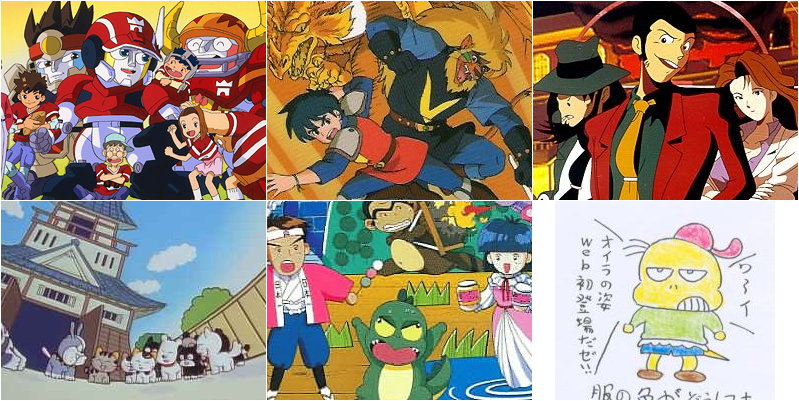
Hurricane! Iron Leaguer, Dragon League, Lupin III Orders To Assassinate Lupin, Tama & Friends, Muka Muka Paradise, Love! Hello Kitty
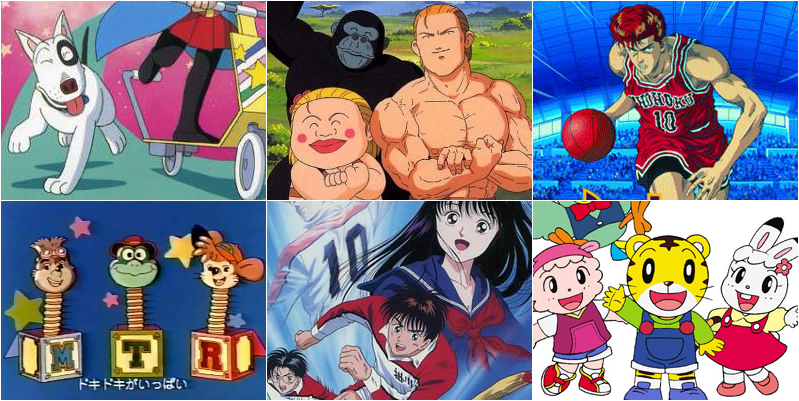
Heisei Inu Monogatari Bow, Jungle King Taa-chan, Slam Dunk, Tanoshi Willow Town, Blue Legend Shoot, Striped Tiger Shimajiro
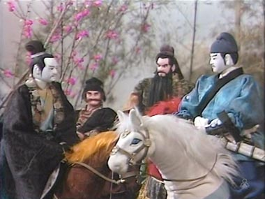
Puppet Show Heike Monogatari

Shows Ending In 1993:
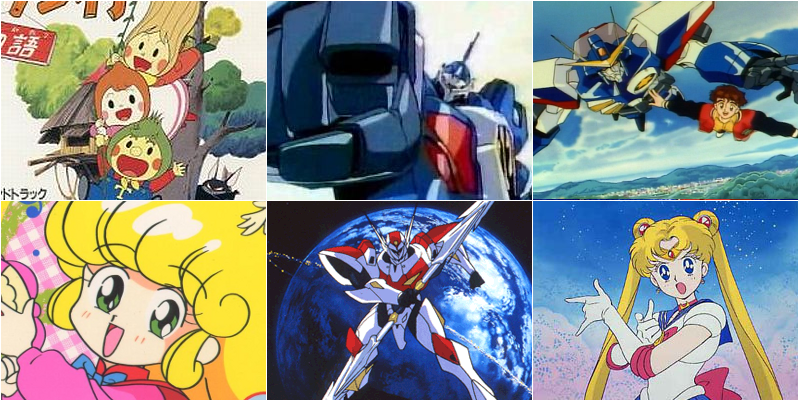
Chirorin Mura Monogatari, Super Electric Robot Iron Man 28 FX, Brave Legend Da Garn, Flower Magic-using Mary Bell, Teknoman, Sailor Moon

Energy Bomb Ganbaruger, Oi! Ryoma, Chikyu SOS Soreike Kororin, Tomato-man and the Knights of the Salad Table, Super Bikkuriman, Yadamon

Mikan’s Picture Diary, Calimero, Dog of Flanders: My Patolasshu, Hime-chan’s Ribbon, Kaze no Naka no Shoujo Kinpatsu no Jeanie, Papuwa of the South Seas
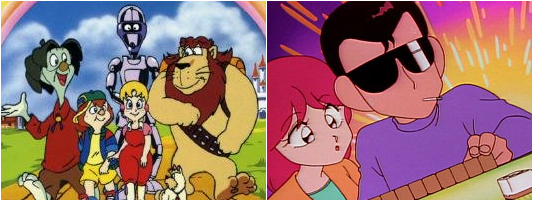
Space Oz Adventure, Super Zugan

Shows continuing through 1993:
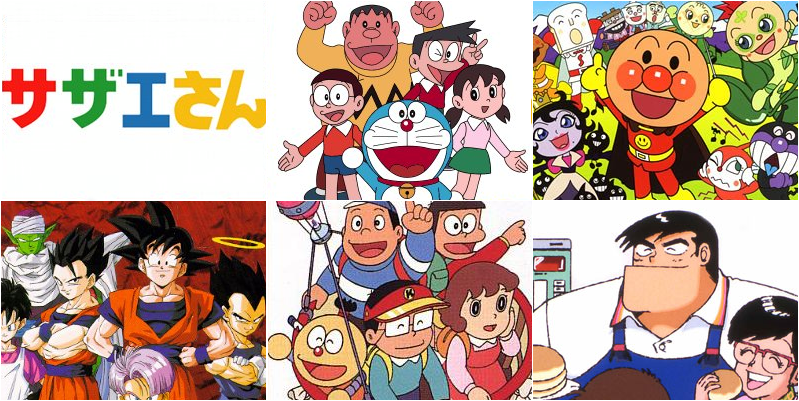
Sazae-san, Doraemon, Anpanman, Dragonball Z, Kiteretsu Daihyakka, Cooking Papa
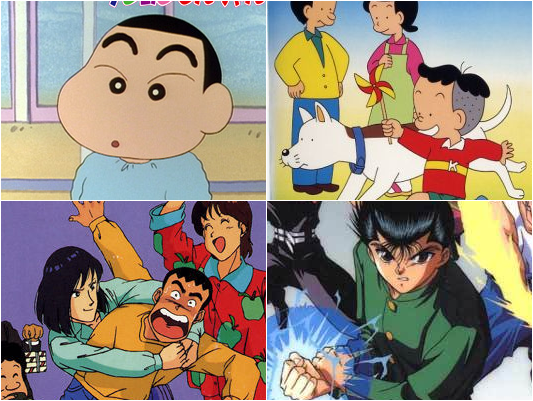
Crayon Shin-chan, Kobo-chan, Get a Grip, Tsuyoshi!!, Yuu Yuu Hakusho

Initial thought after I made this list was “Irresponsible Captain Tylor looks really out of place”. As a non-robot sci-fi show in prime time it looks really odd next to all the manga adaptations and brightly coloured cartoons for kids. In fact it’s so odd, that my post on 1994 that I did for the Golden Ani-Versary blog might have read differently had I realised it before.

The second thought was that we had a lot of shows continuing throughout the year, taking us to ten (eleven if you count the Sailor Moon series as a whole). Five of which are still on the air today. 1992 only had five continue from 91 to 93, and all continued through this year too.

Slam Dunk and Ghost Sweeper Mikami were the big ratings hits among the shows launched this year. However, despite doing better than Super Bikkuriman, Ghost Sweeper Mikami was cancelled after 45 episodes. According to an unsubstantiated “fact” on wikipedia, this was due to lack of merchandise sales.

In terms of longevity though, Nintama Rantaro was the winner, as it continued to air to the present day.

Looking at the Animage Grand Prix ratings, everything was still massively overshadowed by Yu Yu Hakusho and Sailor Moon (which got in there twice). Tylor, Gundam V, and Mikami were the new TV shows making the top ten.

As I go into writing about the new shows, I have seen episodes of four shows that started in 1993. And the Lupin III special.

  • Captain Tylor – I have seen random episodes of this show. I was going to buy it on VHS at one point, but managed to order volume 5 instead of volume 1 and never got the rest. I’ve seen some of the last episodes at a convention back in the 90s.
  • Ghost Sweeper Mikami – I’ve seen the first few episodes of this back when it was getting fansubbed.
  • Mobile Suit V Gundam – I’ve seen the first episode of this.
  • Slam Dunk – I’ve seen the first few episodes of this way, way back before the ill-fated attempt at releasing on DVD in the US. Entirely possible they were dodgy HK bootlegs.

One last note, the odd picture for the Hello Kitty show is the dinosaur character that was the only original animation on the show. The rest was recycled material from earlier Hello Kitty animation. Finding that information out was the trickiest part of compiling this list. Tanoshi Willow Town (a Wind in the Willows adaptation) also proved tricky to find a screenshot for.

Be Sociable, Share!

Category: Anime

Tagged: ,

1990′s TV Anime – Hime-chan’s Ribbon Episode 1 (1992)

In writing my 1994 for the Golden Ani-versary blog, I noticed that Studio Gallop had a group of creative talent running through their shoujo anime similar to Sailor Moon‘s crew. This Akko-chan inspired series is the first in a run of shoujo manga adaptations.

Princess Erika from the Land of Magic arrives on Earth in search of her human lookalike to gift them a magic item. This item is a magic ribbon that allows the wearer to transform into someone else for an hour a day. If this proves useful over the course of a year, Erika will be able to become ruler of her land.

Her human twin is a 14 year old tomboy, Himeko Nonohara (both parts are non talking animal roles for Ikue Ohtani), who has a crush on an older boy at school and wishes she was more feminine like her big sister. While she sulks about kicking another boy in the head in front of her crush, Erika appears outside Himeko’s bedroom window.

She explains herself and the ribbon. As per usual there are a bunch of arbitary rules, you can’t tell anyone, and if you dont recite the reversal chant before the hour’s up you will be stuck in the form you turned into. Oh and Himeko’s plush toy lion, Pokota is brought to life by the ribbon too (voiced by Kazue Ikura, who would go on to cover for Ohtani as Tony Tony Chopper on One Piece when she was pregnant).

The first thing Himeko changes into is her big sister, and that’s where the episode ends.

This is a funny, charming show, with some great character designs from the debuting Hajime Watanabe. Watanabe provides a unifying look to these shojo adaptations, and then would go onto frequently collaborate with the director of two of them, Akitaro Daichi.

No Daichi yet though, he wouldn’t appear on the scene until 1994, the director on this series is Hatsuki Tsuji. Tsuji had been animating as far back as the second series of Lupin III, and was a mainstay at Gallop through the 80s. This was his first director credit though. More recently he’s been the man for bringing trading card games to life, directing Yu Gi OhLive On Cardliver Kakeru and Cardfight Vanguard.

The head writer was Takashi Yamada, who has been head writer on a list of shoujo shows as long as your arm. 

  • Crayon Kingdom of Dreams
  • Heartcatch Precure
  • Hime-chan’s Ribbon
  • Little Red Riding Hood ChaCha
  • Magical Doremi DOKKAN
  • Mo~tto! Ojamajo Doremi
  • Ojamajo Doremi
  • Ojamajo Doremi #
  • Onegai My Melody
  • Onegai My Melody – Kuru Kuru Shuffle!
  • Onegai My Melody Kirara
  • Onegai My Melody Sukkiri
  • Yumeiro Pâtissière
  • Yumeiro Pâtissière SP Professional

I’m sure I’ve missed some, there’s plenty of others he’s written episodes for either under his real name or his pen names Midori Kuriyama and K.Y. Green. And even more that aren’t shoujo shows. Prolific is the word, currently he’s head writer on Danchi Tomoo.

Hiroaki Sakurai (Digi CharatCromartie High School) directed 10 episodes and would be a mainstay on these 90s Gallop shows. I think he’s the only episode director who’d be on the next Gallop show with Tsuji.

Animation directors Masayuki Onchi and Yoko Konishi would join Tsuji again on the next Gallop shoujo project, as would art director Shichiro Kobayashi.

Most of the script writers would return on future Gallop productions, including:

  • Hiroshi Toda (scripts). Toda had been head writer on the first three seasons of Ranma 1/2
  • Shigeru Yanagawa (scripts). And Yanagawa had been head writer on the last three seasons of Ranma 1/2.
  • Miharu Hirami (scripts). Hirami would be head writer on the 1996 Gallop show Kodocha.
  • Ryousuke Takahashi (scripts, production co-operation). Takahashi’s work at Gallop tends to get overlooked in comparison to his famous mecha creations, but he worked on a lot of their output in the 90s.
  • Tomoko Konparu (scripts). Already a veteran in 1992 having started on Ikkyu in the 70s, Konparu has been the head writer on lots of shows in recent years, including Tomorrow’s Nadja, Chi’s Sweet Home and Nodame Cantabile. However, her first head writer position had been the year before Hime-chan’s Ribbon when she was in charge of scripts on the Dear Brother… adaptation.

On a side note, this show appears to have been part of the early push for SMAP, featuring as it does two of their songs for the themes and one of the members in the cast.

Be Sociable, Share!

Category: Anime

Tagged: , , , , , , ,

1990′s TV Anime – Tekkaman Blade Episode 1 (1992)

tekkaman blade

Humanity is trapped on Earth by the alien Radam who have taken over the Orbital Ring System space station that surrounds it. A chance for hope arrives in the form of an amnesiac who can turn into the armoured warrior, Tekkaman Blade.

An updating of the original Tatsunoko Pro series Tekkaman (1975) it aired in an “adapted” English form from Saban as “Teknoman”.

This caught me off guard a little, particularly at the start, when they introduce the Space Knight characters. There was more attempts at goofy humour than I was expecting, such as the pilot Noal getting told off for eating snacks on the bridge, rather than for his aggressive flirting/sexual harassment of his navigator Aki.

This can all be explained when you see that Satoru Akahori & Hiroshi Negishi worked on this, along with frequent collaborator (maybe mentor, does anyone know?) Mayori Sekijima. Akahori had his fingers in a lot of pies throughout the 90s into the 00s, whether as screenwriter, or from having his manga/novels adapted. Or writing novels/manga based on anime.

Akahori & Negishi’s main work together was the 2 Letter Alphabet Series between 1990-99:

  • NG Knight Ramune & 40 (1990 – 1991)
  • KO Beast Century (1992 – 1993)
  • SM Girls Saber Marionette (1995 – 1999)
  • VS Knight Ramune & 40 Fire (1996)

Akahori & Sekijima had previously written Legendary Ninja Cats (aka Samurai Pizza Cats) together for Tatsunoko Pro. Sekijima would write the various Saber Marionette J series that were based Akahori & Negishi’s original concept. Negishi was also involved in Akahori’s Heretical Hour Love Game (yes, Akahori had a series with his own name in the title) and co-created the Master Mosquiton concept with him. 

I’m sure there are others I’ve missed, and I’ve not touched on all the work they did without the others’ direct involvement. They certainly kept themselves busy.

Anyway, the point is, if you see these names working together, you are going to expect something goofier than the you get here, and so some attempt at comedy shouldn’t be unexpected. It’s brief though, and the majority of the episode features Tekkaman Blade tearing up aliens. As you might expect and/or want from such a show.

Looking at what ratings I could find for the time, it fell short of what Scramble Saver Kids, the Monkey Punch tribute to Thunderbirds, was doing in it’s slot previously. Though to give you some perspective, if it got the same ratings today, it would be a top ten anime in Japan. 

From this episode my first thought is that the concept might have been better served with a different creative team behind it. If you’ve seen enough of their other work, you can tell it’s them working on it, but at the same time it feels a watered down version of the work they created themselves. And if you want a serious remake of the 70s show, do you really want to use guys who normally amuse themselves by naming characters after food?

Be Sociable, Share!

Category: Anime

Tagged: , , , , , ,

1990s TV Anime – Yu Yu Hakusho Episode 1 (1992)

The other big new show of 1992. Or at least the one I am able to see the first episode of (sorry Crayon Shin-chan).

Based on the manga by Sailor Moon creator Naoko Takeuchi’s future husband, Yoshihiro Togashi, this anime would run until January 1995 and 112 episodes. A pretty good stint for the 90s, there’s a bigger Shonen Jump manga that gets its anime in 1993 that didn’t run that long.

This first episode introduces us to delinquent with a heart of gold, Yusuke Urameshi, just after he’s been hit by a car and killed. We learn in a flashback some of his troubles, including mean teachers, a drunk mother, unwillingness to attend classes and other kids wanting to fight him. Then we see exactly how he ended up getting hit by a car – he was saving a little kid from getting run over. 

A girl riding a flying paddle shows up, introduces herself as Botan, and says she’s here to take him to the other side. There’s one problem though, they weren’t expecting him, so they need him to go through some sort of trial before bringing him back to life. Yusuke is happy though remaing a wandering spirit on Earth, until he sees how his death is effecting his friends and family, and so decides to let Botan take him to do this trial.

And that’s your lot for this episode.

The positive is it does a really good job of establishing Yusuke’s personality and the world around him, the negative is it feels a little insubstantial as a first episode. We don’t really get to the actual hook of the series. Possibly it didn’t matter at the time as Shonen Jump was still selling like hot cakes, and they take their time and assume familiarity with the source material.

The animation varies from good – the opening shot of Botan – to rough around the edges – there’s some weird proportions in some shots, but nothing too outrageous in either direction. Having seen other shows directed by Noriyuki Abe (Ninku, Flame of Rekka, GTO, Bleach), it feels recognisably his show, but at the same time I can’t say why. There’s something there, but’s not big and flashy enough to be obvious.

An enjoyable enough first episode, but I have One Piece to scratch this particular itch, and I wasn’t able to give Hunter X Hunter my full attention, so I can’t see myself going back to this.

Be Sociable, Share!

Category: Anime

Tagged: , ,

1990′s TV Anime – Sailor Moon Episode 1 (1992)

OK folks, the deadline for my 1994 post on the Golden Ani-Versary Blog is fast approaching, and here I am still talking about 1992 on this blog. It’s time to knuckle down and watch cartoons. Let’s get back on the horse with Sailor Moon.

The big show of 1992. And 1993. And 1994.

We recently talked about this as part of our Magical GIrl podcast, and as I mentioned there, even in the first episode, you can see why the show worked so well. Visually, it contains touches that put the current inheritor of it’s mojo, Doki Doki Precure, to shame. For example, the sequence where Luna walks over the roof of a car, and the way the cat’s reflection distorts with the curve of the roof, is attention to detail that you just aren’t seeing today.

The monster of the week is genuinely creepy, both in design and movement, with more of a horror influence than the tokusatsu gimmick monsters of the week that Pretty Cure has. Doki Doki’s monsters almost seem like something out of the middle of a Kinder Egg in comparison to the soul consuming monster in this episode of Sailor Moon.

In contrast with the horror, there is also some well executed humour. You can definitely see the creative team connection between this and director Junichi Sato’s previous show Goldfish Forecast. The skeleton cutaway of Usagi above, appears as a single frame gag used as she comically hurts her knee on her front door.

The final thing that really struck me from watching it alongside five other magical girl shows, is the everygirl nature of Usagi. As I mentioned in an earlier post, even before they get superpowers, the Doki Doki heroines are already aspirational characters or fantasies. Usagi though is a cry baby klutz who’s not particularly academically gifted. 

She feels more like an identifiable audience surrogate than a lot of magical girl heroines, and that strikes me as being a big part of the show’s success.

In this first episode there is little evidence yet of the innovations it is most famous for, namely the Saint Seiya and Super Sentai influences it brought to the genre. We get a Sailor Venus cameo, and in a clever bit of casting both Luna and archvillain Queen Beryl are voiced by Keiko Han, who had previously voiced Athena in Saint Seiya (both Luna and Athena are responsible for assembling the heroes of their respective shows). When we get to the opening episodes of 1993 and 1994′s sequels, these influences will be more evident, both in Sailor Moon itself, and in other shows being broadcast.

Be Sociable, Share!

Category: Anime

Tagged: , , ,

1990′s TV Anime – Floral Magician Mary Bell Episode 1 (1992)

When Yuri and Ken wish that Mary Bell, the flower fairy from their storybook, could help their parents’ florist shop, their wish comes true. Mary Bell and her seelie court assistant, Tambourine, allow the family to hear the flowers voice and so help them emit “friendly beams” better. However she overdoes the magic and soon the whole town can hear the flowers…

Well, this is certainly the first episode of a magical girl show. In that it goes in hard with shilling the toys that come from the show. In other ways it distinguishes itself quite well.

The first thing that strikes you is that it looks a lot better than most of the TV anime from this era. As well as decent production values, it has strong character design. The original character design was from Kenichi Ohnuki (Major), with final design from the possibly pseudonymous Shigenori Kanantsu. I say possibly pseudonymous as there is no other information about them, they worked on no other show, and one of the episode directors, “Koichiro” was also a mystery. 

Once we get to Mary Bell herself, there’s definitely a different feel to her as a magical girl. She has some similarities to the “visitor from a magic kingdom” magical girls, but there’s an undeniable dose of Mary Poppins in there too. The biggest nod being the Mary Bell story book featuring children with the same names as the children from Mary Poppins. She comes across as a magical girl as some sort of humanised deity, sent to solve the problems of mortals, rather than having been sent to Earth to learn how to be a human, a better person or some such.

That’s added to by the fact that Mary Bell already existed in the minds of mankind through that story book. She’s a mythological figure for some people, in the first episode an elderly woman is thrilled to meet Mary Bell, because she always knew that Mary really existed since she was a little girl.

The final element that sets it apart, at least with this episode, is that there are two songs in it. Not just image songs, but songs sung by characters (albeit flowers) in the course of the story. 

All in all, it was a pleasant surprise. Despite understandably feeling dated and a little sedate in the wake of Sailor Moon’s popularity and it’s many imitators/followers, Mary Bell still manages to feel distinct and finds it’s own furrow to plow. And then plants flowers in it.

Be Sociable, Share!

Category: Anime

Tagged: , ,

1990′s TV Anime – Cooking Papa Episode 1 (1992)

Cooking Papa had been running in Weekly Morning for seven years at this point, and this first episode does feel a little like you are meant to have an idea about what the deal is with the show already. It doesn’t go into any great detail explaining who the characters are, it just tells a sweet story about the son of the family befriending a shy girl and the titular papa having to solve a problem by cooking. You get a pretty good idea of what Kazumi Araiwa, his wife Nijiko and son Makoto are like from seeing them interact with other characters, without it ever spelling out what the series’ hook is.

That hook is as follows, with Nijiko so busy as a journalist, Kazumi working only a 5 minute moped ride from home, and most of all, because he loves to cook, Kazumi cooks for the family. But he keeps it hidden from his colleagues, because apparently in 1992 it would be career suicide if they learnt how good a cook he was. Or that his wife doesn’t cook for him. One of the two, maybe both. Thankfully this doesn’t result in any sort of hackneyed farce nor is it particularly drawn attention to in the is episode. While Kazumi isn’t so sell assured as to tell his collegues, you don’t get him panicking that they are going to find out either.

The other, presumably recurring, characters are a little harder to get a feel for in ths first episode, mainly because there’s so many of them. Despite that I can recall a lot of them, there’s the classmate with the hots for Makoto, Makoto’s weird looking friend, Kazumi’s bumbling junior, a chorus of office ladies, and his boss who wants to eat the lunches that Kazumi’s “wife” made had made for her husband.

It’s not especially funny, and for a cooking show, there’s really not a lot of technical food talk in the episode’s story. The characters though, are so nice and above all, normal, that it’s a pleasant watch.

I think the more exagerrated look of Kazumi and Nijiko, him with the enormous frame and giant chin, her with the thick coke bottle lenses, actually make them seem more normal than if they had a more standard look. People are kinda funny looking more often than they are drop dead handsome or beautiful after all.

Given that it is/was aimed at a young audience, it also makes them look more like parents than just manga characters. Makoto on the other hand is quite blandly designed, making it easier for a young reader to identify with him. Of course, those kids who read it back in 1985 now probably look more like Kazumi or Nijiko. That being said, I see from wikipedia that the characters have aged over the series, with Makoto about to pick a university in 2009. Presumably they have slowly aged, rather than Makoto being held back multiple years.

There’s a live action educational cooking sequence post credits, but it wasn’t fansubbed and Astro Fighter Sunred’s cooking instruction parodies had ruined these sort of things for me already.

Tochi Ueyama’s manga is still running today, and there was a live action TV show in 2008. And Cooking Papa buns in 2012.

Be Sociable, Share!

Category: Anime

Tagged: , ,

1990′s TV Anime – The Brave Fighter of Legend Da Garn Episode 1 (1992)

Well, this was a really well made first episode of a kids TV action anime. Lots of unsupervised adventure, comedy, mystery and a police car that turns into a robot. Earth is visited by a hostile UFO, and the main character Seiji Takasugi runs the gamut of emotion from being exicted about a UFO, happy that school gets cancelled because of the UFO, terrified when the UFO turns into a hostile robot that attacks his town, to being totally stoked that he has a
transforming police car robot that he can order to beat up the evil robot.

The episode builds nicely as what seems at first to be a typical day for Seiji, slowly turns weird and dangerous. Then it gives you some robot action, and finally it leaves you with enough mystery to make you want to come back for the next episode. What’s the deal with spooky girl in Seiji’s class who listens to nature, and who are the aliens orbiting Earth that sent the UFO?

While the opening animation is pretty great, it turns out that it’s not writing cheques the show can’t cash. The animation in the episode has some nice flourishes here and there, telling the story well. And you can definitely tell the human characters are based on some Toyoo Ashida designs. 

This is the first of these 1990′s shows I’ve been watching that I really wanted to watch the next episode of. Which is a pretty good endorsement I think, if not that, then the HUGE nineties anime shoulder pads that the villain has surely are. And if that’s still not enough for you, the ending theme features dancing giraffes in sailor suits.

Be Sociable, Share!

Category: Anime

Tagged: , , ,

1990′s TV Anime – Animage Grand Prix 91, 92, 93

I’ve volunteered to cover 1994 for the The Golden Ani-versary of Anime blog project, so I need to play catch up on my own browse through the 90s and hopefully reach 1994 around the time my post will appear there.

I picked 1994 because it is one of the void years where nothing of great note emerged in TV anime. There were three shows I could see myself talking about, less for themselves and more for what they represented. A fourth show is in retrospect noteworthy, even though it meant little at the time, but beyond that I was wondering what to cover. I didn’t have TV ratings at hand, all I had were hazy memories of what was popular on the VHS fansub scene a couple of years later. By the way if you do have 1990s TV ratings available please let me know, as that would be hellaciously useful.

Then I remembed that the Animage Grand Prix existed. Not only do Animage keep a record on their site of the winners of their annual vote on the best of anime, they also have the top 20 and number of votes cast. This opened things up and I’ve now got eight shows to talk about in 1994. I won’t spoil the surprise, but I will say one gives me the opportunity to bring up Hanna Barbera’s Fred and Barney Meet The Thing.

In the meantime let us look at the top tens for the three years I’ve already covered to some degree here.

May 1991 Grand Prix

Full results on the Animage site here.

Coming as it did in May 1991, this mainly covered 1990 anime. Nadia being top didn’t surprise me. The strong showing for Mashin Hero Wataru 2 did, along with the other two shows cut from the same cloth – NG Knight Ramune & 40 and Grandzort. Perhaps it shouldn’t have done given it’s many imitators. I think the lack of coverage/licensing they got in the UK/US makes them seem more obscure than they were. The TV movie Like the Clouds, Like the Wind, I had never even heard of, but I am now curious about. 

May 1992 Grand Prix

Full results on the Animage site here.

A big drop off for Wataru, presumably his votes ending up with Cyber Formula, which while not a Wataru clone, certainly shares some of the same energy. Otherwise no big surprises here. But it did remind me that Raijin-Oh got licensed, no one bought it and thus no more than three volumes came out. Anime Midstream, the Crusader Video of the 2000s.

May 1993 Grand Prix

Full results on the Animage site here

The year shojo struck back. Wasn’t surprised to see Sailor Moon walk it, but high showings for the new Minky Momo, Mama Is a Fourth Grader and Yadamon did raise eyebrows. Mine in fact. DBZ and Ranma are fading now, and you can definitely see a pattern of the thrill of the new wearing off for former big winners as Cyber Formula drops the same way Wataru did when it came to an end.

I guess that means I better do some more 1992 posts. We’re touching on Sailor Moon in the podcast soon, so I think it might have to be Mama Is A Fourth Grader next.

Be Sociable, Share!

Category: Anime

Tagged: , , ,

1990s TV Anime – Mikan Enikki Episode 1 (1992)

A talking ginger tom causes trouble for his owner. No, not the fat lazy Monday hating one. Nor that delinquent one who likes to terrorize the neighbourhood. This one is called Mikan, likes getting liquoured up, playing the harmonica badly and keeping a crayon scrawled diary.

This show suffered in my eyes due to Chi’s Sweet Home, Poyopoyo and Kuruneko. Compared to those more recent shows it feels too long and too slow. There is funny material in there, both in terms of the situations and the drawings, but it moves at such a languid pace. This first episode is all set up, but there’s not all that much to set up. A ginger cat moves in with a family, and the son discovers it can talk (and likes a drink). That is all that happens in this half hour. Poyopoyo manages more than that in 3 minutes.

I also checked on a couple of later episodes and they had similar pacing concerns. Episode 20 had Mikan turning up to Tom’s school, and it captured the horror a child might have of a pet following you to primary school quite well, but could have lost about half the running time. Episode 21 was more a melodrama dwelling on Mikan’s past before he met Tom, a definite reminder that Miwa Abiko’s original story was a shoujo manga running in LaLa in the 80s rather than modern gag strip comics I mentioned earlier.

That being said, it’s still watchable, and a fine example of an early 90s show that never got any attention during the two anglophone anime booms of the nineties due to timing and format (it did get Spanish, Catalan & Polish dubs).

Notable names who worked on it include its director, the late Noburo Ishiguro (Legend of Galactic Heroes, Macross, Star Blazers) and character designer Noburo Sugimitsu, who’d work with Ishiguro in a similar capacity on Tytania.

Be Sociable, Share!

Category: Anime

Tagged: , , , ,

Podcast

Archives

Twitter