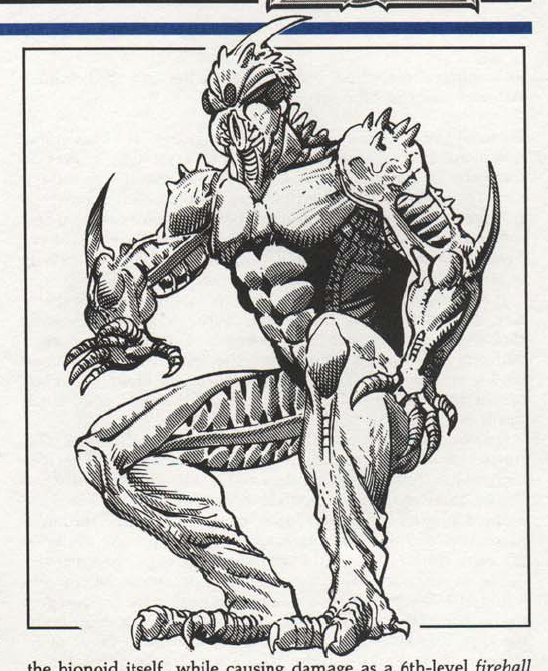
Elven Guyver

Here is the oft-mentioned Elven Guyver, “The Bionoid” from AD&D 2nd Edition game setting Spelljammer. Created by Newton Ewell, as pretty much all the anime influenced Spelljammer monsters were. Though oddly not drawn by him.

Be Sociable, Share!

Category: Anime, Role-playing Games

Tagged: , ,

NO ONE WANTS TO HEAR ABOUT YOUR ELF II – Player Characters

I play one type of character in role playing games. Gobshites.

Fighting can be fun, shopping less so, but I do enjoying just having a good old chinwag during an RPG session. Why wouldn’t you? After all you can kill monsters, take their stuff and sell it to buy more stuff in a videogame RPG. But thoroughly confusing a disguised Rakshasa by claiming that you are their long lost nephew can only be done in an unscripted game with room for improvisation.

Now I am not nuanced about this. I don’t spend ages building a character history for my PCs any more than I do my NPCs. They are schtick, a mouth and a piece of paper with stats on it. I frequently just play variations on two themes – the smart criminal and the heroic idiot. I’m not alone, I’ve found most people have character types they tend towards.

At one time it used to annoy me, but I embraced it. In my campaigns I now just throw in the same NPCs in again and again even if they’re in different continuities/universes. And I kind of treat player characters as different incarnations of the same characters. You can probably blame Leiji Matsumoto and Michael Moorcock for this.

Here are some examples of characters I’ve enjoyed playing.

1) Rusty Blade, swashbuckler, AD&D 2nd Edition, Spelljammer

Not the first character I played with the main group I’ve played with, that was a hobbit whose name I’ve long forgotten, but this was the first memorable character, in the first memorable game I played with them. In part it was memorable for the module we played, namely the awesome Wildspace, but a lot had to do with the gusto at which I could play the character.  Leaping into action with a quip and his wits to save him. Lots of fun.

Of course, the rules bending Vorpal Sabre he had probably helped on the bravado front.

2) Miguel Manticore, peasant hero, AD&D 2nd Edition, Dragon Mountain

My arch-heroic idiot, Miguel was a charismatic fool who dreamed of spending all the gold the party was hauling from Dragon Mountain on building a statue of himself in his home town. Eventually he carried swords as if they were golf clubs due to the sheer variety of modifiers on them and was responsible for the confusing of the Rakshasa. Based in part on Miguel from Ruin Explorers.

3) Larry, elf, AD&D 2nd Edition

This was a character that I inherited from another player. As I was away at university on and off for 4 years, I frequently ended up playing spare characters others had started. I noticed that his weight had been written down wrong on his character sheet and he apparently weighed 500lbs. Rather than correct the weight, I played him as a morbidly obese elf with appalling dietary habits and an appetite for trying new “foods”.

4) Carter Sharpe, Ragabash Glass Walker, Werewolf the Apocalypse

This character was pretty much my arch-criminal character. A grifter with mob connections he was pretty much the only character in a party of living weapons that could sweet talk our way out of situations. He often needed to given the tendency to smash things in the rest of the group. I was never overly keen on the World of Darkness, I tried to run Mage and had little fun. In what few sessions of Vampire sessions I played very little happened.

But the Werewolf campaign I was part of was a lot of fun, involving planting bombs inside vampires chest cavities, becoming the leaders of a paranoid anti-government survivalist group, using the back cover of the Tricky vs The Gravediggaz EP as a shopping list of vampire hunting equipment and battling Chronos. Yes, Chronos out of Guyver. We also had a homebrewed World of Darkness Guyver in our party.

5) Frederico Rodrigo, gnome illusionist/cleric, AD&D 2nd Edition, Thieves World & other realities

I remember this character less for what he did, and more for what happened to him. 

We had a guy in the group called Barry. Now I got accused of my adventures being weird plenty of times, however I could never compare to Barry. And that’s why I loved playing characters in his games. His Thieves World campaign was the first I was involved with (though I think the presence Sanctuary was the only real nod to the books) and this gnome was my character.

The thing about Barry was that he clearly loved magic items like the Deck of Many Things, but didn’t think they went far enough. So at one point he had a home made list of random magic effects that you rolled on with a d1000. In Frederico’s case the party encountered a room of magic mirrors, Frederico rolled on the chart and all of a sudden I had two characters to play one CG, the other LE. Eventually the LE sacrificed the CG one by pushing him off a magic carpet so he’d be eaten by whatever monster was pursuing the party.

6) “Captain Badger”, fighter/cleric/wizard, AD&D 2nd Edition, Forgotten Realms

I can’t recall the real name of this character, but he was from another Barry campaign. Again, he was an inherited character, so I went with the schtick that he claimed he was a ranger. He’d catch/buy all these animals claiming that he was using his ranger abilities. One was a badger that the party decided to make their honorary ship’s captain. Alas, badgers having low saving throws, he was not long for this world. But that didn’t stop his captaincy. We fashioned him into a glove puppet and his captaincy was stronger than ever as he could now talk.

This character also realised that while he could never tame a lion to be his follower, he could buy a lion cub and just cast haste on it until it was an adult, with the mind of a kitten. The campaign ended with nuclear bombs dropping on Faerun. I can’t recall why, but I think Gnolls were involved and also a crossover with Barry’s Underground campaign.

Be Sociable, Share!

Category: Role-playing Games

Tagged: , , , , , ,

NO ONE WANTS TO HEAR ABOUT YOUR ELF

Don’t tell anyone, but over the past year or so I’ve been reading RPG blogs. Probably since I put CUT IT OPEN… on hiatus. While those posts have been personal up to a point, in terms of the systems I’ve played, I’ve rarely talked about campaigns, characters, adventures etc. This is because I’ve tended to view such conversations as the worst. Some roleplayer finds out you play D&D and all of a sudden you’re in a two hour conversation about their Werewolf and how cool he is.

Well, I have bad news for you reader, this series of posts is going to be that conversation.

So why change my stance on such conversations? Well, in reading about other people’s campaign settings on RPG blogs, it’s made me realise they can throw out ideas you can steal, change your approaches & thinking with regards to role playing and they make me realise the breadth of different experiences people have with these games.

So let us get this started with talking about five things I like in my RPGs and five things I don’t.

NPCS

In writing (and writing is a pretty loose term) an adventure, it tends to come from what NPCs I want the PCs to meet and interact with, rather than an epic quest or awesome dungeon design. And from a player’s POV, I get the most fun when I’m engaging in dialogue with a fun NPC. Additionally I like to have recurring NPCs so there’s a sense of a supporting cast.

PC-CENTRIC GAMEWORLD

There’s some games that stress that the world of the RPG should not revolve around the player characters’ actions. I tend to feel that by default they are the main characters, as unlike everyone else in the gameworld they are being played by a single person. Plus one of the earliest AD&D adventures I played were those Ed Greenwood Forgotten Realms adventures where the PCs frequently have to stand on the sidelines while the NPCs move the plot along. Boo to that. That experience really made me want to do the opposite wherever I could.

LEAN RULES

My favourite RPGs have simple rule mechanics and ideally you can fit the rules on one page. Over The Edge, Call of Cthulhu, Feng Shui, Teenagers from Outer Space, Paranoia 2nd Edition, they are all simple and elegant rules systems.

META GAMING

Not in the traditional sense it’s used to describe outside knowledge to gain an advantage, but I’ll put information and events in adventures to deliberately get a reaction out of the players rather than the characters. My most ambitious attempt at this was a superhero campaign I ran over a year involving 9 different hero & villain teams and 9 different time periods. I also am a big fan of game worlds that extrapolate a strange logic from the curiosities in rule books (for example: Spelljammer).

COLLABORATIVE ADVENTURES

As I indicated, I don’t write adventures in detail, and so if the players while discussing the events and possibilities of the adventure think of something that sounds better, I’ll change it match their expectations. It’s that ability to improvise that makes me love pencil and paper RPGs so much.

TRAPS

I loathe traps. I loathe putting them in dungeons. I loathe players slowing things down searching for them. I loathe searching for them when I am a player. I loathe dying because I didn’t search for them. But there are a lot of weird sadist GMs out there, so much so Flying Buffalo put out GRIMTOOTHS TRAPS books that are nothing but traps. Boo to you Flying Buffalo for enabling these sickos. It’s worse than being indirectly responsible for Queen’s Blade.

RIDDLES

Nothing grinds a fast moving adventure to a halt better than having to answer some dumb riddle. Tolkien did it and now all the nerds want to have a go. Unless my character is getting a wish or a sweet magic sword out of this, I am not interested. And even then I will answer your crappy riddle under protest. The answer is always MAN.

DESCRIPTIONS

I am not interested in reading a location or object description out to my players that is any longer than 140 characters. It’s bad enough having to plough through that crap when reading a HP Lovecraft story, I don’t want to read it out loud OR listen to someone reading it out loud. And then have to ask questions because it was so long I forgot the beginning or couldn’t hear over James crunching his crisps too loud. Feng Shui has it right with the idea of simple location desciptions and then letting the players flesh it out in play.

BOOK KEEPING

Having to keep track of how long a spell lasts, managing carrying capacity, mapping, basically anything that makes playing a videogame RPG seem like a better prospect than using pencil and paper. I’ve tried a lets keep count of rations, what we’re carrying etc survival campaign, and less than month in, I’d throw it out the window.

OTHER PLAYERS

I’ve probably gotten off lightly, but there was the real ale flecked bearded racists who met in the Grimsby Conservative Club who I never saw again after one session, coming back from industrial placement to find our gaming group had disintergrated from one member cheating on their spouse with another member of the group, and finally the creepy weirdo with zero imagination, who had to be asked to stop attending. I’m sure you’ve had worse.

NEXT: I’ll tell you about my elf.

Be Sociable, Share!

Category: Role-playing Games

Tagged:

Cut It Open And See If It Swallowed Any Gems Part 27 – Underground

The best produced, best written, bad roleplaying game ever made.

For starters, what other RPGs boast a GEOF DARROW cover? Were full colour throughout? And printed on high end glossy paper? Just as an inanimate object, Underground was better than pretty much anything else on the market.

Sorry, Ray Winninger’s Underground.

Not entirely sure why Winninger got to prefix his game. Sure, he’d written some good DC Heroes material, in particular a Watchmen adventure and the great Watchmen sourcebook. But beyond that his name didn’t mean much to me.

It came out in 1993, and it shows. I believe the original plan was for three books, each satrising a different concept of heroism, with this one taking on the American ideal, and specifically superheroes. It’s a big old allegory for the treatment of Vietnam veterans, but with super powers and big guns.

It’s Marshal Law the RPG, basically. Which is fine, as I love me some Marshal Law.

I think the other heroic ideals to be dealt with that never came to fruition were the ideal of the Teutonic Knight (there’s some sketched in background involving Germany and the Church of Scientology iirc) and some form of “Eastern Hero” (wuxia infuenced maybe?).

I can’t say for sure because I sold it a few years ago.

Despite the setting and idea of the game being right up my alley, not to mention incredibly well written, the game itself is a clunker of a rule system. I never managed to run a game, the character generation alone drove me up the wall. A friend, Barry, managed to get a few sessions out of it, before he had the PCs cross over into his D&D campaign and we forgot all about struggling with Underground.

It’s a shame, because on every other level, the writing, the art, the production, it’s a great game. Everything works together to create this game world. Except the game itself.

Be Sociable, Share!

Category: Cut It Open And See If It Swallowed Any Gems, Role-playing Games

Tagged: , ,

Cut It Open And See If It Swallowed Any Gems Part 26 – Mekton

Hey gang, remember this? Posts where I talk about every RPG/Wargame/Boardgame I’ve played? Well it’s back.

And what better place to pick it up again, than R Talsorian Game’s mecha-themed roleplaying game, Mekton. Running on the same system as their Cyberpunk RPG, I picked up Mekton II second hand while at university. Then never got round to playing it. This is a recurring theme in my RPG purchases.

That didn’t stop me purchasing their next edition of the game Mekton Zeta, and its supplement Mekton Zeta Plus. While Mekton II, like earlier editions of Teenagers From Outer Space, didn’t really wear its influences on it’s sleeves, Zeta was clearly shouting I AM AN ANIME RPG. The cover had upgraded from Ben Dunn’s pastiche on Mekton II, to having the real thing in a painted Yuji Kaida cover. Inside you had a chapter called “Running Anime” that addressed how to get an anime tone to your games.

As good as the basic game was, once you added the Mekton Zeta Plus supplement, it really became the anally retentive mecha fan gamer’s dream. Not only would it let you create stats for pretty much any mecha you might want to imagine, the level of detail meant if had “official stats” for mecha (like weight/height etc) you could effectively reverse engineer a mecha into the game stats.

RTG eventually were involved in the second volume of the anime magazine V-Max, leading to anime gaming articles where you could see the power of that reverse engineering in practice. Do you want to pilot Giant Robo in a RPG? Well volume 2 issue 2 of V-Max gave you that chance.

Not that I did. Instead I ran a couple of heavily derivative campaigns of the my own design. The first was MYSTERY HUNTER ROBO. Which was basically X-Files with giant robots. Including one based on Ninjzz from The Bots Master. This is what happens when you players make their own robots. The problem I ran into was that only about half my RPG group liked anime. So after I put that on hold, we formed a splinter rpg & anime watching group and ran a sequel campaign called HADES EXPLORER Q. Or HEQ for short.

In that campaign the heroes travelled in the titular ship to another dimension called Hades where the villains of Mystery Hunter Robo (a terrorist organisation made up of dragons) had come from. They then got mixed up in the politics of that world while trying to prevent an invasion of Earth.

A third campaign, BONE MACHINE, never got off the ground and instead I returned to the campaign years later using a different anime themed RPG, but that’s another post.

Other campaigns I had sketched out but never ran included GIGA INFINITUS: THE BIGGEST ROBOT IN THE UNIVERSE and I.D.O.L. FORCE. The latter involved David Bowie forming a team of new robot piloting pop stars to battle his former team mates, the now evil Iggy Pop and Lou Reed. In the 70s the three had piloted a Getter Robo style combining mecha together.

If you are interested in finding out more about the game, check out MektonZeta.com

Be Sociable, Share!

Category: Cut It Open And See If It Swallowed Any Gems, Role-playing Games

Tagged: , , , , , , ,

Dynamite In The Brain – Episode 13 – Moose or Astromoose?

ditb12

Today we are joined by Ayacon Events Overseer, Jon Anning to talk anime themed RPGs. Hear tales of UK cons of yore, RPG in-jokes that don’t really work in the cold light of day, unreadable old conbook articles, Guyvers vs. Vampires, Brian’s voice gradually turn into the Fast Show’s Bob Flemming and much, much more. If your name is Barry you must listen to this!

RIFTS
Teenagers from Outer Space
Dragon Magazine Letter about using anime in D&D

Theme music by Paul Smith of quiet quiet band.

You can find Anthony Askew on the web here, here and on twitter here.

Subscribe on iTunes

Subscribe on Feedburner

Join our Facebook fanpage.

Category: Anime, Podcast, Role-playing Games

Tagged:

CIOASIISAG Part 25 – Over The Edge

My neck’s slowly getting back to game strength, so it’s time to return to my journey through my personal gaming history.

While a lot of gamers in the 90s were huge fans of Mark Rein·Hagen’s Vampire the Masquerade, I prefered Jonathan Tweet’s Over The Edge. The pair had created Ars Magica earlier in their careers, and their subsequent individual games are continuations both in gaming mechanisms and story elements.

However, rather than the abiding goth/metal/spiritualist/ecologist overtones of Rein·Hagen’s games, Tweet’s is (as a gamer I ran it with at university once said) Naked Lunch The RPG.

Taking place on the amoral Mediterranean island of Al Amarja, it’s a surreal thriller of game, one whose direction can vary greatly depending on the group of players. In part this is down the mix of influences Tweet brings the background of the game, but more over it is down the incredibly simple ruleset and the infinitely flexible character generation system it supports.

Like Tweet’s rewrite of D&D for the 3rd Edition, OTE is notable for being able to put the rules on a single page. Unlike D&D, it isn’t backing that up with pages of skills, spell lists, character classes, powers and monsters. Each character is described by three stats that are unique to them and a flaw. For anything else they either simply roll 2 dice for or they cannot do it at all. It’s a system that you can easily tear from the background material and use to for any material you want, as long as you’ve got a group who are willing to collaborate rather than play a RPG as some sort of contest between the players and the GM.

A typical Over The Edge game involves the player characters as tourists visiting (or fleeing to) Al Amarja. The why is usually down to the players, they might choose to start as a group or be thrown together by fate and the vagaries of Al Amarja’s immigration controls.

For instance, the last campaign I ran, the players were all recruited by a secret conspiracy who were battling a satanic children’s author in New York prior to being sent to Al Amarja to uncover the conspiracy said children’s author was part of. This being Over The Edge, both conspiracies were actually part of the same larger conspiracy, The Movers, a conspiracy so fractured, large and unwieldy that no one knows who is in charge (one published adventure explores this by having someone just decide that if they act like they are the leader it will have pretty much the same effect as if they were).

Having bought most of the material that was published for the game, I can safely say you can probably just get away with using the core rulebook. A lot of the adventures are fall between two stools, too detailed to improvise around, but not not detailed enough to hold you and your players interests. One of them is even a run around the sewers… Even EVERY Neverwinter Nights level designer figured that out as a setting, you don’t really need to drop money on clichés like that.

You’ll probably be able to put something better together using the vast amount background colour the rulebook provides and the characters your players create. The sourcebooks are stronger, and often have better adventures than the stand alone adventures, but they are not essential. Personally I really liked the Player’s Survival Guide, Weather The Cuckoo Likes and Friend or Foe? Thinking about it, while there’s nothing really essential in terms of supplements for running the game, the Survival Guide is definitely worth picking up. Lots of good ideas in there that go beyond just Over The Edge.

Easily in my top ten RPGs, the setting, rules and highly customisable character generation make it one of the best RPGs of the nineties. Possibly THE best. And if you are loving Durarara and like RPGs then you definitely want to pick Over The Edge up. Their mixes of the mundane, the weird and warring factions are pretty similar. Certainly enough that watching Durarara reminded me I had this post waiting to be finished in my drafts.

Be Sociable, Share!

Category: Cut It Open And See If It Swallowed Any Gems, Role-playing Games

Tagged:

CIOASSIISAG Part 24 – RIFTS

Remember what I said about Kevin Siembieda’s writing being like a fountain of mad ideas hitting paper? Rifts is that writ large.

Around 1990, an idea emerged in the games industry. It may have been born out of the sheer number of games on the market, or it may have come from the success GURPS enjoyed. That idea was a multi-genre, single setting, role playing game.

There were two main proponents of this approach. There was West End Games’ TORG, which I never played, but always wanted to. And then there was Palladium’s post-TMNT hit, Rifts.

Rifts is pretty much Siembieda’s previous games (Palladium Fantasy Role-Playing Game, Heroes Unlimited, Beyond the Supernatural and Robotech) thrown into a blender. You’ve got wizards, super powered aliens, Lovecraftian horrors and giant robots all inhabiting the same world.

Unsurprisingly, this means the game is horribly unbalanced. At least in the early editions. I have heard that the modern iteration of the game is more solid in its design. But back in the day you were dealing with a game system that got so out of control in terms of rules, character classes and settings that they ended up selling a separate index to the game.

That ran to two books.

They also produced a Rifts Colouring Book.

This situation was kind of the endemic of the games market as a whole in the nineties, as games began to choke on their own settings. While bad decisions like Dragon Dice were more the downfall of TSR, the sheer number of setting and settings in those settings didn’t help. Likewise, the World of Darkness line choked on White Wolf’s attempt to maintain some sort of in game continuity.

So you went from a market in the 80s that was distinguished by masses of games which led to the multi-genre games, to a market that was now distinguished by masses of sourcebooks for existing games. Either way you had lots of people buying lots of game books that they never used.

Your typical Rifts book would be full of poorly laid out background material for a geographical location that seemed to only exist to add a ton more character classes, magic and equipment options into an already stuffed to bursting game. Oh, and some new monsters to kill. Or play as Racial Character Classes.

Not all these classes were balanced either in terms of power or material supplied, and you were best not mix and matching between books or you might find yourself playing a wizard or dragon surrounded by ninjas jacked to the gills on cybernetics who spent every session fine tuning their equipment lists.

Despite that imbalance and rules/setting bloat, the fact that there is just so much utter madness slung together makes it a fun game. I had a great time playing a Time Wizard, blowing up evil pyramids in Glastonbury by sending bombs into the future.

Like Mutant Chronicles, Rifts was one of those 90s games that had ambitions of becoming a multimedia franchise. It did eventually make it to videogames. Unfortunately the Nokia N-Gage was the platform.

One last note, back when I first got on the internet at university, there was this DarkWorld RPG that was mentioned on rec.arts.anime. It was basically an anime flavoured rip-off of Rifts, that started off hiding its influence in a thinly veiled fashion like Mayfair’s unlicensed D&D accessories, before giving up with this file that just went ahead and listed Palladium stats for The Dirty Pair, Lum and The Sailor Scouts.

It’s not that surprising that it existed given Palladium’s history with Robotech and Macross II games, but the amount of effort that had gone into it still leaves me gobsmacked today. I’m a lazy gamer and do as little prep as possible, preferring to improvise, so this sort of exercise in cataloguing a world and stats is alien to me.

I’m presuming that the Tony Figueroa who wrote it is the same Tony Figueroa who is now the chair of the Fanime convention. Can anyone confirm that?

Be Sociable, Share!

Category: Cut It Open And See If It Swallowed Any Gems, Role-playing Games

Tagged: ,

CIOASIISAG Part 23 – Teenage Mutant Ninja Turtles & Other Strangeness

Back in June, when I last touched this strand of the site, I hinted that I was going to cover RIFTS next. Well it turned out that I’d forgotten to cover what was actually my first encounter with Palladium Books – Teenage Mutant Ninja Turtles & Other Strangeness.

Based on Eastman and Laird’s classic anthropomorphic Frank Miller & Chris Claremont parody, TMNT the rpg tapped into the same upswell in popularity that TMNT the comic had. It was a massively popular game, only suffering a down turn when the cartoon came along and the TMNT started to be seen as a kid’s thing rather than indie comic cool.

While it suffered a little from the Palladium’s somewhat perfunctory typesetting and layouts, it did benefit from being written by the late, great Erick Wujcik. While both Kevin Siembieda and Erick Wujcik’s books used the same rule system at heart, Wujcik’s are a joy to read, and feel like a complete product whose parts gel together. His own interest in martial arts really comes through and it feels like there’s a clear vision to his books. Siembieda’s on the other hand, often seem the work of someone trying to get every mad idea out of his head onto paper and not caring how they tie together. But more on that when we get to Rifts. Hoo boy.

I mainly played this during my teenage years, before selling it during the peak of the general Turtles craze in the UK. I picked another copy up later in ’96 when it seemed that 50% of Travelling Man’s second hand game stock were copies of this game. I think I’ve played a few sessions of the non-licensed follow up After The Bomb – anthropomorphic animals in a post apocalypse, but they were too brief to get a grip on what that was about.

Be Sociable, Share!

Category: Cut It Open And See If It Swallowed Any Gems, Role-playing Games

Tagged: , , ,

CIOASIISAG Part 22 – Talislanta

A short one this, as it was a blink and you’d miss it game for me. And for a change I’ll focus more on my own experiences playing it rather than the game itself.

Talislanta is kind of the anti-D&D in that it turns its back on the Tolkien-esque fantasy for some all together more alien. Think more along the lines the “Dreamworld” stories of HP Lovecraft. To get this point over it used to advertise itself with the slogan “No Elves”.

This is all well and good, except this was the time our most reliable Gamesmaster decided to get experimental for once in his life…

He decided he’d hide the game from us. No character sheets, no dice rolling, no concept of how the game worked. However he made the one BIG mistake you can make in a no character sheet game – he made our characters into idiots who had no idea of their limits.

Basically we had no idea what our characters considered themselves good at, and so we did very little. Rather than promoting roleplaying it made us all into cowards. It’s one thing to not be able to calculate your chance of doing Task A. It’s quite another to not know whether you’d be any good at Task A whatsoever. The campaign didn’t last long, and I think we were soon back to AD&D or possibly the next game I’ll write about…

Be Sociable, Share!

Category: Cut It Open And See If It Swallowed Any Gems, Role-playing Games

Tagged:

Podcast

Archives

Twitter