“Analyzing humor is like dissecting a frog. Few people are interested and the frog dies of it”. – EB White.
Like that is going to stop me.
The Seitokai Yakuindomo anime started recently as part of the summer season of anime. It’s based on Tozen Ujiie’s 4-panel gag manga that currently runs in Weekly Shonen Magazine. The gags are hung on the premise of an all-girls high school having to open its doors to male students due to a falling birth rate (Gakuen Utopia Manabi Straight! also uses falling birth rate for a springboard). The main characters are three girls on the school council and the boy they press gang onto the council to represent the new gender in the school. So far, so cliched. School councils and press ganging people onto committees seem to be some of the most popular “me-too” ideas in manga and light novels at present.
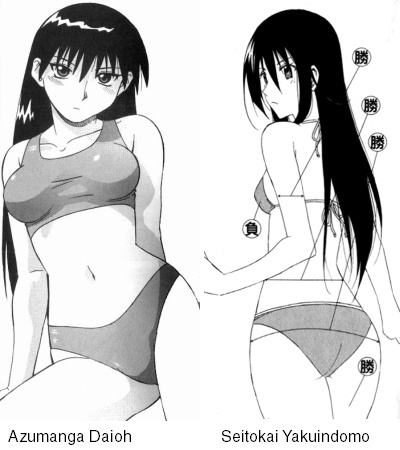
The manga of Seitokai Yakuindomo stands out from its peers and influences on two main points. First off, it’s very low on fan service. In fact in terms of art it’s less salacious than Azumanga Daioh. Compare these bikini pin ups, Tozen Ujiie uses far less suggestive angles than Kiyohiko Azuma, who seemed to love that “looking up at boobs” angle more and more as Azumanga Daioh progressed.
The second point is in direct contrast to the first, indeed without the first it would not be as effective. Namely, “dirty jokes”. Obviously this is hardly unique, we’ve already had B Type H System adapted this year, another series whose female lead is sex-obsessed. The differences are that Seitokai Yakuindomo isn’t visually explicit, there’s no romantic underpinnings and while the lead does/says stupid things, she isn’t a complete idiot. Just a partial one when the gag demands it.
Most of all though, the series is highly focussed on gags over characterisation. The four main characters are basically there to be shuffled about into various combinations to set up and deliver gags. In fact they are barely characters. You’ve got Takatoshi (male, defacto straight man), Shino (President of the Council, sex-obsessed), Aria (busty, tells dirty jokes) and Suzu (super-intelligent, comically short). They’re basically hooks to hang jokes on.
A typical gag set up will be as follows:
* Character A says something ostensibly serious.
* Character A then says something stupid/incongruous to the setup.
* Character B reacts to it.
Normally it will have the same character deliver the setup as the punchline, rather than break it down to a standard feed/comic distribution of roles. The straight man often only comes into play in the last panel, commenting on the idiocy that happened in panel 3.
This is why I don’t feel it’s setting out to shock by using “dirty jokes”, but rather just using sex as the incongruity. Sure, the toilet talk adds a frisson to the joke, particularly as the comic doesn’t try to be sexy, but the funny is in how it gets from something perfectly clean to something dirty. It’s cleverer than just drawing a cock on a blackboard (which is still admittedly funny). There’s other joke formula they use (and over use) like Suzu being too short to do something and something innocent looking like something rude from a certain angle, but the one above is probably the most common so far. It’s all very music hall, rather than out and out shock humour.
The anime on the other hand is different beast to the manga, and that’s what I really want to talk about here. If you weren’t aware of the manga, then from a distance the anime might just strike you as your typical slightly smutty otaku bait shows. One thing that really adds to that is the colour palette chosen. Seriously fuck this colour palette. Particularly when it saturates the incredibly dull opening sequence of episode one, playing like the opening to some dumb erotic video game being adapted into animated homeopathic porn. You know what palette I’m talking about.
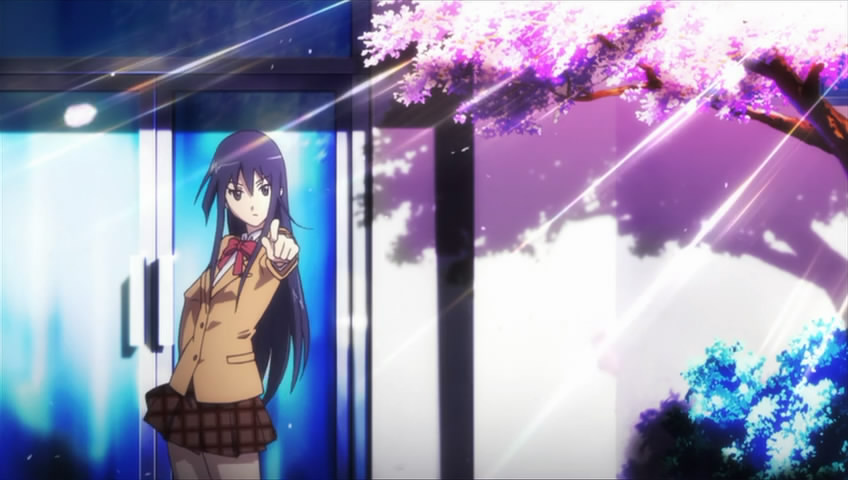

Yeah, that fucking palette. There’s some blue-green in there too, but the backgrounds in that opening are awash with oversaturated pastel blues and pinks. The blues should be complementary to the browns of the school uniform (at least in the RGB spectrum), but they are so oversaturated that they overpower the characters. The pink just makes it so much worse. This sort of thing is what annoys me the most about modern anime, moreso than poor hat animation!
After a couple of minutes of this opening that seems to go on forever, we get an opening animation full of brazen dick jokes and one of those tedious peppy J-pop songs (not to mention some ludicrously ambitious panning animation).
Then we get an even more ludicrous 3D shot to set up the first gag. Which isn’t that great so let’s skip to the second gag, based on the second 4 panel strip. Prepare to have any humour present killed by over analysis.
Panel 1 / Shot 1
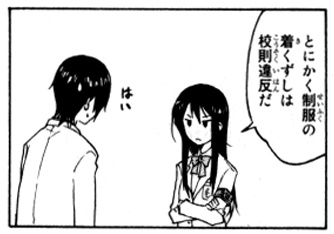
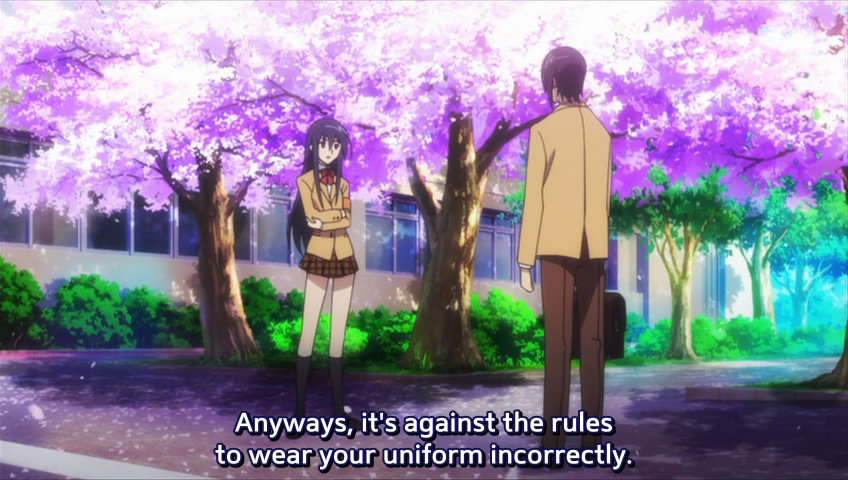
The anime flips the characters around, and pulls the focus from them by filling the screen with a busy, garish background that overpowers the layout. Apart from that it’s pretty much adhering to the strip.
Panel 2 / Shot 2
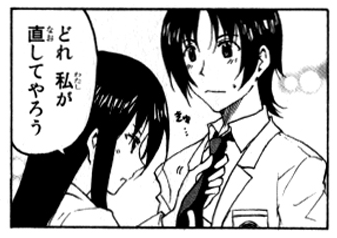
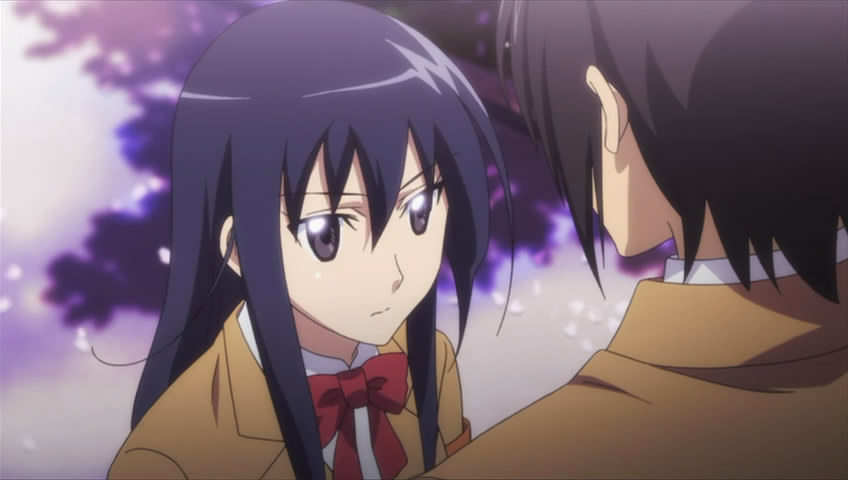
Here we get a complete change in camera position, as the middle two panels are pretty much the same shot it in the original. By changing the shot, the anime can recreate the beat made by the movement from one panel to another.
Panel 3 / Shot 3
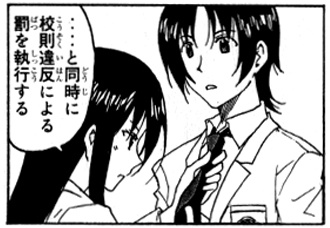
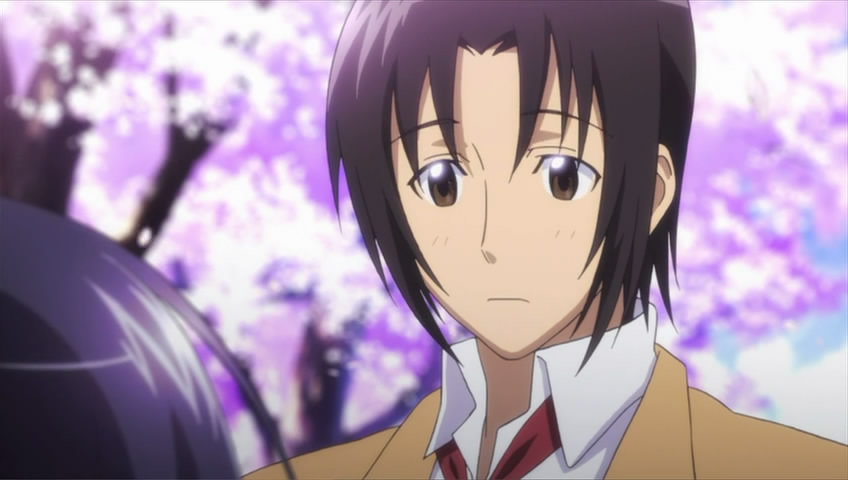
Here the shot is much closer to the original layout, however we now get a budget saving move come into play, where the anime hides the mouth of the character talking off screen. Hooray, one less thing to animate!
Panel 4 / Shot 4
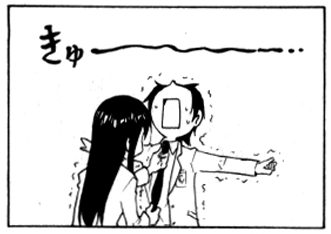
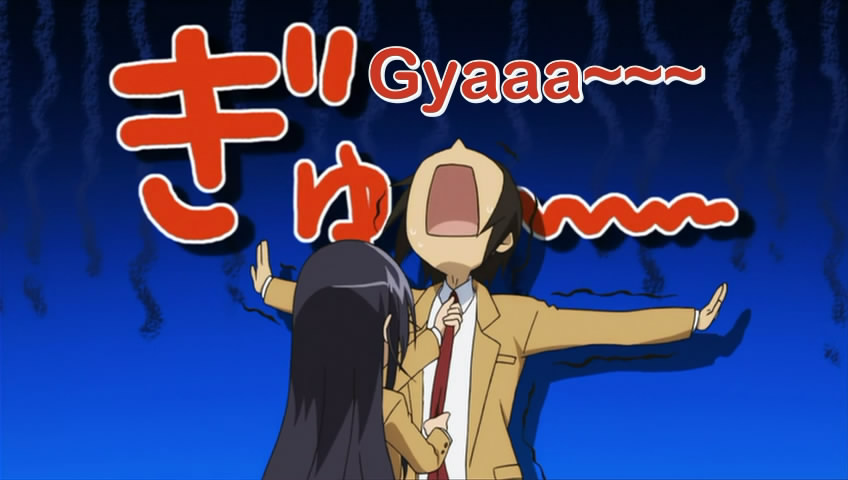
And finally, the punchline is delivered with a shot that’s pretty much straight out of the manga. However, the anime has second response shot that it adds…
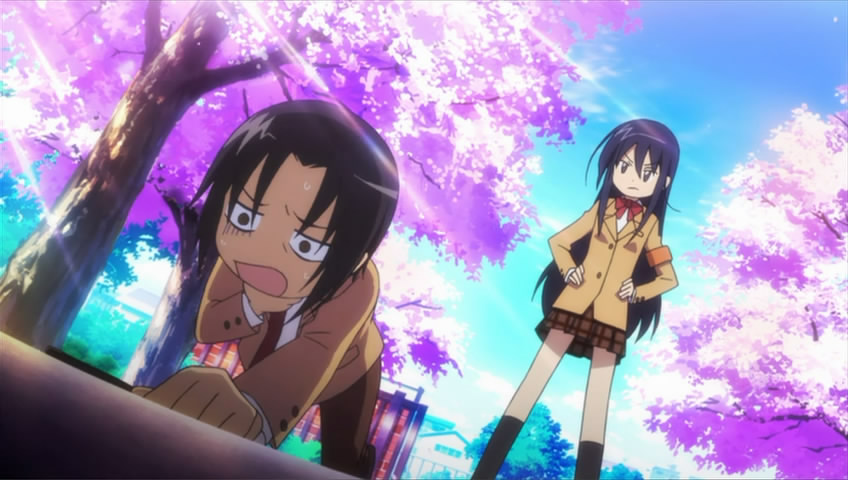
This is the sort of shot that doesn’t really happen in the comic, if only due to the restraint of the 4 panel half page format. It’s one place where the anime can take advantage of it’s medium.
Now while that’s not the funniest or the most typical gag on the show, it does demonstrate what the show does best – nail the rhythm of a 4 panel gag strip.
Here’s a few other notes on how it takes advantage of the medium:
- Movement. Gags that rely on movement (e.g. the kick with the shoe flying off the foot) are framed to take advantage of actual movement.
- Asides. Not super-keen on this technique, if only because it’s been done to death by Family Guy, but it will throw in extra shots to illustrate something said, rather than keep to the proscenium leaning step ups preferred by the manga.
- Visual gags. Similarly it will sometimes add visual gags to the background that weren’t present originally. The best example is the strip where Aria’s suggesting boys might join the school to start a harem and in the anime we see someone in the background clearly hoping for just that. That strip’s anime version is also a good illustration of the asides the anime uses, as we get asides to both an 80’s style sex comedy and a Maria-sama ga Miteru style show to match what Aria’s suggesting.
However, as good as the anime is adapting individual strips from the manga, there’s a couple of flaws.
Firstly there’s the issue of repetition, both in terms of the structure and the punchlines. The structure of the jokes can be so similar, that over half an hour it can get wearisome. Add in the fact that so many punchlines seem really similar in the first episode and I wouldn’t blame you for tapping out. Personally I found enough to admire in the mechanics of it to push on, particularly as most of these sort of adaptations let the air out of the gags, and this gets the rhythm right. You, on the other hand, might find the amount of times Shino turns the conversation towards periods somewhat sapping.
The big flaw though reveals itself in episode 3. Or rather in the preview to episode 3. It just gets confirmed in episode 3.
One of the anime’s gags is that in the preview the characters mention what pages from the manga they are adapting next week. Episode 1 covers the first 32 pages, episode 2 covers pages 33 to 56, episode 3 on the other hand only covers page 57 to 60.
Four pages. In a half hour anime. Even Naruto manages more pages than that.
What this meant was we were going to get lots of anime “original” material. And by original I mean they turned the show into exactly what you might have thought it was going in. We get a load of fanservice, gags that outstay their welcome and finally, accidental bestiality.
There’s a fine line that the manga walks with its dirty jokes and in episode three the anime takes a running jump over that line. There’s clues that the screenwriter’s sense of humour might not be on the same page as the comic’s in the first two episodes, but by episode three it becomes crystal clear. The big problem with it is they don’t have the character Takatoshi around to act as straight man to Shino and so her digressions into stupidity go unanswered. Without someone to annoy them in the show, idiots are just annoying you the viewer. Plus she seems more idiotic when the anime screenwriters write her without the original manga’s scripts to base the gags on.
In short, it’s a really awful episode.
Episode four promises more manga adaptations so hopefully that will get back on form, though given how bad episode 3 was that’s the only chance I’m giving it.
If you do have an interest in the mechanics of gag anime I’d definitely recommend the first episode at the very least, as to me it felt much closer to the sort of shows we got during the dawn of late night anime than we get nowadays.
Oh, and the ending animation is really well made, to the point where you’ll wish you’d seen whatever show from an alternate reality it really belongs to.