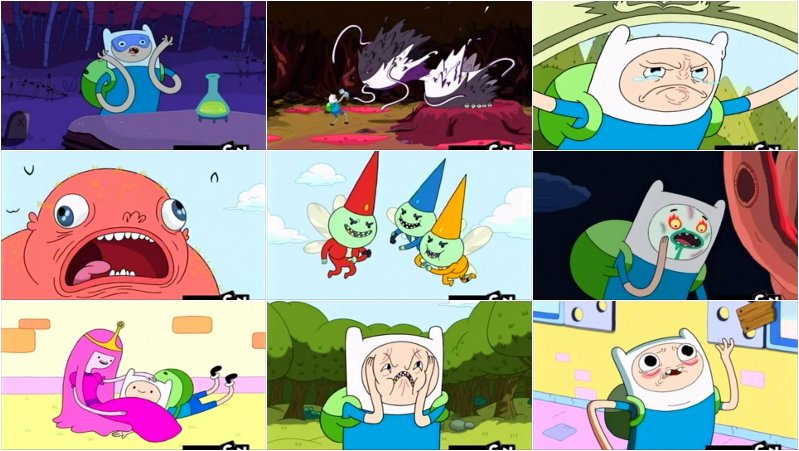
Adventure Time with Finn & Jake – Episodes 1 to 3

Algebraic!

It’s not just Japanese cartoons for kids that I watch, I also watch American cartoons for kids. Most of my search traffic over the years has been for the early post I made about Chowder. It’s now roughly half-Chowder, half-Violence Jack. Oh what have I wraught?

I was all over the original Random! Cartoons short for Adventure Time like a hot rash, pointing it at everyone I could. Once it was announced it was getting a full series on Cartoon Network I was super-stoked. Eventually it arrived and it’s probably my favourite cartoon on right now (close race between this and The Tatami Galaxy).

While it’s not quite the same (Finn is now the original Finn voice’s younger brother. AND he has a different coloured shirt), it is still as awesome. Unlike Cartoon Network’s other new PG rated show, the thoroughly obnoxious Generation Rex, Adventure Time is incredibly charming, despite being violent, scatological, horrific and generally a bit odd.

Not to mention, like all great TV shows for children, it’s fairly traumatising on a regular basis.

If you’re an American or can play one on the internet, you can watch episodes on the Cartoon Network website, so check it out.

Be Sociable, Share!

Category: Animation

Tagged:

The Tatami Galaxy – Episode 1

Boy has overly romantic view of college life. College life fails to live up to his fantasies and he becomes the enemy of romance, via the “help” of a trouble causing friend. Possible divine intervention occurs.

Let’s get the major issue with The Tatami Galaxy out the way first. It is very wordy. I think the wordiness itself is more of an issue than the rate at which the words are delivered (very fast).

I’m not sure if this wordiness is born from it being an adaptation of a novel, or if it’s a specific creative choice. I’d guess the former, simply because Masaaki Yuasa’s other works aren’t wordy in this way and novel adaptations in anime (and elsewhere) find themselves driven by internal monologue in the same way this episode was. Not having access to the original text though means that’s all guesswork on my part, so take it with a pinch of salt. Another difference between this and previous Yuasa projects is the involvement of playwright Makoto Ueda (Summer Time Machine Blues, Go Find a Psychic!), so that may also have influenced the verbosity of the production.

So, having established that monologues are often par for the course for these sorts of adaptation, how does The Tatami Galaxy deal with it? By going about three times as fast as anyone else would go.

That works well in terms of giving the episode a rhythm to work to, but it presents challenges in watching subtitled animation that don’t necessarily exist with conversational dialogue at the same speed. The rhythm of back and forth dialogue lends itself better to rhythms of reading and watching animation than more complex monologues do. If you want a comparison with an English language cartoon, try to imagine watching Tex Avery’s Symphony in Slang with subtitles. Even then, the narration seems positively sedate compared to The Tatami Galaxy‘s. I wonder if the between narration beats that Avery leaves are also present in Tatami Galaxy, but lost when you have to read as well.

I thought I had coped perfectly well, and never felt I was struggling, but going back and watching again without subtitles, I discovered images and details in the animation I’d completely overlooked. That’s fine however, as it’s a joy to watch again and again (though I didn’t go quite as mad with it as I did Kemonozume‘s opening episode which I’d watched three times before I even had subtitles to go with it).

So don’t let the machine gun monologues put you off, as ultimately it is a very minor quibble for what is likely to be one of the best TV shows of the 21st Century.

Visually it’s a treat. It’s full of fantastic shots, movement and character design. Despite it looking different, once again, from Yuasa and Nobutaka Ito’s previous collaborations, you can still tell it is their vision that is driving the overall look of the show. That has a lot to do with the fact that not many creators working in anime would have created a cast of such diverse body shapes and facial features, something they also did in both Kemonozume and Kaiba.

In this episode you’ve got the relatively normal looking lead and the object of his affection, Akashi (though she too is not above cartoon warping of her form), and on the opposite side of the design spectrum, the devilish looking Akashi and a god of matchmaking who’d give Popeye a chinferiority complex.

Ozu is clearly the character that people are going to have most fun animating, and his voice actor Hiroyuki Yoshino (Kazuma Momota in Kemonozume) seems to be relishing the scenery chewing the role gives him. It’s great to have cartoon characters who act like they are. And the final scene he’s involved in this episode leaves so many questions unanswered that you’ve got see more.

If you are in the US you can watch this via Funimation’s various portals, which is great news for Americans who like awesome animation. The rest of us outside of American or Japan will have to use the Evil Powers of the Internet to get to it. It’s worth it either way, as it is just a joy to see something both this idiosyncratic and this well made.

Be Sociable, Share!

Category: Anime

Tagged: ,

PAST MY BEDTIME PART VI – Animation, backwards.

Fuji TV’s toying with late night anime was somewhat sporadic in the early part of the 00s. With titles like Full Metal Panic Fumoffu, Texhnolyze, Girls Bravo and Samurai Champloo, it felt as hotch-potch as TV Tokyo or TBS’ schedules, albeit in much smaller portions.

In spring 2005, that all changed.

A programming block called noitaminA began on April 14th 2005, opening with an adaptation of Chika Umino’s manga Honey & Clover. The aim was to create anime for an audience outside of the young men who most late night anime was being aimed at. As I noted in Part 2, NTV’s Nana adaptation took off around the same time (April 5th). While that was a success, they didn’t continue to mine the adult female audience in the same way that noitaminA did.

Some people make the mistake in thinking that in the mere act of not alienating women, noitaminA is aimed solely at them. Only five have been adapted from shojo or josei manga (though admittedly two have come back for sequels) and while one was originally intended to be adapted from a shojo manga (Genji Monogatari Sennenki), it ended up as something different.

The remaining shows have either been original material, shonen manga, seinen manga, novel or play adaptations. The real appeal is simply that the shows are being made for non-otaku adults. It’s telling that Honey & Clover, Hataraki Man, Hakaba Kitaro (as GeGeGe no Kitaro), Nodame Cantabile, Antique Bakery and Trapeze have had live action versions, this is material that naturally has a wider appeal than just the “typical” adult watcher of Japanese cartoons. Moyashimon is next to get a live-action show, in the noitaminA slot itself and apparently there are plans for a Paradise Kiss live action film.

I originally thought that the Moyashimon live action could have been a possible death knell. If it gets better ratings, surely it would be better to put live action in that slot more often? However, they’re extending the slot this month to run an hour and we’ll now get two shows in the slot at a time. So I was probably panicking over nothing.

Between NTV’s schedules and noitaminA the discerning, but lazy, adult anime viewer who dislikes the trends of late night anime elsewhere should find something to enjoy. Sci-fi fans might have to search elsewhere mind, as might people like me who want interesting animation above all else. Like NTV’s shows, while the material noitanimA delivers is usually strong, it’s not always guaranteed to match that in the visuals (though their hit rate is probably stronger than most anime slots).

Honey & Clover – This is one of those shows, like Genshiken, where I got to an episode and thought “It can’t possibly get any better than this” and stopped watching. In this case I think it was the Twister episode, though it’s been an age since I watched it so I might be wrong. Anyway this is the show where Kenichi Kasai broke out from the pack in terms of being a director whose work was really recognisable, and well worth your time. It’s quite possible that anime would look very different without it.

Paradise Kiss – I believe I first encountered Osamu Kobayashi’s work with his End of the World short and the inclusion of Lolita No. 18 in the opening scene made me an insta-fan. Unlike many other people working in anime, with Kobayashi you have the sense that he has a frame of reference outside of other anime (see his Charles Schulz/Jean-Luc Godard mashup ED for Hanamaru Kindergarten). While this, like his work on BECK, is Kobayashi filtered through the visuals of the manga it’s adapting, it still feels identifiably his work. The sexuality, the ultra realistic backgrounds, and the trademark ED sketches, you aren’t likely to mistake it for somebody else. Even the choice of Franz Ferdinand‘s “Do You Want To” as the ending theme seems a particularly Kobayashi choice given the visual name drops they got in BECK.

Ayakashi: Samurai Horror Tales - I tried this at the time it was airing, but the first story didn’t do anything for me and so ended up missing the piece de resistance of this horror anthology – Bake Neko. Kenji Nakamura’s tale of a mysterious Medicine Seller made enough impact to warrant the spin-off series Mononoke.

Jyu-Oh-Sei – Shojo manga adaptation I know nothing about. It is dirt cheap on play.com at the moment though – worth getting? I’ve liked some Hiroshi Nishikiori shows, but I find he tends to be as good as his material.

Honey & Clover II – The rest of the manga finished off by the not as good as Kenichi Kasai director, Tatsuyuki Nagai.

Hataraki Man – Competent adaptation of Moyoko Anno’s publishing manga. There’s a tendency to over-praise shows that simply offer a different sort of narrative by dint of the material they are adapting. Hataraki Man is one of those shows. It lacks the visual flair of Honey & Clover or Paradise Kiss, instead favouring slick but forgettable interpretations of Anno’s art.

Nodame Cantabile - Hot off a TV dramatisation, Tomoko Ninomiya’s tale of classical musicians in love came to noitaminA. Honey & Clover’s Kenichi Kasai was in the director’s chair and brought as similar delicate touch to this material. The biggest hit of the noitaminA slot, it’s third and final season just ended this year.

Mononoke – Sequel to Ayakashi’s Bake Neko arc, I wrote about it here.

Moyashimon – Like Hataraki Man, this suffers a little from resting on the laurels of the premise of the manga it’s adapting. Of course, the premise is a doozy – an agriculture student can see and communicate with microorganisms. Add to that the strong design of microbes and it adds up to a successful show. The live action may actually work better by limiting the animation to the microbes. We shall see.

Hakaba Kitaro – The 6th TV adaptation of Shigeru Mizuki’s supernatural manga, this time using the original name rather than the GeGeGe no Kitaro name popularised by the previous five anime series. This is to reflect the darker nature of the show and how it adheres closer to the plot of the original book. As good as the show is, it’s overshadowed by the opening animation by the Mononoke crew.

Library War - Production IG adapted Hiro Arikawa’s light novel series about militias formed by library’s to battle government censorship. It’s a bit like Patlabor crossed with Fahrenheit 451. Despite loving the opening episode I got distracted by Soul Eater and Golgo 13, so never watched any more.

Antique Bakery – In fact so distracted was I, I never noticed this was a noitaminA show. And so I have nothing to declare but my own ill-observation.

Nodame Cantabile: Paris - More classical musicians in love action, but this time in France and directed by Chiaki Kon.

Genji Monogatari Sennenki – Osamu Dezaki does the Tale of Genji via the roundabout route mentioned earlier. Had very little interest in the anglophone fan scene, I caught the first episode, but the wait for more meant my interest had dwindled by the time more were available.

Eden of the East – Another show that I’ve only caught the first episode of and want to see more. Arguably the noitaminA show with the highest expectations on its shoulders. It was original material (at this point Bake Neko/Mononoke was the only other show fitting this bill), had character design by Honey & Clover author Umino Chika, was developed by Production IG and created by Kenji Kamiyama (Ghost In The Shell SAC, Guardian of the Sacred Spirit). Furthermore it was developed with spin-off feature films (designed to conclude the story) in mind. It’s an interesting approach, and while it didn’t set the box office on fire, I wonder if low level theatrical releases of material that is essentially OAV episodes of a TV series are more economically worthwhile than a straight to DVD/BD release.

Tokyo Magnitude 8.0 – Talking of original material, here we have BONES joining the fray with this disaster TV series. While I can see why people like it, for me it sits in the realm of animated series that are only animated because the live action budget would be prohibitive. Plus it suffers from writing that doesn’t seem to take into account what makes effective animation. Crowd scenes for instance are easy to write, notably harder to animate effectively.

TrapezeMononoke‘s Kenji Nakamura returns with what is easily the most experimental of all the noitaminA shows. Masaaki Yuasa’s Mind Game is probably the closest visually in terms of the mixed media collage that Nakamura uses here. It’s not as effective as Mind Game, nor as polished as Mononoke, but the ambition just about pays off in the finished show. The quirky psychiatric drama of Hideo Okuda’s novels is delivered in an episodic format, but they act as individual layers of a larger whole as it dawns on the viewer that all the episodes happen over the same period of time and the stories overlap and intrude on one another.

Be Sociable, Share!

Category: Anime

Tagged: , ,

New Anime I Failed To Watch

I had in mind that I might do lengthy first episode reviews again like in January, but the fact of the matter is that with a new Masaaki Yuasa show starting soon and Adventure Time starting last week, I really had a hard time sitting through cartoons that weren’t pushing my buttons. So here’s some I tried watching, but gave up before the end.

I did watch all of the first episodes Arakawa Under The Bridge and Giant Killing however, so I will give them their own posts eventually. It may take me watching a few more episodes of them first. With shows I like, I often find it takes two or three episodes before I can really vocalise what I love about them.

Whereas the hate comes straight from the gut. And here it comes now!

Ichiban Ushiro no Daimao
Endurance: 1m39s
Why I gave up: Cheap animation, charmless character design, charmless performances. The weird shot of the lead turning his head from looking at the information board at the station.

Angel Beats
Endurance: 12m17s
Why I gave up: Character design by someone who clearly doesn’t have to try and make it move. Lack of weight to the animation. Plus the general Visual Novel aesthetic. Actual idea is perfectly fine, execution is execrable.

Mayoi Neko Overrun
Endurance: 7m5s
Why I gave up: The non-stop incessant chatter of characters who sound like they are just imitating the cadence of umpteen other light novel based shows. It wasn’t funny. Occasional bits of nice movement in the animation were not enough to press on further.

Senkou no Night Raid
Endurance: 8m53s
Why I gave up: A-1 doing their best/worst Production IG impression. Or possibly Bee Train impression. The sedative effect it had on me suggested the latter. Character design that doesn’t look like it was designed for A-1′s strengths, and stiff movement that suggested likewise.

Most importantly: too many hats that didn’t look like they were really being worn. My experience in watching cartoons and reading comics is that a Fedora or a Bowler is really hard to draw to make it look like they have the right weight & shape and appear to be firmly sitting on someone’s head from all angles. Sometimes they get it right here, but often it’s really distracting. Particularly as so many hats are being worn.

Be Sociable, Share!

Category: Anime, Hate Fun?

Tagged: , , ,

PAST MY BEDTIME PART V – Wonderful.

I’m going to get around to TBS’ late night anime in general later on, as it is taking a little longer to get a good overview of. Early on there seems to be more of collaboration with non-Tokyo based broadcasters in production of the shows, so I want to see if I can figure all that out first.

Instead, I’ll begin with looking at show that’s part of a lineage of anime that represents both its past and its future – Wonderful.

TBS’ Wonderful slot ran Monday to Thursday, 23:55 – 24:50 from 1997 to 2002. It contained a variety of content, of which anime was but one element. What unites a lot of the series that Wonderful featured is that they were based on gag manga.

Ping Pong Club
Director: Masami Hata
Studio: Grouper Productions

Table tennis themed juvenile delinquency. Brought to the US by CPM. Uniqlo have some Ping Pong Club T-shirts coming out soon. Of course they do.

Sexy Commando Gaiden: Sugoiyo!! Masaru-san
Director: Akitaro Daichi
Studio: Madhouse Studios

Kyosuku Usuta’s first major work got this anime adaptation on its completion. It is near perfect, actually improving on the manga. One of my favourite TV anime of all time.

AIKa
Director: Katsuhiko Nishijima (who else but!)
Studio: Studio Fantasia

TV broadcast for the first 4 episodes of the underwear obsessed action OAV. Nishijima must be the anime industry’s top lingerie fetishist, but he’s also a solid animator.

Futari Kurashi
Director: Futa Morita
Studio: Public & Basic

I remember the video release advertised in Newtype back when I was buying it in the late 90s, but history seems to have completely forgotten it. Here’s the truly awful opening, see if you can figure it out.

Super Radical Gag Family
Director: Akitaro Daichi
Studio: Studio DEEN

Scatological buffoonery. For everything bad I say about Studio DEEN post-Kitty’s demise, they have had a decent track record with minimal budget gag shows.

Momoiro Sisters
Director: Noburo Shirohata – I believe this is the name Bob Shirohata (Hetalia) used to use
Studio: Studio DEEN

Hardly a moe show, but this Young Animal manga turned anime contains a lot of the elements that were popularised in moe shows during the coming decade (or possibly un-popularised, as the Anime Encyclopedia suggests that Wonderful outperformed most standalone late night anime). It’s a gag strip for an audience of young men, about elements of the lives young women that young men may not be privy to, written by a woman, Tamami Momose (Doki Doki School Hours). Unlike the shows that followed in its path, it’s much more bawdy and explicit in its approach, having more in common with Ebichu than Chu Bra.

Let’s Nupu Nupu

Director: Issei Kume, Jouji Shimura, Shigeru Kimiya, Kazuhiro Sasaki
Studio: ????

Another gag manga adaptation, this has elements of absurd comedy, sexual comedy and manzai. With those last two elements oddly tied together in the skits involving a school nurse sexually harassing one of her pupils. They have the manzai style, but with the boke’s idoicy manifesting in the sexually harassment of the tsukkomi. Given that no one over-riding director or studio is listed, I wonder if the material was split up between them, as there’s little to no overlap in the scenes of the perverted nurse, the cat, the hamster and the Melmo parody that make up the show.

Only · You: Viva! Cabaret
Director: Mitsuo Kusakabe

I have no idea about this show. Even the Japanese wikipedia page is distinctly lacking detail, let alone there being much English language information.

If I See You in my Dreams
Director: Takeshi Yamaguchi
Studio: J.C. Staff

This got an release in the US via ADV. Despite that I had never heard of it until writing this post.

Most Spirited Man in Japan
Director: Hiroyoshi Yoshida
Studio: Studio DEEN

According to the Anime Encyclopaedia this got a 9.2% rating. That seems insane compared to what typical late night anime get. Haven’t found any stats for other shows in this slot (annoyingly I used to have them years ago, but threw them out) so I don’t know how accurate that is or how it compares. It’s another show that Bob Shirohata worked on, this time as Animation Director and now using the Bob name.

Iketeru Futari
Director: Hideki Okamoto / Takeshi Yamaguchi
Studio: Geneon Entertainment

Despite the tiny running times, this sex comedy still feels really slack. Avoid.

Petshop of Horrors
Director: Toshio Hirata
Studio: Madhouse

Like AIKA, another OAV on TV

You’re Under Arrest Specials
Director: ????
Studio: Studio DEEN

Shorts of the Kousuke Fujishima light-hearted cop manga. Not seen them, but I’d imagine that the manga is probably best served by this format.

Most Spirited Man in Japan 2
Director: Hiroyoshi Yoshida

Studio: Studio DEEN

More from this hit sex comedy.

SURF SIDE HIGH-SCHOOL
Director: Hiroyoshi Yoshida
Studio: Magic Bus

Ken Sawai’s almost unfinished manga (he finished it off this year in collections) got this brief, and mostly forgotten, adaptation.

Let’s Dance With Papa
Director: Bob Shirohata
Studio: Studio DEEN

Adaptation of Chuya Chikazawa’s long running gag manga.

COLORFUL
Director: Ryutaro Nakamura
Studio: Studio Wombat / Triangle Staff

The most successful in the US/UK of the Wonderful shows, this gag manga compilation from Torajirou Kishi’s original work got a release from ADV and aired on G4.

Ippatsu Kiki Musume
Director: Hiroyoshi Yoshida
Studio: Group TAC

This is great. A rare combination of cerebral and slapstick comedy as the laws of physics are applied to life threatening farce.

Itsumo Kokoro ni Taiyou wo!
Director: Hiroyoshi Yoshida
Studio: Studio DEEN

I have zero idea what this about. Has the same name as the Japanese translation of the Lulu film “To Sir, with Love“. There was also a song by that name used on an earlier anime – and that’s what you get when you do an image search. So no image for this one.

I do note that the mystery person Hiroyoshi Yoshida is involved in many of these final shows. They then appear to have had no career in anime after this. Anime Encyclopaedia lists them as Tokio Yoshida and Nobuyoshi Yoshida, rather than the Hiroyoshi Yoshida that Anime News Network uses. But those names lead nowhere when searching for other works too. Possibly pseudonym?

Di Gi Charat
Director: Hiroaki Sakurai
Studio: Madhouse

It’s somewhat fitting that Di Gi Charat should close Wonderful’s anime programming in 2000, as it feels like the transitional phase in the move from the sharp edged gag manga that many Wonderful shows were based on, to the softer gag manga that many of the modern shows are based on. Plus it has an otaku in-joke element missing from a lot of the Wonderful shows that would be driven into the ground over the next decade. This particular incarnation is still weird and misanthropic, even with the cute designs for the female leads, but it would get cuter and less funny as the years went by. And also they would move to morning slots on the weekend.

While we’ve not seen such a concentrated amount of spikey, often outright ribald, gag manga adaptations in subsequent years, in terms of form, you can point at a number of shows that follow in their footsteps. Frequently low budget and with short running times, the Wonderful approach represent the ideal form for animation for the web. It’s no coincidence that the recent big web anime hit, Hetalia Axis Powers, is directed by Wonderful alumnus, Bob Shirohata. Even if you don’t like the material, in terms of its format and direction, it’s definitely one of the better gag anime in recent years.

Akitaro Daichi of course has enjoyed success all over the schedule and in a variety of forms, but his work on Gag Manga Biyori has clear echoes in his Wonderful shows (Sexy Commando, Super Radical Gag Family). Other shows like Astro Fighter Sunred also share the “give a joke the right amount of time” approach that many of these short form anime have.

It’s not all good news on the gag anime front. In the wake of Azumanga Daioh (is there an earlier precedent I’m unaware of?), we’ve also had the rise of the moe gag manga and their anime adaptations. Though once again, the moe-ness (moeosity?) is probably a red herring.

In some cases the flaws in the anime are inherent in the source material. Hidamari Sketch is relatively free of the chuckles because the original strip is just as anaemic as the anime. The anime might be better than the wet lettuce that is the manga simply because it has the usual clever SHAFT shots that cover a multitude of animation sins. Well one really – too much talking, not enough moving.

On the other hand Kyoto Animation’s Lucky Star and K-On anime actually have jokes in them, but it frequently feels like they are sabotaged by being dragged out to fill the allotted time. Considering that many are pretty weak jokes to begin with (especially in Lucky Star‘s case), they just can’t survive this bloated approach. If they animated the same material in half the running time and added less lackadaisical soundtracks, then the series would be much improved and closer to the quality of their manga.

Working with tighter time and budgetary constraints might hone some of the creative forces’ sense of comic timing. It doesn’t have to be at a Daichi-style machine gun pace, I think you can work with a slower pace if you get a rhythm that works – Azumanga Daioh had a more Bill Melendez-esque pacing that was helped by the soundtrack in the same way the Peanuts cartoons were helped by Vince Guaraldi’s music.

Given that gag manga is being increasingly turned to once again, people need to pick their game up and stop relying on the appeal of the character design to soft boys. Comedy is the hardest things to get right, and the big dogs in anime like Sazae-san, Chibi Maruko-chan and Shin-chan relied on delivering laughs for their success not how many Figmas they could sell. Like I said, I think the whole moe-ness of modern gag shows is a red herring. If these shows simply told their jokes better, they’d broaden their appeal further.

Be Sociable, Share!

Category: Anime

Tagged: , , ,

B Type H System – Episode 1

It’s a new anime season and that means the race is on to be offended by at least one new show. Go, anime bloggers go!

In the lead at present is B Type H System, based on Yoko Sanri’s manga that runs in Weekly Young Jump. Once again it’s a female author giving young men a glimpse into the lives of young women via the medium of sex comedy. I believe in this case, she’s claimed that lead character is based on her younger self, and that makes some sense of the moustachioed tiny version of the lead who floats on a cloud providing commentary on her inept attempts at losing her virginity. However in the manga that device doesn’t show up until the end of the first volume, and she also turns her eye to the libidos of teenage boys more than is indicated in this first episode.

The plot summary given at the start of the episode is that the lead wants to sleep with 100 boys at high school, but has such a messed up idea of sex and relationships that the chances of her actually managing to do this are non-existent. Having grown up during the success of the Secret Diary of Adrian Mole, the fact that anyone thinks she’ll actually manage this, that it will even be the focus of the show or that this sort of teenage sex comedy is so inherently creepy amuses me greatly.

In fact now that I think about, we still have that sort of sex comedy in the mainstream with The Inbetweeners, a show that just like B Type H System has sex-obsessed teenagers played by adults, and is far less satiric than Adrian Mole was. Honestly, so much writing about anime lately seems like a race to be offended that people aren’t properly analysing the shows they are watching. Chu Bra was creepy because it was excusing itself – B Type H System has no excuses, it’s just a comedy about horny teenage idiots.

That’s not to say the show doesn’t have its problems. In fact it’s full of them from head to toe. The real problem with B Type H System is that it’s so shoddily executed.

The original manga, while not the work of a great illustrator, has a lightness of touch completely absent from anime. Yuuko Yahiro (also the Animation Director) just kills all that dead. Even the well chosen colour schemes from the original book covers are turned into the usual palette of digital colours and soft focus crap in the anime.

Most importantly though, the manga is a four panel gag strip. Something you cannot tell at all from anime. The rhythm of the manga’s beats are just laid waste to in the anime. Which is not that surprising when you consider that they’ve actually removed some of the punchlines. Sanri often uses the beat of three panels of a continuing scene, then the four panel acts as a smash cut to the punchline. It’s hardly rocket science, lots of authors use similar beats, but when you remove that final panel, you aren’t left with much in terms of a gag. She’s also a lot more realistic in her portrayal of teenage horniness than the anime which may go some way to explaining why some of those punchlines are just missing in the anime. What I’m saying is this – there’s a lot more jokes about masturbation in the manga.

It’s not a masterpiece by any means, it’s just one of many 4-panel sex comedy strips that have been created, but it’s certainly better than the anime might lead you to believe.

It all boils down to the fact that this is one of those manga that would be much better served as an anime by being 5-10 minutes per episode and in the hands of a director who both understands the rhythm of comedy and would keep it closer to the visuals of the manga like Akitaro Daichi, Hiroaki Sakurai or even Bob Shirohata. Even if you still didn’t like the subject the matter, the gags would work better.

Instead it’s been pushed through the same aesthetic filter that so many anime seem to use nowadays and toned down for an audience that can’t handle jokes about wanking. That’s what you should really be annoyed at rather than the shocking revelation that teenagers think about sex a lot.

Be Sociable, Share!

Category: Anime

Tagged: ,

Heroman – Episode 1

Heroman is a fantastically crafted piece of hokum. As long as you aren’t some sort of po-faced nincompoop who mistakes a lot of writing for “depth”, you’ll likely have a lot of fun with the show. Not all entertainment has to be art, and highly skilled craft is a far more valuable commodity than bad art.

The craft in Heroman lies in two places. The first and most obvious is in the animation. Not only does it have a great set of character designs, full of variety and fun, but the first episode blows most other television animation out the water in terms of actual movement. It may not have the best direction or storyboarding, but what there is on screen is incredibly slick in execution and aesthetically pleasing. Denton, the scientist who accidentally dooms humanity through his well meaning attempts to contact extraterrestrials, is an especially fun design, that is echoed in all the character his movement has. Also look at how fat rich kid Nick and his gang of hangers on move around each other, there’s a character work going on with them in the actual animation, not just what they say. It is those touches that set this apart from other shows that will get taken more seriously, it’s a cartoon that’s a cartoon, not just the cheapest delivery medium for a story.

The second place the craft lies is in how it ties classic Stan Lee ideas and concepts to the ideas and concepts of classic robot manga, namely those originated by Mitsuteru Yokoyama. It’s rare enough nowadays that a manga or anime will channel Yokoyama directly, let alone one that’s got Stan Lee involved at the same time. Not only is the core concept pure Yokoyama – a young boy who controls a robot via a device on his wrist, but Heroman also has this stoic, almost sad face that has echoes of Giant Robo‘s face.

With the various Stan Lee-isms (orphan raised by elderly relative, having to do a part time job, name alliteration, bullied at school, hots for blondes) mixed in, it feels like Peter Parker cast in the role of a Yokoyama hero. While that means that most, if not all, the story elements will be incredibly familiar to most people due to Spider-Man and Tetsujin 28-go/Gigantor being such a part of the global pop culture consciousness, you probably haven’t seen them combined before. And certainly not with such skill.

If you like either classic Stan Lee or Mitsuteru Yokoyama it’s worth your time checking it out. If you like both, like I do, then you’ll probably love it.

Be Sociable, Share!

Category: Anime

Tagged: ,

Podcast

Archives

Twitter