Lum-A-Week 138 – Job Hunting! Sneaky Return of the Reject!

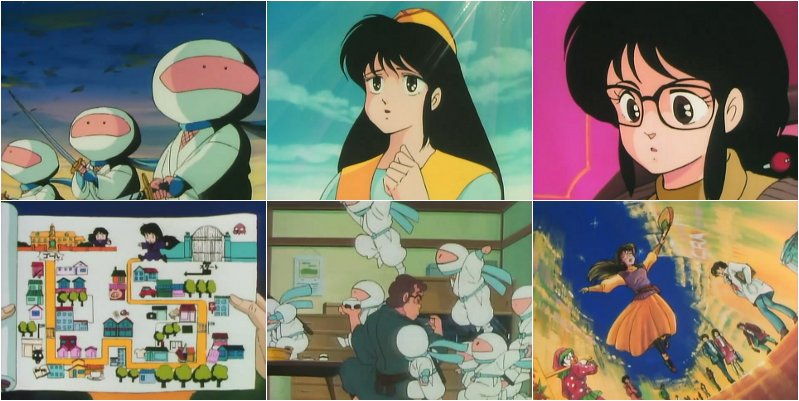
Kaede, the lady ninja from the spring special makes a belated return, as she once again flees the life of a ninja in search of a new job. She’s afraid that if she keeps up the ninja lifestyle it will make her as ugly as her ninja leader.

Of course she is pursued by her leader and the clan of tiny Bomberman-looking ninjas, and after a brief stint as a drive-thru rollerskating waitress (did/do these actually exist? It seems like a piece of Americana I’ve only ever seen in fiction), she ends up in Tomobiki.

Starving and homeless, she is found by Mendou and taken in. After she saves him from one of Ryoko’s attempts to blow him up, he offers her the job of his bodyguard. Ryoko however demands a test, Kaede must run from the Mendou Estate to the school and launch a rocket by a specific time. Ryoko booby traps the route and tips of the ninja clan in an attempt to prevent it.

This leads to a great second half of the episode where we get two comedic devices that Urusei Yatsura does repeatedly well.

The first is the chase. I’ve discussed before how the use of the chase scene is lacking in modern anime. Admittedly, these later UY episodes have a ridiculous budget for their time, but even the lower budget Oshii episodes frequently made use of the device too. I don’t think it’s just down to animation talent and budget though, the nature of the material being adapted has also changed. A lot of recent comedy manga have a stage-y feel that is absent from Takahashi’s work, likely a reflection of the boom in variety comedy Japan has experienced. Just look at Astro Fighter Sunred, that uses a number of stage comedy troupes in its voice cast.

The second device is the reversal of expectations. This does still get used a lot in anime comedy. Here, we have the ninja leader call on the help of sleeper agents who lead normal lives in Tomobiki, but are secret ninjas. The whole sequence is played totally straight, as a parody of serious ninja fiction. That is until the sleeper ninja’s actually try to do something. The first’s sword has rusted into his sheath, the second’s certain death technique is just the ability to climb trees really well and the final one has the special ability of falling.

Despite Ryoko’s and the ninja’s best efforts, it is Lum who accidentally thwarts Kaede at the last second, when she catches Kaede in a lightning bolt meant for Ataru. And so she must disappear from the show once more, in search of a new job.

A great episode, particularly in terms of animation. It pretty much feels they are showing off how great they are for much of the episode, something else that is all too rare nowadays. And despite that sense of showing off it avoids being too self-indulgent, the showing off is in service of the story, rather than an attempt to do a segment that feels like a completely different show (see Episode 130).

Screenplay: Shigeru Yanagawa
Storyboard: Junji Nishimura
Director: Junji Nishimura
Animation Director: Takafumi Hayashi

Be Sociable, Share!

Category: Anime

Tagged: , , ,

Lum-A-Week 137 – Lum’s Courageous Duel! An Ironic Victory

A return to a common theme in Urusei Yatsura and a return to a better class of episode.

Something that comes up a lot in Urusei Yatsura is the idea that any woman who is acting overtly “girly” is doing just that, acting. Ran, the obvious example, being a direct parody of the Burriko girls of the time, but other characters indulge in it too – Shinobu often acts weak to try attract Mendou, even though she’s clearly the toughest character in the series, Ryu hangs onto to a warped, overly romanticised, view of femininity, rather than being herself.

In this episode we meet Katsuragi Anna, a Tomobiki High School student from the year below Lum, Ataru et al. She admits early in the episode that she feels like she’s acting like a girl rather than actually feeling like one. And she appears to be a parody of female manga/anime leads, in that she’s excessively girly and has excessively sparkly eyes.

She gets mugged by Soban and Lum comes to her rescue. She asks if Lum could beat him without her powers, and Lum says yes. This is all done in a way that comes across as a parody of the schoolgirl romantic friendship genre, though not as obvious and all-out as Project A-Ko would do it. However, Anna then goes and challenges Soban to a fight on Lum’s behalf, so that she can see Lum beat him and Anna can become really brave.

Lum, foolishly accepts, only to discover that without her powers she is really weak. There’s an hilarious line at this point from Shinobu who claims that “It’s too much for a girl. We just don’t have the strength” that leads to a fun visual gag.

We then get a training montage, and for once it shows great restraint in not doing a Star of the Giants or Tomorrow’s Joe homage. We do however get an Ultraman homage with Ryu and her dad, and a Rocky homage with Lum. There’s some fun physical comedy in this sequence and some very Eighties keep fit outfits.

Lum realises she can’t get stronger naturally in the three days Anna had given her, so uses some power boosting alien bracelets and strength boosting pills.

We then get the fight and the resolution, and this is probably where it comes undone a little. Soban eats Lums bracelets and she has to rely on the pills which only last 3 minutes and get less effective each time. Eventually everything descends in chaos, but as well the Oshii era episodes did. Could have used one really strong punchline to end everything on.

Screenplay: Shigeru Yanagawa
Storyboard: Iku Suzuki
Director: Iku Suzuki
Animation Director: Yuichi Endo

Be Sociable, Share!

Category: Anime

Tagged: , , ,

This post is basically the opposite of twitter.

Be warned. This is long and rambling and may not arrive at a point. It was originally a completely different post and has ended up somewhere else. And yes, I ignore animated feature films, as I am want to do.

Kidfenris asked on twitter today:

Question for the anime crowd: what’s the worst T&A fan service you’ve seen in an
otherwise mainstream, please-take-this-seriously anime?

Response to this question highlighted a frequently made misconception, that please-take-this-seriously anime is mainstream. On the rare occasion it is, but for the majority of the time it’s as much about otaku decadence as any other late night anime. They aren’t sticking a show full of tired old sci-fi or cyberpunk cliches on TV on Sunday afternoon any time soon. And chances are they won’t break through late at night either. Plus, if you’re a non-sci-fi, non-fantasy serious minded manga, you’ll probably get a live action adaptation before an anime one anyway. And chances are you’ll get higher ratings than a cartoon.

The fact is that the mainstream is mainly made up of shows that don’t want you to take them particularly seriously – namely kids shows and family comedies. Of the shows that broke the Top 10 anime in Japan last year you’ve got just three shows made for primarily adult audiences. Two of them were from the successful noitaminA slot, namely Eden of The East and Dezaki’s The Tale of Genji adaptation. The other was the final episode of Shin Mazinger. I’ll let you argue whether any of them were begging you to take them seriously.

Obviously noitaminA has been a success in finding an elusive adult audience, both in the ratings and that we’ve seen Fuji TV try and recreate the success with Noise and other networks have taken note too (TV Tokyo’s Power of Anime). I do wonder though if the live action Moyashimon due in the slot later this year will prove a death knell should it get better ratings than anime in the same timeslot.

Now, a short diversion to what this post originally started out as. Back in January Tim Maughan was complaining about the number of kid protagonists in anime, and I questioned if that was really the case – producing this list over at one of my 15 or so tumblr accounts.

I then thought that it was perhaps skewed a little by shows people weren’t actually watching in any great numbers, so made another list from all the shows that Anime News Network listed in the weekly top 10 anime charts over the whole of 2009.

It broke down as follows:

ADULTS 29.4%
TEENAGERS 17.6%
CHILDREN 23.5%
ADULT ALIEN FROGS 2.9%
CURIOUS PRIMATES 2.9%
DIGITAL PETS OF INDETERMINATE AGE 2.9%
GENETICALLY ENGINEERED ALIEN BIOWEAPON 2.9%
MICE 2.9%
LIONS 2.9%
RABBITS 2.9%
ROBOT CATS 2.9%
TEENAGER TRAPPED IN CHILD’S BODY 2.9%
YOKAI 2.9%

I only took the main protagonist, had I averaged the age of the main casts it would probably have had more adults due to parents in some shows being in the main cast, and the fact One Piece now has an 88 year old living skeleton as part of the cast. On the flipside, some shows are basically about children, even if their leads are technically not kids.

It’s those same shows that I’m looking at today when I take a look at what the mainstream is. Back to the issue at hand!

So what is the mainstream?

Well, the biggest TV anime hit last year, as it almost always is, was the Lupin III TV special. This time boosted by being a crossover with another mainstream anime show – Detective Conan. It’s light adventure fare, not really asking the viewer to take it any more seriously than an episode of The Avengers or The Saint would. With an aging (and in some cases, increasingly frail) cast, I’m wondering if Lupin III will remain as popular once the inevitable cast changes have to made. While it survived its lead actor changing in the 90s, it definitely took a while to find its feet again. I should really look at how Doraemon was effected when it went through with its wholesale cast change a few years ago.

Here are shows that made up the mainstream for much of 2009:

Sazae-san
Chibi Maruko-chan
Crayon Shin-chan

These three are on a plateau above everyone else in terms of being mainstream. Sazae-san is arguably another step above everyone else too. They’re all family comedies and when you take into account the success of Mainichi Kaasan last year and the occasional charting of ATASHIn’CHI, it suggests that family comedy is the true mainstream TV animation in Japan. Just as it is everywhere else in the world.

Doraemon

Another evergreen title, though one that doesn’t quite fit the family comedy mould of those other three. Given that parents grew up with the character and now have kids of their own, its continued success makes a lot of sense. That, and the fact the character is both a work of genius and a true icon.

Detective Conan
MAJOR

Shonen Sunday still proves a strong source of anime. Conan’s been running for over decade on TV now, and each MAJOR season proves successful with their return. The inevitable Rin-ne adaptation is pretty much guaranteed to be the next big Shonen Sunday anime hit.

One Piece
Dragonball Kai
Naruto Shippuden
Gintama

The Shonen Jump gang. One Piece and Dragonball Kai are the massive successes of the group, the other two dipping in and out of the top 10. While aimed at kids, One Piece and Dragonball Kai have cross over appeal due to being based on two of the biggest manga of all time. Gintama is an odd one, for reasons we’ll get to later. Dragonball Kai also has nostalgia appeal like another recent success…

Yatterman

The revival of Tatsunoko Pro’s classic kids show was a massive success to begin with, but it started to trail off last year. However it was still far more popular than the majority of anime produced last year.

Battle Spirits
Pokemon
Inazuma Eleven
Beyblade
Tamogotchi

Toys and games still put kids in front of the telly. For better or worse, these are pretty much the giant robot anime of modern times. Too often the sci-fi elements are attributed to being the reason for old giant robot shows’ success, rather than their toyetic nature. And modern shows in the Pokemon mould do that toyetic thing far better than modern giant robot shows do. Talking of which…

Mobile Suit Gundam 00
Fullmetal Alchemist
Brotherhood

The various Gundam, Fullmetal Alchemist & Code Geass series have been alternating in and out of a shared time slot for years now. Currently it’s Sunday, 1700 on TBS, which they’ve had since mid-2008 (Geass R2, then Gundam 00 season 2, then FMA Brotherhood). They’re pretty much guaranteed to slip into the low end of the top ten a few times a year with that slot. Before that they had the 1800 slot on Saturday since 2002 (when Gundam SEED took over from Ultraman Cosmos), where they performed much stronger in the ratings. I think some analysts have judged this a sign of them not being as popular, not taking into account the timeslot change from their earlier incarnations.

Shugo Chara!! Doki-
Whatever two Pretty Cure shows aired in 2009

The twin giants of magical girl shows. Well one giant – Pretty Cure – Shugo Chara was sort of bubbling under and snuck in the chart once. That there were only two shows aimed at specifically at girls has less to do with the shows themselves, and more to do with the unisex nature of the other shows. Particularly the toy based shows like Pokemon, where the toys & games they are based on are no longer just for boys as the robot toys of yore were marketed. When you do market them like that, you tend to fail, as the makers of Kabuto Borg VxV are probably all too aware.

GeGeGe no Kitaro

Thriller Restaurant

Supernatural shows for kids! And their parents. And adults who grew up reading/watching the originals. The latest Kitaro revival ended last year after another successful run, and the successful Thriller Restaurant storybook series got an equally successful anime.

Stitch!
Curious George

Stitch is the Madhouse version of the Lilo & Stitch TV series (sans Lilo)for Disney, but Curious George is the US series. Both performed well. In fact shows with cute animals / genetically engineered monsters tend to do well.

Tale of Genji
Eden of the East
Shin Mazinger

Eden of the East is the most consistent performer of these, Dezaki’s Genji show charted early, but later ones didn’t. Personally I think the expectations from the name value of the story and director weren’t really met. Shin Mazinger’s finale was a bizzarely high jump in the ratings. It was doing fine throughout for a late night show, but certainly spiked with that last episode.

There’s a few specials I’ve not mentioned – most of which involved talking animals. Plus Sgt Frog scraped the chart once or twice too, along with Sanrio’s Onegai My Melody Kirara. But that should give you an idea of what the “mainstream” is in terms of eyes in front of TV sets. It’s really not all that different from cartoons elsewhere in the world, save for a few things like that TBS slot for Gundam etc. and noitaminA. There’s just more of them.

But what of DVD & Blu-ray?

What of it, indeed…

It’s clear from the sales figures that in 2009 Blu-ray was the domain of the Otaku. Shows like Bakemonogatari & K-on, which didn’t set ratings on fire on TV, tore it up in the Blu-ray sales chart, but didn’t see those sales matched on DVD. In fact they outstripped sales for similar shows, pre-Blu-ray. It’s like that hardcore otaku niche finally had a medium that matched their obsession with detail. Or that before they were shunning DVD in favour of hanging onto hi-res HDTV rips. Probably a bit of both.

Shows like Gundam 00 and Code Geass, which had enjoyed something akin to mainstream TV success, had similar sales on both media, but couldn’t match the overall sales more niche shows enjoyed.

However, the bulk of niche shows released in 2009, and there were a lot of them, did absolutely nothing of note. If the business plan is that the late night TV acts as an advert for the BD or DVD, then it looks like its failing an awful lot of shows, even if it works great for a handful of shows.

One interesting trend is the success of Gintama. While outperformed by many shows on TV, it’s currently a bigger hit on video than its Shonen Jump peers (well, at least until the latest One Piece movie hits video). I’ve not watched any of it myself, is it tapping into an otaku audience more inclined to drop money on it than the audiences its peers get? I’ve noticed it trends higher in Google than Naruto, despite selling less manga volumes. I suppose I should really watch some and figure it out for myself.

Oh, and I should mention MTV’s Usavich. Always seems to be overlooked when discussing successful, mainstream Japanese animation. Probably because it doesn’t fit people’s expectations of what Japanese animation should look like.

Be Sociable, Share!

Category: Anime

Tagged: , , ,

Anime as a Manifesto


Manga Mania Issue 19 (February 1995)

What better way to celebrate Valentines Day than to look at a 15 year old manga/anime magazine?

Articles on The Legend of the 4 Kings (oddly enough a gateway anime in the UK due to it’s televised broadcast later on), Green Legend Ran (something I totally ignored back then, wouldn’t mind checking out now), Ushio & Tora and a review of the year just gone. The editorials now have become utterly worthless, just talking about the issue’s theme, but there’s still Trish Ledoux’s column. Here she’s talking bishonen, nothing ground breaking now, but it was news you could use back in 1995.

There’s also a column, Manga Watch, not sure if it’s new this issue, or so small I missed it before. Anyway, this issue has a few words on British artists working in Japan at the time. Obviously, the ubiquitous Tony Luke is featured, but so are Manga Mania’s own Woodrow Phoenix, who was working on Inseparable for Morning at the time, Carl Flint on Giant Baby and Chris Webster on Mr Pillow.

UK NEWS

  • From Western Connection: Lupin III – The Fuma Conspiracy, Salamander 1, Devil Hunter Yoko 1
  • From Kiseki FIlms: MD Geist, Adventure Duo 2, Macross: Do You Remember Love, Return of the Overfiend 4
  • From Anime Projects: Bubblegum Crisis 1 (dub), Urusei Yatsura 5
  • From Manga Video: Legend of the Four Kings Eps 1 & 2, Wings of Honneamise, The Guyver 11, AD Police File 3, Genocyber 3
  • From Pioneer Video: Green Legend Ran 1, Tenchi Muyo 3, Moldiver 3

US NEWS

  • Ianus Publishing released the Project A-Ko Roleplaying Game. I have this, but have never played it. Nor have I managed to sell it on eBay.
  • No US video releases mentioned this time round.
  • Just the one notable new US manga release – They Were 11

JAPAN NEWS

  • Magic Knight Rayearth TV and Saturn game.
  • Darkside Blues in the theatres.
  • Red Baron on the TV.

More fun in the letters pages!

I’m not trying to pick on Paul “Otaking” Johnson, but these teenage fan letters he kept sending are full of value. If you are familiar with him it’s probably either through his rant about fansubs or his Doctor Who “anime”, but he has more strings to his bow than that. He also likes to complain about the lack of shading in anime and how everything new doesn’t compare to Madhouse OAVs of the 90s.

Well, this issue’s letter from the future self styled “Otaking” sheds some light on that viewpoint:

His first anime purchase was Cyber City Oedo, a show he turned into a manifesto! Though, considering the first anime I purchased was Urusei Yatsura, I probably shouldn’t be throwing too many stones from my glass house. There’s one more letter from him to come and it’s a real doozy, but that’s not until issue 26.

Be Sociable, Share!

Category: Anime, Manga

Tagged: ,

Lum-A-Week 136 – The Birth of Ten-chan’s Son? I Didn’t Know a Thing

Boy, Rumiko Takahashi really likes stories where things get attached to peoples bodies.

A space duck is making a delivery, when he is distracted by a lady space duck and bumps into a space sign. This causes him to drop his load of strange green eggs over Earth. One of which flies past Ten and attaches itself to his stomach.

For most the first half of the episode Ten is moping around with this egg, worried it’ll take over a month to hatch. It’s full of the faux melodrama and melancholy you’ve come to expect from the show by now, but not many laughs. Once it does hatch, and out comes a bee with Ten’s face and personality, the episode gets going.

The bee torments Ten, much like Ten torments Ataru, eventually leading Ten to flee to Tomobiki High School to get Lum to help him. Of course all the girls are charmed by the bee in the same way first Ten charmed them, and the boys similarly see through the bee’s personality. The duck finally catches up with his eggs, and is shocked to see one has hatched.

The eggs, it turns out, contained “Mirror Bee” larvae. These take on the personality of the men they attach to, hence the name. This is, of course, the cue for the punchline and we learn that not only Ten has had an egg attach itself to him, but so have Ataru, Mendou, Megane, Onsen-Mark, Ryu’s dad and Cherry.

Cut back to outer space and we see a disgruntled delivery duck now “bee-ing” harassed by bee doppelgängers of the male cast.

Perfectly acceptable episode, though not as good as the same team’s work on episode 125. Definitely could have used more laughs in the first half and coming straight after the talking flower episode didn’t help either.

Screenplay: Tokio Tsuchiya
Storyboard: Tomokazu Kougo
Director: Tomokazu Kougo
Animation Director: Kyoko Kato

Be Sociable, Share!

Category: Anime

Tagged: , , ,

Violence Jack – Beast King

Back when I first read this, Beast King felt like the last gasp of Violence Jack as being shocking for shock’s sake. Suitably, it’s a direct follow up to Hell City Kanto (adapted as Evil Town in the OAVs) the last chapter that I found truly shocking. However going back again to write about this chapter, it didn’t seem quite as shocking. I’m not sure if that means I’ve been desensitised to phallic tiger tongues and beheadings, or if it was just the jumbled way it was arranged in the collections I read.

King Bomber

In addition to the return of Aira Mu from God Mazinger, the main source for this chapter comes from King Bomber (1976). As best as I can tell it involved teen drummer Shingo Hibiki who merges with the golden African statue, King Bomber to defeat his enemies. It’s probably a lot more complicated than that, the villain here seems named after a civilisation that King Bomber had destroyed earlier in history in his own manga.

Really simple to sum up this time, as Jack is barely in it, and that means we don’t get lengthy speeches or random shaming of the Slum King to confuse matters. The androgynous, abused, frequently naked, blonde waif Shingo Hibiki wanders into a jungle full of wild animals that escaped the zoo after the Great Kanto Earthquake.

Meanwhile, we meet the villain of the piece, Kibara. Who is, of course, an evil zoo keeper wearing a crocodile’s head as a hat. He’s trained animals to kill man, and is upset that strangers have arrived in his jungle. Not Shingo, but Aira Mu and her followers. Who, Shingo happens to come across when both decide to bathe at the same time. Aira almost comes a cropper at the hands of a wild tiger, but Shingo’s innate animal empathy saves her.

He returns with her to her settlement, where they have made a wooden statue of their saviour, Violence Jack that they call King Bomber. Kibara meanwhile is tearing through the forest hunting for Aira Mu. Sensing danger, Jack turns into his phoenix form and flies off.

If only his danger sense was a little more prompt…

The village is massacred and the survivors taken to Kibara’s camp to be tortured. Shingo was left behind and plead for the statue of King Bomber to rescue Aira. At which point Jack arrives and the pair merge into the statue, and Jack raises the tiger Shingo befriended from the dead (though it appears he’s just putting part of his essence into it’s body).

And the pair go and rescue Aira in the bloodiest way possible.

Unfortunately, the chapter seems to run out of pages and the final fight between Jack and Kibara happens off panel. All we get is Aira discovering Kibara dead, and Shingo lying in the broken shards of the King Bomber statue. A disappointing ending considering some of the sequences of carnage that other chapters have had.

Thankfully the next chapter is perhaps my favourite and full of some utterly genius moments of (re-)invention

Be Sociable, Share!

Category: Manga

Tagged: ,

Best Anime of the 00s – The Diary of Tortov Roddle (2003)

Early web-animation from Oscar winning animator Kunio Katō. This review originally appeared in my livejournal in 2005, when the animation was still available on his website – you can now see it on Crunchyroll.

The Diary of Tortov Roddle is a short film divided into shorter, well not even stories, more like tableau, of a traveller. The land in which is he travels is surreal. The way in which he travels is surreal. The things he sees are surreal. Now surrealism is a difficult thing to pull off. You see it often mistaken for Eddie Izzard-style meandering wacky nonsense, invariably ending in “…err…FISH!”.

This is not the route this piece takes.

This is not a comedy, is more a creation of a feeling or mood. Slightly melancholy, yet warm and inviting. It’s not a scary surrealism, its more the feeling of seeing something out of the ordinary and then being able to sit back and feel the glow of being gifted with the opportunity to see that. Be it a cartoon projected onto the side of a bear, or rabbit people commuting to the moon. This is achieved not only by the events depicted but by the techniques used. No dialogue is used, only music and interstitial captions. But more importantly is the art. Apparently using pencil illustrations and 2d computer animation, it has wonderful sense of being to it.

Be Sociable, Share!

Category: Anime

Tagged: ,

Death Comes To Town – Episodes 1-4

We’re now halfway through the Kids In The Hall’s big television comeback, a murder mystery narrative, and it’s one of the best new comedies I’ve seen in a long time. While they’ve freely admitted to the influence of The League of Gentlemen on the format, it actually has more in common with Psychoville. This is at its most obvious in the opening episode where it similarly suffers on the laugh front from having to introduce so many characters and plot elements. Though unlike Psychoville however, KITH aren’t so in love with horror movies that it gets in the way of the funny. I always got the feeling from Psychoville that Pemberton and Sheersmith were actually those “How Many Kills?” teenagers from The League of Gentlemen when they were younger. And possibly hadn’t grown up all that much.

In fact Death Comes To Town is very light and whimsical in its handling of material that could have easily been made spooky and creepy. As grotesque as some of the characters are, there’s a degree of sympathy in their portrayals. While it’s shed the sketch show element of their earlier work, the actual performances of the older Kids are far beyond their old work. This is reflected in the characters who, by and large, are new creations.

Of the main characters, only Bruce McCulloch & Mark McKinney cop characters have been imported from original KITH show intact, though others appear as cameos (The Chicken Lady showed up briefly in episode 4) and other characters are extensions of types they’ve portrayed before. McKinney’s Death character feels like a deadbeat version of his Satan and Kevin McDonald’s public defence lawyer is a variation of the multitude of twitchy neurotics he’s portrayed over the years.

Another big difference is that there are plenty of non-KITH performers showing up too, from original (pre-TV) KITH member Luciano Casimiri as The Prabbi (Half Priest-Half Rabbi) to Colin Mochrie as an exploitative vet who has kept McDonald’s lawyer characters cat alive for 30+ years.

The greatest thing about it though is that as well as having great gags and great performances, it also legitimately works as a mystery. Not only is it slowly revealing more about the murder the show hinges around, there’s also a secondary set of mysteries surrounding Death. Like a lot of the characters he started off one-note, but as we get more and more glimpses of his past, he becomes a lot more complex and more questions are raised.

You’ll have to be Canadian to watch it at the moment, or do a decent impression of one on the internet, and as much as I’d hope we’d get this over in the UK, the fact we only got 13 episodes of KITH in the first place doesn’t exactly bode well. It’ll be a shame as it’s one of two recent comedies (both from creators making comebacks of sorts) that really gave me some confidence about TV comedy again.

Be Sociable, Share!

Category: Comedy

Tagged: , , , , , ,

Lum-A-Week 135 – What Do I Care For Talking Flowers

We’re back, after a long hiatus, to reviewing every episode of Urusei Yatsura. Real life took the sheen off writing about Urusei Yatsura day in day out, plus the reason I started it (sitting at home with a foot injury) eased off. But now it’s back, back, back! Once a week this time, so I don’t burn myself out again.

What a shame that I came back to such an annoying episode.

The animation is fine, continuing the high budget Studio Deen episodes. But good grief, this contains one of the all time annoying vocal performances.

Ran has purchased some flowers that mimic people repeating what they say, but Cherry ends up blowing the blooms all over town after they have recorded Lum and Ran talking.  The blooms then latch onto various members of the cast, repeating fragments of the earlier dialogue. It drives everyone mad, including the viewer, as not only is the dialogue repetitious, it’s in this annoying, demented, effect laden voice. Horrible. I can’t even force myself to re-watch the ending to see how it wrapped up.

Screenplay: Yumi Asano
Storyboard: Junji Nishimura
Director: Junji Nishimura
Animation Director: Takafumi Hayashi

Be Sociable, Share!

Category: Anime

Tagged: , , ,

Prison Pit Book One

Finally got this wonderful Johnny Ryan comic for Xmas.

Ryan’s said that Kentaro Miura’s Berserk was a influence on the book, but the thing its relentless black comedy and violence reminded me of was Go Nagai at his prime. If this was 1970s Japan, there’d be a Cannibal Fuckface cartoon for the kids to watch. Next to Scott Pilgrim this felt to me like the western comic that’s got closest to properly understanding the energy of manga, rather than simply aping the surface elements.

The story, such that is, follows our hero Cannibal Fuckface who is thrown in the eponymous prison pit and then commences killing and eating the similarly ultraviolent inhabitants of the pit. The first chapter is named “FUCKED”. The second is named “MEGAFUCKED”. That is probably all you need to know.

It’s the best art I’ve seen Ryan do in his career, more focused and while it mainly maintains a four-panel-a-page rhythm, when he breaks from that to do a splash page or change the panel rhythm, he does to great effect. If you’re going to do a splash page, it might as well be of a monster made of sperm or a barbed penis.

While part of me hopes for Cannibal Fuckface’s adventures to continue, it is “Book One” after all, I’d also really like to see Ryan do more work that expands his horizons from his gag roots.

Prison Pit @ Fantagraphics
Johnny Ryan

Be Sociable, Share!

Category: Comics

Tagged: ,

Podcast

Archives

Twitter