Inazuma Eleven

I’d been crunching some Japanese TV ratings numbers for a different post, and one thing that struck me was, beyond the usual ignored-by-internet-chatter shows that tend to top the ratings (Sazae-san, Chibi Maruko-chan, Doraemon and Shin-chan), there was another show that occasionally squeezed in at the bottom of the top ten, often above the pop culture sensation that is Naruto.

That show was Inazuma Eleven.

Which you had probably guessed from the name of the post.

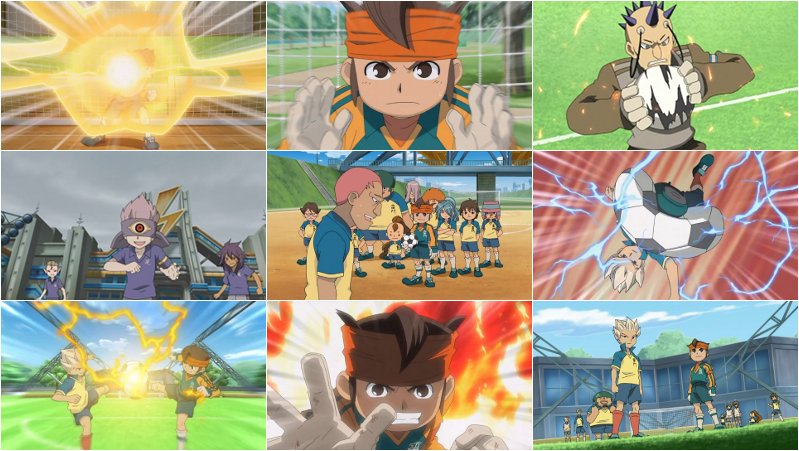
Based on the hybrid RPG/football game from Level-5, it presents an OTT version of a school football league that resembles Shaolin Soccer more than it does Jossy’s Giants. As best I can tell from the eight episode’s I’ve watched so far, the plot closely follows that of the videogame. And there’s a recurring visual of players running towards goal that I’m guessing is a straight pull from the videogame as it really doesn’t belong in animation otherwise.

Despite that adherence to its videogame parent, there’s plenty to recommend if you’re a fan of OTT exaggeration and of Level-5′s character design (like Professor Layton, Inazuma Eleven benefits from a huge cast of characters who are far from cookie cutter in design). The exaggeration though is where the real fun lies.

For starters you’ve got a team of kids learning special football moves (the goalie summons a giant hand, the striker has a flaming kick) from an secret handbook in an underground training compound built under the school. That’s bigger than the actual school. And then there are the opposing teams.

The “evil” team drives arround in a bizarre looking giant bulldozer type vehicle that they use to destroy the schools of the teams they beat. It looks like something that belongs in a Warhammer 40,000 army. The other teams I’ve seen them play so far include a team of supernatural monster children, children raised by wild animals like Tarzan and cyborg children. Such are the wonders of the Japanese education system. Of course they’ve all got their own special football moves too – for example, the supernatural team cast “spells” on our heroes mid match.

You may note that I’ve mentioned 4 teams there, and indeed they’ve played 4 matches so far in the 8 episodes I’ve watched. No Eyeshield 21-style pacing here, Inazuma Eleven moves ahead at a fair clip, with nothing taking more than two episodes to resolve so far. As kids shows based on handheld RPGs go, this is up there with Pokemon. That might seem like I’m damning it with faint praise, but given the usual success rate with transferring properties from videogames to cartoon, Inazuma Eleven is a resounding win for director Katsuhito Akiyama (Gall Force) and OLM (Pokemon). In fact, if it wasn’t for the United States’ disinterest in the sport, I’d have expected the game and anime to have had an English language release.

One final note. The end credits feature the three female leads singing the ending theme in what I believe is a homage to the daddy of all sports anime with ridiculous training regimes Star of The Giants. Of course, Star of The Giants homages are as regular as clockwork, but I’d not seen that particular aspect, The Aurora 3 (or Three Daughters of Aurora, not sure on the exact translation/name), being referenced so directly before.

Be Sociable, Share!

Category: Anime

Tagged: ,

Durarara!! – Episodes 1, 2 & 3

From the author of Bacanno! and the folks who turned that book series into a cartoon, comes this tale of strange goings on in the Ikebukuro district of Japan.

Like Bacanno! the first episode flings a whole load of characters, factions and plots at you at once. However it’s a little easier to get to grips with as it’s all taking place in the same time period and locale. Well, ignoring the fact that the lead character has no head. It’s an approach that worked well in Bacanno! and it works here too, though perhaps not quite as well. It’s a little more linear in its approach and the characters doing the introduction are more part of the story than in Bacanno!.

It reminded me of Jonathan Tweet’s RPG, Over The Edge, as you have a locale populated by outsiders, some of whom are somewhat odd, and all sorts of conspiracies, secrets and gangs operating beneath the surface. Like Baccano! there’s a very thin line between normality and the supernatural, and having your lead be an Irish unseelie faerie (Durarara!! is a corruption of Dullahan) calls into question the humanity of some of the other characters who show unnatural abilities and behaviours.

Episodes 2 & 3 begin to put some distance between Durarara!! and Bacanno! in the approach to adaptation. Each Durarara!! episode has a narrator, and focusses on an individual story, even if there are sub-plots ongoing throughout. Gone is the clockwork script and editing of Bacanno! and its time slips, instead we get a slower paced, more deliberate approach. It’s more interested in the characters and, so far, works very well, as different characters see different sides of each other depending on the episode and circumstance. Most notably, the information broker, Izaya Orihara, sinister and manipulative in episode 2, comes across more positively in episode 3.

As to the narrator, it’s not clear who the narrator is in Episode 2, but in Episode 3 it’s the character of Simon (the guy who works at the Russian sushi restaurant with the overly complicated nationality) suggesting that the each episode has a different character narrating, so Episode 2′s could be supposed to be Celty the Dullahan’s voice rather than just Narrator as actress Miyuki Sawashiro is listed as.

In terms of animation, the character design isn’t quite as solid as Bacanno!, but there’s lots and lots of great movement. A lot of it is in the body language and poses, but there’s also a lot of physical comedy, particularly from the supernaturally strong and perpetually angry Shizuo Heiwajima (shades of Bacanno‘s Graham Specter). There’s one beautiful gag in episode 3 that had me cackling, and it’s something you could only do in cartoons.

Other bits I liked included, the spot in episode 3 where Mikado and Anri are running away and she ends up dragging him along, Masaomi’s general theatricality in the way he moves and how that disappears when Izaya shows up, and the puckish way Izaya moves throughout. It feels like Masaomi is putting on a show in his movements, whereas Izaya’s feel like the movements of a natural born trouble-causer and shit-stirrer.

It’s the only new show that’s really gripped me in both story and animation, an all round great package. So check it out.

Be Sociable, Share!

Category: Anime

Tagged: ,

Kaitou Reinya – Episode 1

Behold. The Future of the Anime. Today.

Forget moe. Forget light novels. Forget visual novels. They are all red herrings. They are just pop eating itself, and most of those who protest their existance would simply replace them with works equally niche and worthless.

If you want the actual future of anime, look to this show. The future is cheap flash animation done badly.

When you look at Akitaro Daichi’s Flash work on Gag Manga Biyori, it is hard to distinguish from his hand-animated work on 1998′s Sexy Commando. The makers of Kaitou Reinya on the other hand have gone for a look that is much closer to Flash artists like FROGMAN or Weebl. And that’s probably an overly favourable comparison. Lets just say it is very obvious that the show has  been made in Flash or something similar. At its worst, it equates stretching and squashing a static drawing of a figure as animation.

It feels like they’re seeing just how much they can shave the production budget down to before viewers stop tuning in. Similar to when Adult Swim started squeezing animation budgets and we ended up with stuff like 10oz Mouse. Of course there’s a second factor involved here and that’s the fact the show is a vehicle for one of the womanchildren spat out by the Morning Musume machine. In this case, Tanaka Reina who is cast as the lead character thief Kaitou Reinya. So it’s possible most the budget is going to her, or her management, and that’s why this thing looks so cheap.

It’s a shame, as the character design is quite fun and there’s actually some good gags with the mouse that would work so much better they’d put more money/effort into it. Thankfully what little I’ve caught of Ufotable’s Yawarakeme and of the fourth season of GMB suggests there’s still some promise in this growing sector of anime. And as more people turn to it, I think we’ll see innovation in the same way we’ve seen it in western Flash animation over the last decade.

Be Sociable, Share!

Category: Anime

Tagged: ,

The downward spiral begins.

Manga Mania Issue 18 (January 1995)

In case I haven’t mentioned it already, the issues of Manga Mania that I’ve been talking about so far are ones my younger brother had bought, and I’d only been reading the Akira strips. He stopped buying them and this issue was the first I actually bought myself, mainly for Akira. I think I’d bought the Boxtree Ranma books just before or around the same time, so I was already on the slippery slope.

Looking at the issue now, it’s not a particularly strong one. Very little authorial voice (most articles are attributed to Manga Mania) and a couple of the articles are just not worth bothering with at all.

ARTICLES:

  • An overview of Kosuke Fujishima, particularly Oh My Goddess and You’re Under Arrest. Interview with him, translated from Kappa Magazine.
  • A look at Robot Carnival, tying into a Collector’s Card set being released in the UK. Yes, we got the merchandise and not the film.
  • An overview of Ryoichi Ikegami’s career.
  • An article on the Johnny Mnemonic film!
  • Trish Ledoux’s column was about shoujo manga.

JAPAN NEWS:

  • Gatchaman OAV
  • Ghost Sweeper Mikami: War In Heaven film
  • Key The Metal Idol
  • Tenchi Muyo TV
  • Yamato: The Next Generation
  • Suikoden: Demon Century

UK NEWS:

  • From Kiseki: Star Blazers #3, Return of the Overfiend III #3, Robotech #3, Ambassador Magma #5, Adventure Duo #1 & #2
  • From Manga Video: Guyver #10, Crying Freeman #5/6, AD Police File 2

US NEWS:

  • From Viz Video : Fatal Fury

One final note. There’s an advert for a shop selling garage kits and that reminded me there used to be a degree of overlap between modellers and anime fans. I think I encountered imported Gundam model kits years before I encountered the anime. Did that crossover increase in proportion when the boom happened? Or did it stay the same size and is now a much smaller part of the “hobby”?

Be Sociable, Share!

Category: Anime, Manga

Tagged: ,

Okami Kakushi – first 10 minutes or so of Episode 1

Boy, do I ever hate Visual Novel adaptations.

They’re everything that’s wrong with videogame adaptations, but with added problems of:

  • Having emulate the visuals of a medium that has some of the most moribund visuals in the videogame market.
  • Adapting something inherently heavy with dialogue and exposition.

The episode with an avant title sequence that exhibits a whole bunch of elements I hate in modern Japanese cartoons:

  • Sad doe-eyed girls.
  • Excessive use of a colour filter. In this case red.
  • Glaringly obvious 3D modelling work.

Then we get an opening sequence full of girls that I can’t tell apart. The discount CLAMP, Peach Pit, did the design work for the game, so that’s another negative against it.

Then we discover that the opening was a flashforward, and we meet the lead and his family (dad and wheelchair bound little sister) driving to their new home in their dreadful-looking 3D model of a car. Then the lead meets the sad, doe-eyed girl of the opening, except here she’s aggressively upbeat.  I should also mention, the wheelchair is also a 3D model much of the time, and it’s possible the sister wears an excessively large hat when going out in it to hide the model of her that’s riding it, rather than shade from the sun.

There’s then a ton of exposition from various people. As it’s based on a visual novel after all and as you can’t read all this in a cartoon we get characters clunkily telling you the information in boring scenes. Then around 10 minutes in I decided this whole exercise was a waste of my time and gave up. Yes, it is worse than Chu Bra, Ladies versus Butlers and Baka to Test to Shoukanjuu. While they might have been either offensive, poorly directed or overly ambitious, none of them ever induced the feelings of utter boredom that the small portion I managed to watch of this show did. Nothing in the story, characters or visuals held my interest at all.

Visual novel adaptations are the dirt worst thing to happen to anime in the last 15 years.

Be Sociable, Share!

Category: Anime

Tagged: , ,

Getting the SHAFT again.

As I may have mentioned, I have a recurring problem with SHAFT productions and the work of their director Akiyuki Shinbo. That problem is that while I like the art direction & design in their shows, the actual material they are adapting leaves me cold. Mainly it’s the fact they tend to handle otaku pandering material that’ll shift DVD units and merchandise in Japan.

This week they launched the latest of Shinbo’s works, an adaptation of the manga Dance In The Vampire Bund. Also launched this week was Baka to Test to Shoukanjuu from frequent SHAFT collaborator SILVER LINK, with Shin Oonuma directing. Oonuma worked on many SHAFT shows like Ef, Natsu no Arashi & Pani Poni Dash. In fact looking at the staff list it’s only animation director Miwa Oshima who seems the odd one out, with much the remaining staff coming with Oonuma from Ef. So I’ll be looking at that show as well, as it’s an interesting comparison to Dance In The Vampire Bund. And finally, to get some perspective, I’ll take a look at the first episode of last years Bakemonogatari, the show that cemented Shinbo as an otaku favourite.

Bakemonogatari Episode 1

With a completely different story, or possibly just a different script I’d probably love this. But when you’ve got characters in a show about ghost stories discussing and using otaku jargon, it feels like they are grasping for those otaku wallets a little too hard.

Visually of course, it’s fantastic. While Shinbo’s particular fetishes are all over the show – namely typography, geometrical design and near subliminal editing – he allows Akio Watanabe to bring plenty of himself to the show too in the action and character design. The only real flaw in Shinbo’s approach for me is his love of dialogue, too many long conversations and monologues slow the show down, even with all the visual tricks he pulls to try and keep them interesting. While that could be said to be the fault of the script, the fact is he does it across a lot of his shows, so it’s clearly something he digs himself. To the point where you think rather than a way around bad scripts, Shinbo thinks Wally Wood’s 22 Panels That Always Work are the be-all and end-all to visual storytelling.

While it’s not for me, though the ghost story aspect comes really close in making me want more, I can definitely see why so many people really loved it. It’s not just a lazy otaku pandering show, though there’s plenty of that if you are a lazy otaku obsessed with specific character traits and slang, but it has a distinct visual style that will appeal to the aesthetes too.

Dance in the Vampire Bund Episode 1

This time round Shinbo is working with Naoyuki Konno (009-1, Cyborg 009, Kikaider) as animation director and character design, and again, the animation director’s own individuality shines through. Though it’s worth noting that it’s Masahiro Sonoda credited as series director, with Shinbo just listed as director.

Once more the show suffers from its source material. Not only does it feel like someone’s Vampire The Masquerade campaign, but the lead is one of those HONEST GUV THEY’RE OVER EIGHTEEN characters that crop in both anime and vampire fiction far too often. And so was absolutely guaranteed to show up in the new vampire anime from the makers of Moonphase. As clever as the actual set up of this first episode is, it’s not enough to get me to follow the adventures of an underage vampire princess and her lycanthropic bodyguard.

What is clever about this episode, is it takes the artifice of the Shaft/Shinbo aesthetic and finds a way to make it work in a realistic fashion. The entire episode takes place on a variety panel show where celebrities are debating the existence, or not, of vampires. This gives them an opportunity to actually work their fetishes for typography and monologues into the story in a way that feels natural, rather than cutting to subliminal interstitials or unnatural camera angles. Here that’s all part of the fictional TV show within the show.

Watching it again in light of watching Bakemonogatari though, as clever as the device of the TV show is, it doesn’t do as a good a job of hiding the weaknesses of the story. Though they’ve really got their work cut out on hiding the weaknesses in Nozomu Tamaki’s trashy manga, so I can cut them some slack. Won’t be coming back for more though.

Baka to Test to Shoukanjuu Episode 1

And what we have here is SHAFT-lite. Or shite for short.

If it wasn’t for so many SHAFT alumni on the staff, it’d be really easy to accuse this of blatant me-too-ing of their formula of abstract design. Oh what the hell, it’s a blatant attempt at recreating the formula that’s served SHAFT well on a lower budget and with less able hands.

Most egregiously you can see it in the ending credits which hamfistedly tries to do what Shinbo does with typography to  the English translation of the songs lyrics. And fails miserably. But that’s just the topper on a show that clumsily tries for a minimalist “manga on the screen” approach along the likes of Sayonara Zetsubō Sensei. Unlike that show, they haven’t got a decent manga to crib for the design notes, and so they just end up sticking ziptone everywhere willy nilly.

Which is a shame, as the actual concept for the series is fine, even though it feels like a failed pitch for a DS game that someone turned into a light novel. Classes at a bizarre school fight one another in exam battles, involving the summoning of super-deformed versions of themselves. Combined with the visuals of the battles, in particularly the overhead views of characters like pieces in a tactical board game, it leaves you with the impression that someone really wants this made into a videogame at some point.

However videogame aesthetics do not a good cartoon make, particularly when the game doesn’t even exist yet.

Be Sociable, Share!

Category: Anime

Tagged: , , , , , ,

Essential Peter Parker, The Spectacular Spider-Man Vol. 4

It’s felt like an eternity between this and Vol. 3, but finally we get the end of Bill Mantlo’s lengthy run on the title and the beginning of Al Milgrom’s continuation of many of Mantlo’s threads.

Much of the book is devoted to the development of Spider-Man’s romance with Black Cat and then it’s slow deconstruction as we see the start of the return of Mary Jane Watson that would eventually lead to the marriage. Unfortunately while much of the construction of the Black Cat relationship happens in these pages, the end of the relationship seems to mainly be happening in the pages of Amazing Spider-Man, which are unseen here. The end of the alien symbiote suit gets a similar hasty recap here.

That leaves you with the impression of the work Mantlo did being given short shrift by editorial edict. Not helped by Milgrom trying to keep up Mantlo’s weirdness quotient, but not really having the same knack for it. His creation The Answer is a weird, origin-less, super-villain who seems almost cosmic in his abilities and decisions at times. He’d later be brought down to earth when he returned, but here he seems like a walking, talking plot device. Milgrom would have more success in later issues with cult-favourite The Spot, but that’s for the next volume.

As well as writing the later issues in the book, Milgrom also provides the bulk of the artwork, along with Jim Mooney inks. Unfortunately the earlier volumes had Ed Hannigan, and while Milgrom has his moments (especially during the Dr Octopus vs. Owl war), his Cloak and Dagger are disappointing in comparison to Hannigan’s.

The best issues here, oddly enough, are two of the fillers. First is a J. Jonah Jameson story, told from his point of view, with some great Ditko pastiching from Ron Frenz. Secondly is the Assistant Editor’s Month issue, which features the great Fred Hembeck as artist, drawing a fairly straight story with the Human Fly. There’s a line in there that nails Mantlo’s style where assistant editor Bob DeNatale refers to it as “urban weird”.

Going back the Spider-man / Black Cat relationship, there’s an underdeveloped part to it that could be revisited with a different character later. There’s hints of a love triangle between Spider-Man, Black Cat and police captain Jean DeWolff. What made that unique for Spider-Man was that the two women were love with Spider-Man, rather than Peter Parker. Not to mention that Jean DeWolff is a rare woman in Spidey’s life who behaves like an adult (well apart from the 1930s cosplay) and isn’t an OAP. Ignoring the underdeveloped romantic aspect, she was to Spider-Man, what Robbie was to Peter, a level headed voice of reason. Her key story should be in the next volume, and as much as I have fond memories of that story from its Spider-Man & Zoids UK reprint, now I’ve actually read her earlier appearances, I’ve a clearer idea of why it was shocking and controversial.

Also of interest here is an early outing for Hobgoblin, with a plot assist from Roger Stern, so presumably he was written with the intention here of it being Roderick Kingsley. We also start to get the various false leads (Leeds?) that caused so much confusion when Stern left and they couldn’t make up their minds who the Hobgoblin was… Unfortunately I think I’ll have to wait for either Vol 10 or 11 of the ASM Essentials to pick-up the main Hobgoblin story that I loved from Spider-Man & Zoids.

Be Sociable, Share!

Category: Comics

Tagged: , , , , ,

So·Ra·No·Wo·To Episode 1

Here’s that europhile bugle anime you’d been demanding.

As much as I’d want to encourage well produced, original anime, So·Ra·No·Wo·To kind of makes things hard for me. On a purely technical and artistic level it’s head and shoulders over most TV anime. However, there was only about 5 minutes that I was particularly happy with.

The problem is that it feels so safe.

Most obviously that problem lies in Akai Toshifumi’s design of the lead characters. They look like they’ve been spat out by a machine that’s processed what character design elements have shifted DVDs in the last couple of years.

However Hiroyuki Yoshino’s script is where the real problem lies. As respectful as it is to the animators, there’s no bite to it. It was so utterly inoffensive and twee, I found it hard to invest myself in the show. I’ve had similar to problems with other Yoshino shows, most recently Macross Frontier. Even when there are supposedly emotional scenes, they always seem to lack real passion. It’s the sort of show you’d imagine Noah and The Whale fans watching.

Even the biggest strength of the Yoshino’s writing, the world-building of the psuedo-Europe of the story, feels like they didn’t go the whole hog. We’ve a town that’s clearly Spanish, but the characters write in French, have Japanese names and use Yen as a currency. Taking that into account, the world still feels better developed than the characters. They feel like they have character traits that have been chosen by market research, rather than actual personalities. Again, that was a problem I had with Macross Frontier and My-Hime too. So, I suspect if you were fine with those shows, and there are a lot of fans of them, you’ll find a lot to like here too.

And that’s because the show looks fantastic. The backgrounds are impeccably designed and researched. And most of all there’s some really great movement, that’s all the better in some instances due to the fact they’re making life difficult for themselves by having the main characters wear baggy, ill fitting uniforms and writing two short crowd scenes. Thankfully the crowd scenes have individually drawn characters rather than a crowd brush.

So, I’ll be interested in seeing highlight reels of the animation from future episodes, but I can’t be dragging myself through the cloying tweeness of the story and characters each week.

Be Sociable, Share!

Category: Anime

Tagged:

It’s 1994! Who had been “converted into a massive DP fan”?

Manga Mania #17 (December 1994) was probably the best issue so far. Mainly because nothing was happening in the UK and so there was a lot more coverage of Japan.

Manga had their “Cyberpunk Collection” out, so Cyber City Oedo 808 got an overview from Peter J Evans, along with a look at the work of Tony Takezaki (whatever happened to him?).

Then, to tie into Boxtree’s release of Ranma 1/2 in the UK, there’s an interview with Rumiko Takahashi by Toren Smith.

Finally with The Cockpit coming out, there’s Trish Ledoux’s column on Leiji Matsumoto, an article reprinted from Kappa on him and an overview of the stories included on the OAV.

UK NEWS

  • Mandarin Paperbacks released Akira, Domu, Memories and Gon. These had really nice production quality from what I remember.
  • Manga Video were releasing: Appleseed, Guyver Vol. 9, AD Police File 1 and Cyber City Oedo Vol. 3. They also had Wings of Honneamise doing the rounds at the cinema.

US NEWS

  • From Viz: Ranma 1/2 TV Vol. 2
  • From AnimEigo: Kimagure Orange Road: Whimsical Highways Laser Disc set
  • From Streamline: Robotech Vol. 5 and 8 Man After Vol. 3
  • From US Manga Corps: Detonator Orgun Vol. 2, Gall Force: Earth Chapter 1, Project A-Ko Final and Godmars.

JAPAN NEWS

  • The second episode of the You’re Under Arrest OAV series was out.
  • As was the sixth volume of Iria.
  • And the first volume of Bounty Dog.
  • A Riot drama CD was released.
  • Newtype had asked various artists to create their dream Gundams:


Fun in the letters pages!

This is a sketch from what appears to be UK small press comic artist Bob Lynch. Then there’s a fan letter from future shading enthusiast and Doctor Who curmudgeon Paul “Otaking” Johnson.

Be Sociable, Share!

Category: Anime, Manga

Tagged: ,

Chu Bra!! Episode 1

For a show that’s about schoolgirls starting an “underwear club”, this isn’t as bad as you might expect. Assuming you were thinking it was going to be the worst thing in the world.

There’s a kernel of a good idea here – a comedy about a character who is a genius at fitting underwear. There’s plenty of manga and anime about characters with genius ability in something either utterly mundane or bizarre, and that idea could be made to work well too.

The question is though, why would you need to set it in a school?

Turns out the answer is so you can draw schoolgirls in their underwear. Obviously.

From Yumi Nakata’s wikipedia article, it’s mentioned that she’s a friend of Towa Oshima. Oshima’s High School Girls has a lot in common with Chu Bra, in that ostensibly it’s supposed to be a female author showing a male audience a glimpse into what girls are like around each other. Both have been marketed as “shoujo for males”. But all of that comes across simply as an excuse to draw schoolgirls in their undies. Just because a woman created it doesn’t make it any less sleazy. It just means the characterisation is a little better than the usual copying and pasting of it out of Tokimeki Memorial. Or the nth generation erogame clone thereof. The fact of the matter remains you’d be better off just buying shoujo, rather than some creepy version that’s been filtered through the minds of marketing men and editors trying to grasp a niche male audience.

It’s disappointing that Nakata took this approach (presumably because that’s what sells rather than some deep seated artistic need to go in this direction), because there’s also a much cleverer shoujo comedy about puberty trying to escape here. But you’ve got to look really hard for it as it’s buried under the panty shots and some of weird and creepy tangents the story takes. What it amounts to is that the whole “shoujo for males” idea is a godawful one and you invariably end up with the worst of both shoujo and seinen in one creepy mess. The whole basic plot of this first episode could have been presented in more traditional shoujo manner and it would have eliminated 90% of the creepiness hanging over it. Instead, as it plays out, the plot ends up acting as an excuse for the creepiness.

So why isn’t it as bad as you’d expect?

Well, while it’s not as honest in its decadence as Ladies Vs Butlers was, and contains a lot of frustrating missed opportunities to be far cleverer than it is, it is better made. Director Yukina Hiiro is firmly focussed on the gags, and while they aren’t great gags, they are well executed. The dialogue and performances aren’t as trite either, it certainly benefits from Reiko Yoshida (Maria-sama ga Miteru) overseeing the scripts. There’s two segments in the ending sequence that visually knock the rest of the show for six (and in doing so look really out of place). And it has a line in English that doesn’t sound like it’s been learnt phonetically. Yes, I’m scraping for positives now, but given the synopsis I was expecting much, much worse.

However, unless you are the target audience for this, all that probably won’t get you over the fact it’s constantly making in-story excuses for it’s own sleaziness. Or, indeed, over that sleaze in the first place. As well made as it is, let’s face it, it’s not the gag execution or script that’s selling this to it’s audience, it’s the schoolgirls in their undies.

Anyone who claims any different is making worse excuses than the show itself makes.

Be Sociable, Share!

Category: Anime

Tagged:

Podcast

Archives

Twitter